
Swimming in the family lane: Reagan and Walker Mattice
Reagan Mattice still remembers why her parents first signed her up for swim lessons at age 6. She wasn't sleeping through the night, and they thought the water might tire her out.
"My parents didn't realize what they were getting themselves into," the Purdue chemical engineering senior says with a laugh. "I ended up loving it and doing competitive swimming young, as well."
Her younger brother Walker's entry into the sport was even simpler. "I originally got into competitive swimming solely because Reagan did it," says Walker, now a sophomore studying mechanical engineering with a management minor. At the time, he also played basketball, football, lacrosse and soccer. "But my parents made me join the swim team because Reagan was already going to the pool every night. Over time, I eventually fell in love with the pool and slowly cut those other sports out of the picture."
Today, both Mattice siblings compete for Purdue's swimming and diving teams while navigating the demanding coursework of engineering degrees. For them, the combination feels almost inevitable. After all, nearly their entire family attended Purdue, including both parents who were engineers, their uncles and aunts, and even their grandparents.
"My mom was a chemical engineer at Purdue, while my dad was an electrical engineer," Walker explains. Reagan followed their mother's path into chemical engineering. Walker initially planned to follow their father into electrical engineering, but after his first year, he switched. "I decided that mechanical engineering fits what I enjoy most."
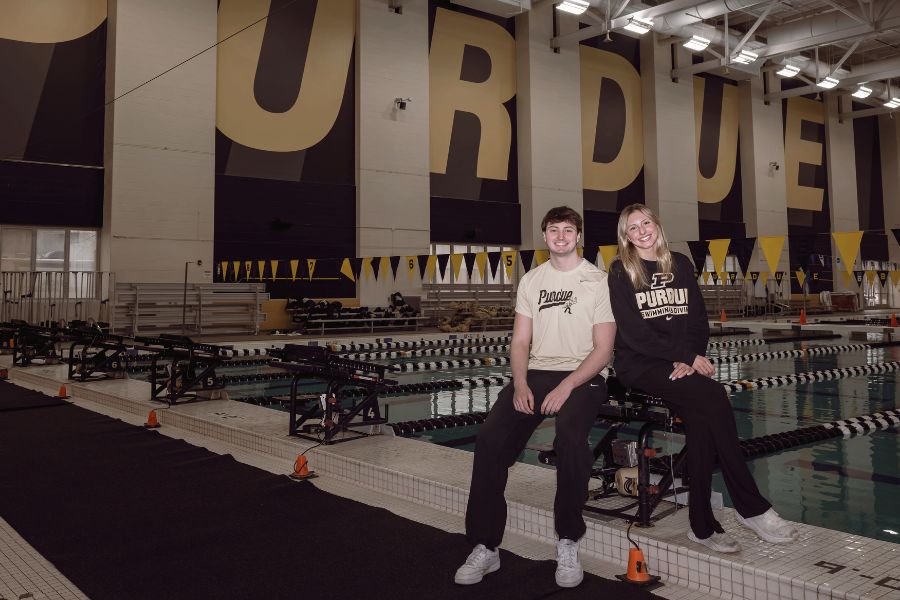
Growing up in Zionsville, the Mattice siblings were surrounded by Boilermaker pride. "Growing up, I always loved math and science, particularly chemistry, and engineering is a great way to combine the two," Reagan says. "Engineering is also a diverse field, so I knew I would have a lot of different opportunities and career path options."
Reagan competes in distance freestyle, with the mile as her best event, though she says the 1000 is her favorite. Walker races the 100 and 200 freestyle, with the 100 as his favorite.
As Reagan prepares for the Big Ten Championships this February, the meet represents the culmination of years of dedication. "Big Tens is an awesome meet, and it's the meet that the whole season leads up to every year," she says. "We spend so much time in the water practicing and working hard all for that meet, so it means a lot to be able to show up for each other and for the P on the cap."
The path to that meet requires navigating one of the most challenging balancing acts in collegiate athletics: engineering coursework combined with Division I competition.
A typical week includes morning practices, a full day of classes, afternoon practices and homework before bed. Reagan's chemical engineering classes often conflict with team practice times, requiring her to complete separate "conflict practices" away from the team. "Time management is the biggest thing I've had to perfect to make sure I get enough time each week to get everything done on time and well," she says. "The biggest challenge is definitely trying to fit everything in. Trying to make sure I still have time to get to bed early for morning practices, fuel during the day, and do conflict lift or swim is the challenging part. But time management is really the key, and that's something I had to adjust to, especially freshman year."
Walker has developed his own strategies. "I try to sneak a nap into some part of the day, so I don't feel tired and sluggish for my afternoon practice," he says. On weekends, he makes the most of any downtime. "Usually Sunday afternoons, I sit in my living room with my roommates, also swimmers, and we do our homework with Sunday football on the TV."
The most critical skill both have mastered is planning ahead, especially before travel meets. "When I have a travel swim meet, it is really important that I do a lot of my homework days in advance, so I don't have to worry about it while also dealing with preparing my body and mind to race," Walker explains. "This is especially important when we have our midseason or end-of-season championship meets. They are week-long meets where there isn't much time each day to sit down and study."
Reagan credits Purdue's support systems for helping her succeed. "There are so many resources at Purdue, not just provided by Athletics but also by the College of Engineering," she says. "Professors are always understanding if I have to miss for meets. My coaches are also a huge help, along with Darlene Renie and Nicole McKinney through the Athletics Department, so even though it's tough to manage, I always feel like I have the support I need."
For Walker, his teammates provide an essential foundation. "The biggest resource for me to succeed at Purdue is being surrounded by such a great group of teammates," he says. "Since the day I stepped on campus, I didn't have to worry about making friends. The team is my second family, and they always have my back and will support me."
And then there's the advantage neither would have anywhere else: a sibling who truly understands.
"I have always gotten to train with Walker, so having him here at Purdue is awesome," Reagan says. "We're close and I get to see him a lot, I get to see him swim, and he takes classes I've taken before occasionally."
Walker finds similar comfort in their shared experience. "Having Reagan as both my sibling and teammate at this point in my life doesn't feel out of the ordinary. We have always swum together, or at least for the same club team, taken similar classes, and gotten along great. Having someone so close who always supports me and knows what I am going through, as she's also an engineer at Purdue, means a lot to me and helps me get through hard times."
The parallels between swimming and engineering extend beyond just time management.
"Swimming and engineering are a lot more similar than people might think," Reagan says. "Both require dedication and consistent hard work, time management, communication and more. Especially doing the two together, it takes a lot of commitment and sacrifice to be able to do both well."
Walker draws an even more direct comparison. "Engineering classes at Purdue are extremely challenging, and you'll always have to find a way to persevere and fight through hardships," he says. "This especially comes out when some classes have exam averages in the 50s or 60s, and you're fighting to be on the upper side of a curve in the class. Competing against classmates in a way feels like competing against teammates in meets."
That competition, he believes, makes Purdue's engineering program so strong. "Competing against classmates makes everyone better and pushes people to their limits, ultimately preparing Purdue students for the real world extremely well."
Swimming has also taught both siblings lessons that extend beyond the pool. Walker has learned the importance of goal setting with concrete plans. "Swimming so long has shown me how simply setting a goal doesn't mean anything unless you have specific tasks and plans to work towards those goals," he says.
Reagan believes her years of juggling both pursuits have prepared her exceptionally well for her engineering career. "Being a student-athlete has prepared me for competing deadlines, multiple stresses, and taught me time management and hard work," she says. "I honestly feel like my future engineering career might be less stressful than doing engineering coursework and swimming together because it's more focused on one thing."
As Reagan approaches her final semester of competitive swimming, she's already looking ahead. She's graduating a semester late and has an internship lined up for this summer at a chemical plant, where she'll work in manufacturing. Her extra semester in the fall will focus on completing a management minor. "I'm excited to be able to focus only on the internship, as my swimming career will end in the spring since I'm a senior," she says.
Walker still has time to figure out his exact career path. While he hasn't attended events like Industrial Roundtable or EXPO yet, he's heard from teammates about their value for making connections with potential employers.
For both siblings, the message to future student-athletes considering engineering is clear: it's possible, but it requires dedication.
"You have to stay on top of schoolwork even when you're gone for a competition or meet," Reagan advises. "However, my biggest piece of advice is probably to enjoy it because getting the privilege to do both things that I love, swimming and engineering, has been so rewarding, especially now that I am at the end of my journey. It's also the hardest thing I've ever had to do and there are times when it's super stressful, but it goes by faster than you'd think and I have also had the best time."
Walker echoes this sentiment. "Other prospective student-athletes should know that engineering and athletics at the same time are going to be difficult, but there are also ways to manage them. The biggest piece of advice that I can offer would be to get ahead on work, don't put things off, and utilize all of the opportunities given to you by both the university and the athletics department."
As Reagan prepares for the Big Ten Championships in February, she'll have Walker there, just as he's always been, following in her footsteps from their neighborhood pool to Purdue's world-class facilities.
For the Mattice family, excellence isn't just expected. It's a tradition passed down through generations, one degree and one race at a time.
This story was developed as part of "Victories & Heroes: Your Campaign for Purdue." Join us in elevating Purdue Engineering education and excellence. Click here to be a part of Purdue history.