
My victory: Building a research team from scratch
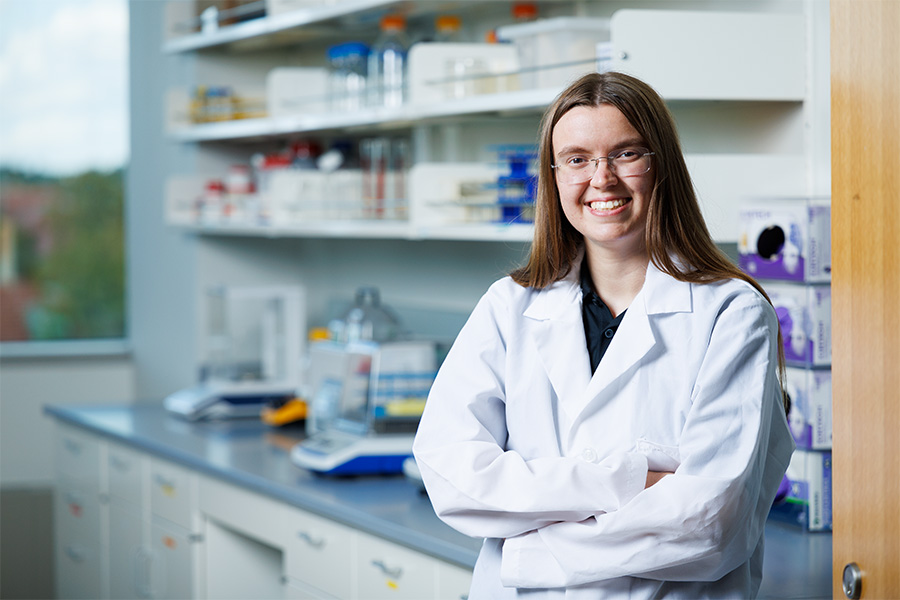
ABE student Amanda Wolf transforms uncertainty into opportunity, founding SABER and earning recognition as a 2025 Dean's Leadership Scholar
Amanda Wolf spent an entire semester cold-calling faculty members across Purdue, pitching what must have sounded like an absurd idea: Could a team of undergraduate peer learners work in a biological lab together, receiving regular genetic engineering mentorship despite having no formal training?
The conversational dead-ends piled up. Faculty after faculty said no. But Wolf had a strategy. She turned every rejection into opportunity by asking for referrals. "I asked all around Purdue, using the research connections of my peers and friends," she recalls. "While naturally there were a lot of no's, I was able to turn every no into more possible connections just by asking for referrals."
The persistence paid off when she met associate professor Stephen Lindemann, who works with microbiology and human gut microbiota. He'd been wanting to create approachable, repeatable genetic engineering lab experiences, too. His graduate student Anurag Pujari agreed to the heavy mentorship role. "The rest is history," Wolf says.
That history is SABER (Synergies Agricultural & Biological Engineering Research), a student-run research team that Wolf founded and now leads as president. Today, SABER offers Purdue students up to three academic research credits per semester for hands-on genetic engineering work, filling a gap that Wolf identified in her own education.
Filling the gap
Wolf's drive to create SABER came from a clear need. She aspires to work in biodefense after graduation, where genetic engineering is vital for virology and therapeutics work. "Genetic engineering is ubiquitous in bioengineering in general, from sustainable agriculture to biofuels, but at the time, my curriculum did not really offer exposure to it," she explains.
Some student efforts had provided related experience, but none offered the direct mentorship and immediate path to wet lab work she was seeking. Her inspiration came from a popular bacteriophage discovery class that provided wet lab skills and bioinformatics experience. "This got me thinking, is that model repeatable for genetic engineering, if we build ourselves the 'class?'"
Wolf and several teammates had previously been involved in a bioastronautics and space agriculture team, which first exposed her to reaching for knowledge outside the curriculum and learning from peers. "So, from the roots of the old one, I decided to launch SABER. My teammates helped transform it with me, and have wonderfully supported it every step of the way."
The transition wasn't easy. During that first semester of setup and searching, keeping membership was their biggest struggle. The team maintained side projects and volunteering, including work with Purdue Space Day, to stay visible during the metamorphosis.
Today, SABER works with Lindemann's lab on a genetic engineering project to characterize glycoside hydrolases from the human gut. The work encompasses both "dry lab" work (plasmid creation and software-based tools) and "wet lab" benchwork with biological material. The team trains students in all lab techniques involved.
As president, Wolf acts as a liaison between student members, the principal investigator, and faculty advisors, amplifying student voices and helping to streamline the program through continuous feedback and collaboration.
Beyond research, SABER continues its volunteer work. At this year's Purdue Space Day, an annual event bringing younger students to learn about space exploration and engineering, SABER will represent bioastronautics by crafting sealed terrariums with students to simulate closed-loop life support systems for space travel and extraterrestrial colonies.
Recognition and responsibility
In 2025, Wolf was selected as a Dean's Leadership Scholar, recognition that came with both honor and a sense of responsibility. She was one of 14 exceptional undergraduate students chosen for the prestigious program, which positions student leaders as key advisors to the dean on strategic college initiatives.
After leading SABER for two years, Wolf brings valuable perspective to the role.
"When I received the Dean's Leadership Scholar opportunity as a senior, it meant I would be representing not just fellow seniors of similar experiences to mine, but also all the students I'd been in the past, needing different things at every stage," she reflects.
The program allows her to speak directly to the dean on new initiatives and focuses of Purdue Engineering administration. "With a senior's retrospect, I can speak with the insights and student needs that I wish I'd known how to recognize or address in earlier years, in the hopes it will inform decisions and cultivate an environment that will help another student down the line."
That perspective is particularly meaningful given Wolf's own journey at Purdue.
Finding her way
Wolf entered Purdue with a clean slate: no connections, no familiar faces in her major, no tangible path to her career plans, and no idea who to ask. "I spent my first two years in complete trial and error, learning time management, how to use my Purdue resources and cold-call to push my aspirations, and exploring involvements to find where my time was best invested."
The uncertainty was difficult. "I had imposter syndrome for almost everything around me, as people who came in with their paths in mind forged ahead while I was still just looking around."
But what seemed like scattered interests eventually became her strength. "As an artist and an engineer, if I know one thing, it's that disconnected interests and experiences are actually useful directly because of the diverse facets they develop in you," she says. "Without my early interests in political science and writing, for example, I wouldn't have run into the right people to hear about biodefense, which is now my main career passion."
Her department recognized this diversity as a strength, naming her Outstanding Student in her junior year precisely because of her varied background and ability to bring ideas together from different places. She also serves as vice president of the Mortar Board Honor Society, where she advocates for incoming students who might be experiencing the same uncertainty she once felt.

A diverse research portfolio
Wolf's undergraduate research experiences reflect that interdisciplinary approach. Her earliest research was with the School of Engineering Education, helping assistant professor Kirsten Davis on a project quantifying the "complexity" of Purdue's largest majors in relation to curricular flexibility and study abroad rates.
"While it didn't relate directly to my major of bioengineering, it makes for a great party trick to be able to share the complexity of people's majors on the fly," she jokes. More importantly, "what this did teach me for future research was the importance of good documentation, communication, and dedication to the work."
Next came bacteriophage discovery and bioinformatics with professor Kari Clase through the SEA-PHAGES program, where she discovered, characterized, and analyzed the evolutionary history of a new bacteriophage from Purdue soil. "This was a perfect introduction to the wet lab skills I'd need for my developing interests in virology, synthetic biology, and biodefense, and was a major part of my inspiration for starting my student team, SABER."
She then worked with professor Jong Choi in the School Mechanical Engineering on programmable DNA nanomaterials and gold nanoparticle synthesis for biomedical applications. "This lab was in Mechanical Engineering, a far cry from my home of Biological, but it once again showed me the value of interdisciplinary learning."
Currently, Wolf works in professor Robert Stahelin's lab investigating the membrane and lipid interactions of the Ebola virus' matrix protein to improve models of viral assembly and identify promising routes toward interfering with its spread. "This topic is directly aligned with my interests in biodefense, and I'm continuously excited to learn about it and think toward applying it in my future!"
Industry experience
Wolf's industry experiences have been equally diverse. Her first professional experience came through an internship with AgroRenew, a bioplastics startup in Vincennes, Indiana, situated among one of the nation's watermelon-growing hotspots. Working as a process engineer, she helped develop manufacturing lines and design novel machinery to convert waste from melons and other sources into biodegradable bioplastic.
Her next internship pivoted to IQVIA Laboratories, where she worked to integrate new bioseparations equipment into the workflow for drug development client studies. "Each internship's mixed characteristics, between end-stage industrial mass production at a small company, and microbiological, early research at a large company, not only gave me technical knowledge but a thorough look at bioengineering business operations from startup to stability."
During the school year, Wolf works with Lawrence Livermore National Laboratory through Purdue's Data Mine program, where she helps test and refine their machine learning software pipeline for cheminformatics modeling. "During the current AI boom, it's been fascinating to work behind the scenes with a national laboratory on developing predictive algorithms for drug molecule prediction."
Balancing it all
Beyond SABER, Wolf serves as executive officer of the Purdue National Defense Society, where she leads the organization's creative direction and media strategy. She also serves as president of the Creative Writing Club, coordinating with faculty and campus partners to host speakers, events, and writing opportunities that reach a broad audience. It's a role she first took on as a freshman.
"My schedule is packed just about to the gills," she admits. "But I made the decision long ago that I wanted to get everything out of these four years at Purdue that I could, and specifically, things that I could not get anywhere else: the organizations and communities."
The Creative Writing Club presidency was a turning point. "Running for president as a freshman, even for this smaller organization (and one that was entirely unrelated to any degree of mine at the time), was hardly something I'd have considered wise," she reflects. "But seeing that the dedication I had put into it paid off? It really cemented in my mind that dedication is recognizable. Nothing is unattainable if you're present to keep pushing for it."
That confidence carried forward into founding SABER and taking on other leadership roles. The key to balancing everything? "Majorly, I learned that I can't do everything myself, and that a leader's mission is also to cultivate other leaders, by entrusting responsibilities and sharing visions around."
Looking ahead
Wolf's ultimate goal is a career in biodefense, working on human therapeutics or bioterrorism prevention and remediation. She's currently exploring graduate program options from Purdue to both coasts to overseas, aiming for a master's or PhD in biotech for biodefense applications, then transitioning to a national laboratory for full-time research.
"With the dawning accessibility of biotech raising the threat of bioterrorism, the pandemic providing many lessons on the importance of better disease modeling and treatment development, and the unexplored potential and ethical issues of genetic engineering coming into greater societal spotlight, I want to be there on the front lines using my education for the service of a more capable and sustainable future," she says.
She may also explore startups in the biotech sector to investigate starting her own accessible therapeutics organization one day. "We may not be able to put full brakes on the advancements coming for the field, but I can do my best to make them as equitable as possible to bring the world into the future together."
For students considering starting their own organization or taking on leadership roles, Wolf's advice is direct: "Whether you heard it from me, or Nike, or that one Shia Labeouf video back in 2015, there's really no other secret than 'Just do it.' The fact that you have the desire at all to start something or get involved shows you have important passion, so don't let it fizzle out alone."
Her approach? Treat your endeavor like a sales pitch. Figure out exactly what you want to obtain or start, what you'll be offering, what you need to make it happen, and who can help you get what you're missing. "Then just ask, and ask, and ask, and if someone says no, ask them who else they know that might say yes."
From a lost freshman with no connections to a Dean's Leadership Scholar who founded her own research team, Wolf's journey embodies the power of persistence, interdisciplinary thinking, and asking the right questions, even when the answer is no.
This story was developed as part of "Victories & Heroes: Your Campaign for Purdue." Join us in elevating Purdue Engineering education and excellence. Click here to be a part of Purdue history.