
Adrianna Waterford, Purdue Engineering student, lives on a sailboat while working for NASA
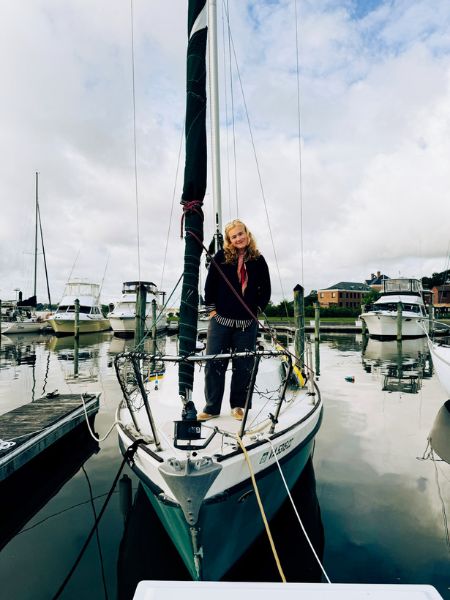
Adrianna Waterford, Purdue Engineering Student, Lives on a Sailboat While Working for NASA When Purdue materials engineering student Adrianna Waterford accepted her internship at NASA’s Langley Research Center, she knew it was the opportunity of a lifetime; she just had to find a way to make it work.
After paying for summer tuition and planning ahead for fall housing, she realized rent near the Virginia coast was far beyond her budget. “I wasn’t about to let that stop me from taking my dream internship,” she says. “I just needed to get creative.”
Whatever It Takes
That creativity led her to a 1974, 27-foot Titans sailboat available for rent at a fraction of the cost of an apartment. The vessel had seen better days — electrical issues, plumbing problems, and leaks that appeared with every heavy rain — but to Waterford, it was the lifeline that would carry her to NASA.
“I didn’t grow up sailing,” she says. “But I did grow up fixing things. My dad and I rebuilt cars together, and when I was 15, I bought a broken-down car for $1,000 and learned how to bring it back to life. That was basically how I learned engineering — if something broke, I figured out how to make it work.”
That same ingenuity became her compass. “I wasn’t worried about not knowing how to fix a boat,” she says. “If there was something in front of me that needed fixing, my problemsolving experiences gave me the confidence to figure it out.”
Over the summer, she patched leaks, rewired solar panels, repaired electrical systems, and kept the sailboat afloat through storms that tested both her patience and her problemsolving skills. But for Waterford, the boat was never the story — it was simply the vessel that carried her to NASA. At Langley, she worked alongside engineers developing hypersonic high-temperature materials and thermal protection systems, gaining firsthand experience in a high-stakes, technical environment.
“Living on the boat wasn’t ideal,” she says. “That summer really tested my limits — balancing the internship, other part-time jobs, and summer courses, all while managing the challenges of boat life. But it pushed me to be resourceful and resilient in ways nothing else had.”
Her instinct for unconventional problem-solving isn’t new. When she first came to college at 17, she wasn’t old enough to participate in U.S.-based astronaut training programs. Instead of waiting, she traveled to Krakow, Poland, to train as an analog astronaut. For seven days, she and her international crewmates simulated space missions in isolation, navigating technical challenges and communication barriers.
“Working with Adrianna was an extraordinary experience,” recalls Patrycja Zuber, the crew’s medical officer. “From the very beginning, she stood out for her focus and calm determination, which naturally motivated everyone around her. She always seemed to know exactly what needed to be done — it often felt as though she could communicate without words. Even with language barriers, she adapted effortlessly to the environment around her.”
That same adaptability and resilience have carried her through every challenge. “It’s never been about having everything figured out,” she says. “It’s about figuring things out as you go.” From a farm in southern Indiana to NASA’s hypersonic research program, from rebuilding an old car to living aboard a 1974, 27-foot Titan sailboat, Waterford’s journey has never followed a straight line. But like any good engineer, she’s learned how to steer through uncertainty — and to keep moving forward, no matter how rough the waters get
Becoming a Boilermaker
As a first-generation college student, Waterford faced a world of unknowns when she set her sights on higher education. She grew up homeschooled on a farm in southern Indiana, where college was never a given. The path to Purdue required determination, creativity, and a willingness to navigate obstacles on her own.
A conversation in ninth grade with Jesse McKeeman — a family friend, pilot, and Boilermaker engineer — changed the trajectory of her life. McKeeman noticed her fascination with a telescope his family had given her and encouraged her to explore Purdue’s aerospace engineering program. From that moment, Waterford set her sights on Purdue as the only path that would make college a reality.
“I wouldn’t have gone anywhere, honestly, if it wasn’t Purdue,” she says. “The scholarship and the frozen tuition made it possible for me to even consider college. That’s what gave me the chance to become a Boilermaker, and I’ve loved every step of the process.”
Waterford entered Purdue planning to major in aerospace engineering, seeing it as the most direct route to NASA. But a chance encounter with NASA Hypersonics researcher Dr. David Glass after her freshman-year internship at the Naval Surface Warfare Center in Crane, Indiana, opened her eyes to materials engineering — a pathway that aligned even more closely with her goals. That same drive and curiosity that guided her through the summer on a sailboat now guided her through every academic and research challenge at Purdue.
Initiative and Adaptability
Her ability to tackle unexpected challenges and adapt to new environments has consistently stood out.
Patrycja Zuber, her analog astronaut crew’s medical officer, recalls one defining moment: “Adrianna was always ready for any challenge. Her work ethic was steady and inspiring: she consistently dedicated time to her research and training, and when needed, she was equally available to support her crewmates with conversation, advice, or practical help. One of the situations that best captured her character happened during a flight simulation when our spacecraft experienced a temporary failure — Adrianna reacted with composure and precision, repairing what was necessary and even improving systems that technically didn’t need improvement. That kind of initiative and adaptability is exactly what makes her stand out as an engineer.”
Being a first-generation student comes with its own set of challenges. It’s not easy to work multiple side jobs to pay bills while balancing academic responsibilities, research, and internships — and it’s certainly not easy to live on a sailboat. But her determination and resourcefulness set a tone of possibility, encouraging everyone she works with to push further.
“When I see somebody with a broad range of skills and such enthusiasm, I’ll go 100 miles for them,” says Dr. Vincent Cuda, her NASA-affiliated research mentor. “I want to make sure she has an opportunity to really push her limits.”
For Waterford, becoming a Boilermaker wasn’t just about earning a degree — it was about finding a place that challenged her to think bigger and work harder than she ever thought possible. That mindset has carried her through research, leadership, and internships that pushed her limits and shaped her identity as an engineer.
“I’m grateful for the mentors and people who believed in me, especially when I was still learning to believe in myself,” she says. “Coming from a humble beginning, finding my footing at Purdue and being surrounded by people who expect the best from you — that’s been one of the most meaningful parts of my journey.”
Lessons Learned and Looking Forward
“I’ve learned that your circumstances don’t define your potential,” she says. “Growing up on a farm doesn’t exactly prepare you for hypersonics, but Purdue Engineering shapes you into a problem solver and puts you in places you might never have imagined.”
Now, Waterford is continuing to build on that momentum. After her summer at NASA Langley, she received a return offer to continue her research in hypersonic compressible flow under the mentorship of Dr. Vince Cuda — work she now conducts remotely while collaborating with Dr. Carlo Scalo in Purdue’s Compressible Fluid Acoustics Lab.
Waterford hopes her journey shows other first-generation and underrepresented students that they can chart their own course. With focus, persistence, and creativity, what seems impossible can become an opportunity. The sailboat wasn’t the story itself — it was a tangible reflection of Waterford’s ability to overcome adversity with creativity and resourcefulness; a mindset she credits to the type of engineers Purdue University produces.
One of Adrianna Waterford’s favorite quotes, one that has stayed with her since pursuing higher education, comes from Theodore Roosevelt’s 1910 “The Man in the Arena.” It’s been a constant source of motivation through the ups and downs of her journey, both at sea and in her studies.
“It is not the critic who counts; not the man who points out how the strong man stumbles, or where the doer of deeds could have done them better. The credit belongs to the man who is actually in the arena, whose face is marred by dust and sweat and blood; who strives valiantly; who errs, who comes short again and again, because there is no effort without error and shortcoming; but who does actually strive to do the deeds; who knows great enthusiasms, the great devotions; who spends himself in a worthy cause; who at the best knows in the end the triumph of high achievement, and who at the worst, if he fails, at least fails while daring greatly, so that his place shall never be with those cold and timid souls who neither know victory nor defeat.” — Theodore Roosevelt, “Citizenship in a Republic” (1910).
For Adrianna, these words capture the heart of her experience: the courage to take risks, to live unconventionally, and to keep striving even when the outcome isn’t certain. Whether she’s navigating her boat or charting a course towards Hypersonics, she carries this reminder with her: real growth happens in the arena.