
Shubh Mehta earns American Heart Association Predoctoral Fellowship for translational cardiovascular research
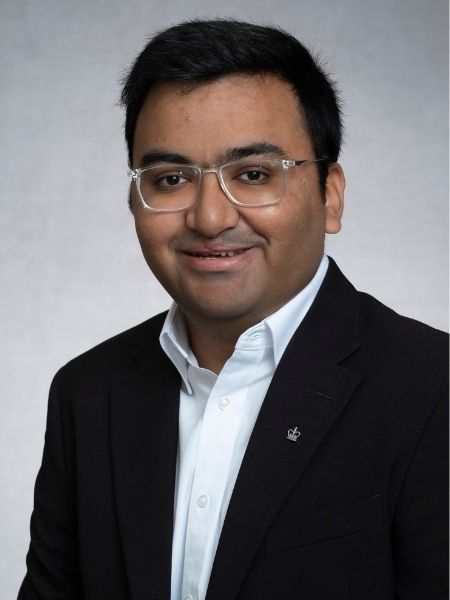
Shubh Mehta, a second-year PhD student in professor Craig Goergen’s laboratory in Purdue University’s Weldon School of Biomedical Engineering, has been awarded the 2026 American Heart Association (AHA) Predoctoral Fellowship. The highly competitive award supports promising predoctoral researchers pursuing careers aimed at advancing cardiovascular and cerebrovascular health.
Mehta received the fellowship for his proposal, “Deep Learning-Based Echocardiographic Biomarkers and Genotype Correlations in Pediatric Thoracic Aortic Aneurysms,” which integrates artificial intelligence, medical imaging and other clinical data to improve how disease progression is assessed in children with inherited aortic conditions.
The AHA Predoctoral Fellowship is designed to enhance integrated research and clinical training for future scientists, physician-scientists and clinician-scientists. Mehta shared his reflections on the honor, his research trajectory and what drew him to Purdue Engineering.
What is your research focus, and what investigative avenues are you pursuing?
My research focuses on improving how pediatric thoracic aortic aneurysm progression is assessed and monitored using routinely acquired echocardiograms. Today, many clinical decisions rely on static measurements of aortic size, which may not fully capture early disease progression or changes in vessel mechanics.
Through my doctoral work, I am investigating whether dynamic, functional features of the aorta can serve as more sensitive indicators of vascular health. By integrating these features with genetic data and longitudinal clinical information, my research aims to better characterize disease variability in children with inherited aortopathies. Ultimately, the goal is to enable more precise, patient-specific risk assessment using tools that build on existing clinical imaging practices.
What spurred your interest in this particular line of research?
During my master’s research at Columbia University, I developed deep learning techniques for MRI segmentation and OCT region-of-interest extraction. That experience sparked my interest in applying clinically translatable AI approaches to ultrasound data, which is both widely used and technically challenging.
This project aligned perfectly with those interests. It offers the opportunity to automate echocardiographic analysis while addressing an important clinical need for a small but critically underserved patient population. The potential for real-world impact made the work especially compelling.
What does winning this prestigious award mean to you personally and professionally?
On a personal level, the award is deeply meaningful. It reflects years of sustained effort across different academic systems and countries, and it marks an encouraging milestone in a journey centered on improving care for vulnerable patient populations. It also comes with a strong sense of responsibility — to use this opportunity thoughtfully and to produce work that justifies the trust the AHA has placed in me.
Professionally, this award represents validation from a national organization that deeply understands both cardiovascular science and clinical impact. It affirms not only the technical rigor of my work, but also my ability to articulate a clear scientific vision that bridges engineering innovation with unmet clinical needs. The recognition strengthens my confidence and reinforces my commitment to translational cardiovascular research.
Why did you choose Purdue to continue your graduate studies?
Several factors influenced my decision. Working with Craig Goergen, professor and associate head for clinical engagement in the Weldon School of Biomedical Engineering, along with Ben Landis, MD, a former Riley pediatric cardiologist now at Yale Pediatrics, provided an ideal balance of rigorous engineering research and real-world clinical grounding.
Equally important was the supportive lab environment and strong sense of community I experienced during my recruitment visit. It was clear that Purdue valued both scientific excellence and trainee development.
When did you first become interested in biomedical engineering?
My interest began early, shaped by growing up in Mumbai, India, an environment where disparities in healthcare access were visible and consequential. Seeing how delayed diagnoses and limited resources could dramatically alter outcomes motivated me to pursue a field that combines engineering problem-solving with direct societal impact.
Biomedical engineering appealed to me because it offered a pathway to translate technical innovation into accessible, affordable and scalable healthcare solutions — an ethos that continues to guide my research today.
What have you learned at Purdue beyond technical subject matter?
Beyond deepening my technical expertise, Purdue has reinforced the importance of mentorship, leadership and communication in scientific work. Through mentoring undergraduates and participating in professional service, I’ve learned how to clearly convey complex ideas to diverse audiences and how to build collaborative research environments.
I’ve also gained exposure to regulatory science through the Graduate Certificate in Regulatory Affairs and Regulatory Science for Medical Devices, as well as clinical research ethics and real-world translational constraints through clinical shadowing and interactions. These experiences have fundamentally shaped how I approach translational research questions.
What advice would you give to students deciding where to attend graduate school?
Research alignment is critical, but I would encourage students to also consider mentorship style, lab culture and departmental support. Graduate training is a long and demanding process, and factors such as psychological safety, peer support and professional development opportunities play a major role in long-term success. Finding an environment that values mentorship, collaboration and trainee growth can be just as important as the specific research topic.
Looking ahead, what are your goals for the future?
My long-term goal is to develop clinically deployable, AI-driven tools that integrate seamlessly into existing workflows — reducing the manual burden on clinicians while improving diagnostic precision. I am particularly interested in approaches that are interpretable, reproducible and designed with regulatory and clinical constraints in mind from the outset.
Can you share a glimpse of who you are beyond the lab?
Beyond the lab, I’m driven by curiosity in quieter ways. I enjoy exploring different cuisines — sometimes by cooking, sometimes by trying new places — and I like documenting everyday moments through photography. Both give me a chance to slow down, notice details, and reflect outside the pace of research. These habits shape how I approach my work as well: with patience, openness, and an appreciation for perspective.