
Purdue Engineering pipeline: ChE Professional Master's Program connects talent to industry
How Purdue's one-year intensive program transforms chemical engineers into industry-ready leaders across pharmaceutical, chemical and energy sectors
Several years ago, academic chemical engineering programs across the United States largely transitioned away from thesis-based master's programs. While this shift made sense for research-focused institutions, it left a gap in the market. Students bound for industry careers still needed credentials beyond a bachelor's degree, but they didn't need to spend years in a lab writing a dissertation.
The Davidson School of Chemical Engineering at Purdue University was among the first to recognize this opportunity. In 2015, they launched the Chemical Engineering (ChE) Professional Master's Program (PMP), a non-thesis program designed specifically to prepare graduates for industrial careers rather than academic research.
Nearly a decade later, the program has become a proven pipeline connecting top engineering talent with leading companies across pharmaceutical, chemical, petroleum and energy industries. Students complete real-world capstone projects with industry partners, graduate in just 12 months and step directly into roles at companies like Pfizer, Evonik and beyond.
"Purdue's ChE PMP is focused on preparing students for employment in industry with a curriculum that includes business courses and technical electives, allowing for specialization based on concentration choice," explains William Clark, the Director of the program, and a professor of engineering practice in the Davidson School of Chemical Engineering.
A different kind of master's degree
Unlike traditional thesis-based master's programs, which are research-oriented and involve laboratory or computational work culminating in a dissertation, the ChE PMP is a non-thesis program built around coursework and experiential learning. "A traditional thesis MS program is research-oriented and involves either experimental, laboratory-based or computational work under the supervision of a faculty advisor and other faculty members," Clark explains. "On the other hand, the PMP is a non-thesis program, involving didactic coursework and an experiential learning project, called a capstone project, with no production of a dissertation."
The curriculum deliberately develops skills that textbooks alone cannot teach: leadership, management, business acumen, financial analysis, oral and written communication, teamwork and project management. Students supplement their technical chemical engineering knowledge with the business and professional competencies that employers consistently say they value most.
The program's efficiency is remarkable. Students with a chemical engineering undergraduate degree can complete the entire program in just one calendar year. Purdue's College of Engineering, the largest top five graduate engineering program in the U.S., offers this combination of speed and quality that Clark calls "excellence at scale."
Students choose from seven concentration areas to gain specialized knowledge suited to their interests and career goals. These concentrations allow graduates to position themselves for specific industry sectors, whether pharmaceutical manufacturing, petroleum refining, chemical production or emerging fields like sustainable energy.
For working professionals who cannot step away from their careers for a full year, the program offers a part-time track that allows students to earn their degree in three to four years while continuing full-time work.
Building bridges to industry
The program's primary connection to industry runs through its capstone experience. Students are paired with industry mentors from companies across diverse sectors: pharmaceutical giants like Pfizer, chemical manufacturers like Evonik, energy companies and emerging technology firms. These partnerships span the full spectrum of chemical engineering applications.
"Our primary industry connections are through the capstone program," Clark notes. "Students are paired with industry mentors from companies comprising many different sectors, including the pharmaceutical, chemical and energy industries."
The capstone course represents six credits, or 20% of the total degree requirement. This substantial commitment reflects how critical the industry experience is to the program's mission. "The capstone experience is critical because it provides students with opportunities to work on real-world problems that have been identified by subject matter experts at leading companies in the world," Clark explains.
The timing is strategic. Most students take traditional coursework during the first several months of their matriculation and finish with the capstone project just before graduating. "Thus, the industry exposure during the capstone course is timely as students embark on their professional careers,” Clark says.
These capstone projects differ fundamentally from traditional homework assignments. They're dynamic, less defined, and require students to navigate real company constraints, politics and procedures. McKenzie Temme, a process safety engineering manager at Evonik who is pursuing her ChE PMP while working full-time, explains the projects from both sides of the equation.
"The capstone project is an important part of the ChE PMP because it gives the student a taste of what engineers are working on day-to-day in industry," Temme says. "These projects tend to be less structured than most traditional homework assignments and require significant review and understanding of the company's goals, resources and procedures. In addition to the project itself, working with a mentor from industry exposes the ChE PMP students to a non-academic's approach to project management and problem solving."

The working professional track
Temme represents a growing segment of ChE PMP students: experienced professionals seeking to formalize and expand their expertise without leaving their careers. As both a current student and a hiring manager, she offers unique insights into what the program delivers.
"I have always enjoyed formal learning, and as a working professional, I like that the program focuses on real-life connections and employability instead of academic research," Temme explains.
Balancing full-time work, family responsibilities and graduate coursework requires significant support and flexibility. "In my experience, the program administrators and professors have been very supportive of my need for flexibility, only taking one class per semester, an unexpected medical leave and some minor scheduling adjustments," she says. "That said, attending an in-person class while working full time and caring for a family can be quite challenging. It has required a lot of flexibility and support from my employer and from my husband to make it all work."
The effort pays dividends in her day-to-day work. "What I enjoy most about taking engineering classes is learning more of the detail and nuance behind tasks that I already do," Temme says. "It will never make sense for me to take the time and effort to hand calculate data for consequence modeling at work, but having done it as part of a class assignment, I better understand the assumptions and limitations of the models that I order and interpret."
From her hiring manager perspective, Temme sees clear differences in PMP candidates. "As a hiring manager, I like that ChE PMP students are intentionally preparing for and seeking industrial roles like the ones that I am interviewing for. Industry-relevant electives and the capstone project set these students up to onboard quickly if hired."
The program delivers strong technical skills, but it goes beyond that. "Strong technical skills are always desirable in industry, and the ChE PMP delivers on this, but it also emphasizes teamwork, clear communication and looking at problems from the perspective of the whole company instead of just from the perspective of an engineer. These less technical skills are important for transitioning from a student into an employee."
These program benefits and industry connections become concrete when examining individual student journeys. The capstone experience, in particular, serves as the ultimate test of whether the program delivers on its promise to transform students into industry-ready professionals. For Juliet Freed, that transformation would culminate in a presentation that showcased not just technical solutions, but a fundamental shift in how she approached engineering challenges.
My victory: From food chemistry to process safety
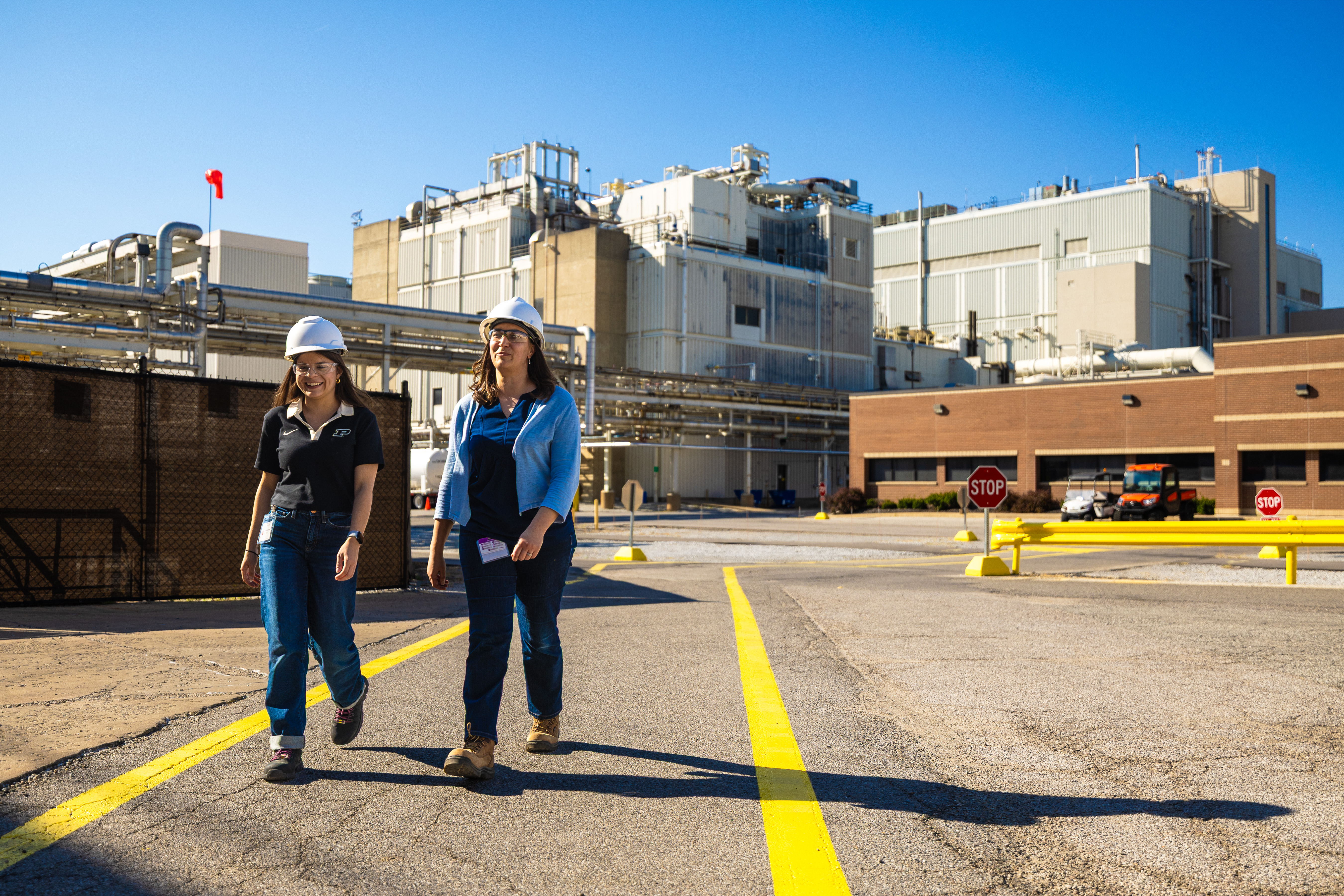
Juliet Freed stood in front of a room full of process safety experts at Evonik Tippecanoe Laboratories, presenting the culmination of months of work. Her team had developed a new framework for classifying and storing hazardous chemicals, a system that would make operations safer and more efficient. As she walked through the findings, she realized how far she'd come from her days as an analytical chemist in food industry research and development.
Before enrolling in the ChE PMP, Freed enjoyed her work as an analytical chemist, but she reached a point where she wanted to grow beyond her current scope. "I wanted to better understand how large-scale engineering and process design fit into product development," she explains. "I was motivated to pursue a professional master's degree to strengthen both my technical and leadership abilities while staying closely connected to industry applications."
When evaluating graduate programs, Purdue's ChE PMP stood out. "Purdue's program stood out because of its strong industry alignment and applied approach," Freed says. "I wanted a program that would allow me to deepen my technical foundation while also developing the professional and business skills needed to lead in an industrial setting. Purdue's reputation for excellence in chemical engineering and its professional network were also major factors in my decision."
Once enrolled, Freed moved through the program's coursework, building technical depth and business acumen. As she progressed, she knew the capstone experience would be the culmination of everything she'd learned, the moment where classroom theory would meet industry reality.
Her capstone project with Evonik Tippecanoe Laboratories tackled a critical safety challenge: improving existing documentation on how hazardous chemicals are classified for safe storage. "We examined the current hazardous material codes and developed a more organized framework to help process safety personnel quickly and consistently determine storage requirements for oxidizers based on both class and volume," Freed explains.
The challenge wasn't just technical. "At the start, our team spent a lot of time understanding the existing documentation and how it was being used in practice," Freed recalls. "The biggest challenge was striking the right balance between technical accuracy and usability, ensuring that the information was both comprehensive and easy for engineers to apply quickly."
Through close collaboration with Evonik's process safety experts, Freed and her team refined their framework over several months to deliver practical solutions. The result was a cleaner, more efficient system that supports safer and more streamlined operations, a tangible improvement that would impact daily work for years to come.
Standing in front of those safety experts at her final presentation, Freed had transformed from an analytical chemist into a chemical engineer ready to lead complex industrial projects. The capstone had delivered exactly what the program promised: real-world experience solving real-world problems.

The two-way pipeline
The benefits of industry partnerships flow in both directions. Companies gain access to talented students who bring fresh perspectives and technical skills to concrete problems. Students gain industry experience, mentorship, and often, job offers.
"Partnerships between industry and programs like the ChE PMP are beneficial to both the students and the company," Temme explains. "Students get to apply their knowledge to a real-life task while getting a taste for company expectations, communication styles and values. The partner companies benefit from the energy and technical skills of the students, and they receive a much better sense of a potential employee than they ever could from an interview."
One success story exemplifies this dynamic. During the COVID-19 pandemic in summer 2020, a PMP student completed his capstone project with Pfizer. Though his project didn't specifically pertain to COVID vaccine development, his performance was so outstanding that Pfizer hired him upon graduation in August 2020. His first assignment was vaccine-related, giving him immediate opportunity to work on cutting-edge research with enormous clinical impact.
The program stays responsive to changing industry needs through regular feedback loops. "We have regular update sessions with the industry subject matter experts who mentor our students during their capstone projects and value their feedback," Clark explains. "In addition, we use the school's Industry Advisory Council as a sounding board for trends that we are seeing in the PMP and changes that we might be considering."
What sets PMP graduates apart
Clark confirms that industry views PMP graduates distinctively. "First, industry has a very positive view of Purdue ChE graduates in general. The high degree of industry preparedness of students from all of our academic programs is widely appreciated." For PMP students specifically, industry values the specialization beyond a standard bachelor's degree through business courses and their chosen concentration, along with the industry experience gained in the capstone.
Several factors make Purdue's ChE PMP unique. "First, ChE PMP students graduate from a U.S. News & World Report top five graduate engineering program, which is also one of the largest in the U.S.," Clark says. "This combination of size and quality, 'excellence at scale,' is one factor making our program unique." The time efficiency for full-time students and the focus on industry preparedness through business courses, technical specialization and hands-on capstone experiences create a distinctive value proposition.
Temme summarizes it simply: "The ChE PMP is a quality program that is designed to support a career in industry. It's designed to be relatively short, one calendar year for full-time students, and to broaden an engineer's skills to include more managerial concerns like financial analysis, marketing and strategic planning."
For companies considering partnership opportunities, Temme's message is clear. "It obviously takes time and effort to coach and build relationships with students, but partnering with the ChE PMP is a great way to recruit and gain exposure to young talent."
Expanding the pipeline
Looking ahead, the program continues to expand its industry reach across both traditional and emerging sectors. "We are always on the search for new companies with which we can develop collaborations across diverse sectors," Clark says. "We are particularly interested in expanding our collaborations with the pharmaceutical industry and strengthening our presence in the semiconductor field. Also, we are actively exploring opportunities with companies interested in leveraging our students' data science expertise."
The pharmaceutical expansion into Indianapolis represents strategic positioning in one of the fastest-growing sectors. The semiconductor focus addresses critical national needs as the U.S. works to rebuild domestic chip manufacturing capacity. The data science emphasis recognizes that modern chemical engineering increasingly relies on advanced analytics, machine learning and computational tools.
As industries evolve, so does the pipeline. The ChE PMP isn't just responding to current industry needs. It's helping shape the future of chemical engineering by producing graduates who bridge technical excellence with business acumen, who understand both the science and the systems, who can step into leadership roles and drive innovation from day one.
From Freed improving safety protocols at Evonik to the Pfizer hire who immediately contributed to vaccine development; from Temme deepening her technical knowledge while managing process safety to countless other graduates now leading projects across pharmaceutical, chemical, petroleum and energy companies, the pipeline delivers.
One year. Real problems. Industry-ready graduates. That's the promise Purdue's ChE PMP has kept for nearly a decade, connecting academic excellence with industry impact, one capstone project at a time.
This story was developed as part of "Victories & Heroes: Your Campaign for Purdue." Join us in elevating Purdue Engineering education and excellence. Click here to be a part of Purdue history.