
My victory: Breaking through barriers
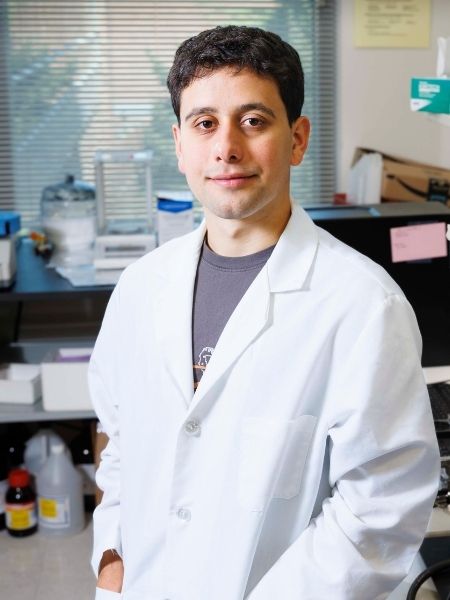
Deniz Eksioglu was sitting in his Signals and Systems class, checking his phone almost every minute. He knew the exact time and date he would receive the notification about the Goldwater Scholarship. Even though the official release time hadn't arrived yet, he kept refreshing his email, hoping they might "accidentally send it out early."
When the email finally appeared, everything around him seemed to disappear. "I felt like I wasn't even in the classroom anymore. I couldn't hear the teacher or feel the presence of the other students," he recalls. Too impatient to wait until after class, he opened it right there.
"When I read that I had received the scholarship, I couldn't believe it; it didn't feel real. I had to hold myself together for the rest of class, even though I was overwhelmed with happiness and felt like I might cry after all the hard work and stress I had gone through."
Within minutes, he sent a message to his family group chat. As soon as class ended, he called them and thanked the graduate mentors and professors who had supported him.
Eksioglu had become one of only two Purdue students to receive the prestigious 2025 Goldwater Scholarship, and the only recipient from the College of Engineering. The recognition would open doors he'd been working toward for years.
Making neural devices that last
The problem Eksioglu is working to solve is deceptively simple to state but remarkably complex to address. When any device is implanted into the human body, the immune system attacks it as a foreign invader. For devices designed to interact with the nervous system to treat neurological disorders, this response can prevent them from working properly. Worse, metal components can corrode over time, causing harmful side effects for patients.
"One way to prevent corrosion and reduce immune response is by using biomimetic and biocompatible materials," Eksioglu explains. His research involves coating neural devices with a conductive polymer that previous studies have shown provides excellent electrical and ionic conductivity, enabling it to both stimulate neural activity and record neural signals.
But there's a catch. When electrical signals are applied through the device, the polymer tends to separate and become damaged. Eksioglu's breakthrough was to computationally prove a hypothesis by a graduate student that a platinum grass-like structure on the surface of the metal electrode and within the polymer coating could solve the issue. "This structure helps absorb mechanical stress and prevent damage to the polymer, ultimately increasing the device's durability and extending its functional lifetime."
The implications are significant. More durable neural interfaces could improve treatment for severe neurological disorders, potentially transforming lives for patients who currently have limited options.
Building faculty relationships
Eksioglu's path to this research began with something remarkably simple: sending emails to professors.
"Honestly, all I did was reach out to these professors through email," he says. He joined professor Hugh Lee's group at the start of his sophomore year, interested in wearable and implantable medical devices but unsure exactly what direction he wanted to pursue. The experience in Lee's lab introduced him to neural engineering and biocompatible neural interfacing devices.
When Kevin Otto, now the Dane A. Miller Head of BME, joined Purdue, Eksioglu noticed that Otto's work focused heavily on neural interfaces. With the graduate student he'd been working with in Lee's lab about to graduate, Eksioglu reached out to Otto to learn more. After expressing his strong interest, he eventually joined Otto's group.
Working in these labs has been transformative. "I'd say the graduate students were the people I collaborated with most closely," Eksioglu notes. "While professors focus on the overarching research goals, each graduate student brings a unique set of skills, and together they work to solve complex challenges."
His research schedule is intensive but flexible. Much of his computational work can be done from anywhere, though classes take up most of his time during the academic year. "The summers are when I make the greatest impact," he says. Every summer since his sophomore year, he's either volunteered in research labs or participated in paid research programs, allowing him to make significant progress.
A childhood in motion
Eksioglu's path to Purdue research labs winds through three states and countless transitions. Born in Starkville, Mississippi, he lived there until age 10. Then his family moved to Clemson, South Carolina, which became his favorite place. For his last three years of high school, they lived in Fayetteville, Arkansas.
The constant movement stemmed from his parents' careers. Both are engineering professors who have held faculty positions at several universities. His father is from Turkey, his mother from Albania. "I honestly didn't enjoy moving so often and wished I could've stayed in Clemson until graduation," Eksioglu admits. "But now I understand that each move had its purpose."
The move to Arkansas proved pivotal, though not in ways he initially expected. In South Carolina, his English and history teachers had refused to let him take honors or AP classes because they believed he wouldn't do well. Eksioglu has dyslexia and needed extra time on exams, which his teachers interpreted as a limitation rather than simply a different way of learning.
"However, in Arkansas, my teachers recognized my potential and encouraged me to take advanced courses," he says. That recognition and encouragement changed his trajectory.
An immigrant's perspective
Eksioglu's mother's journey shaped his understanding of opportunity and privilege. Born in communist Albania, she faced obstacles in pursuing her academic dreams that are difficult for many Americans to imagine. "She was forced by the state to study a major she wasn't passionate about," Eksioglu explains.
After Albania was freed from Soviet influence, his mother was able to leave the country and earn her master's degree in Greece. Today, she holds a Ph.D. in industrial engineering and is a professor at the University of Arkansas.
"Her journey reminds me how fortunate I am to have the opportunities she didn't," Eksioglu reflects. His family's pride in his Purdue achievements is matched by their unwavering support. "They've always supported me every step of the way."
This background informs his vision for the future. While he plans to earn his PhD in biomedical engineering and pursue a research-oriented career, his ultimate goal goes beyond academic achievement. "Ideally, I want to start my own company focused on developing novel, high-quality neural interfacing devices to treat severe neurological disorders and make these technologies accessible to countries with limited healthcare resources."
The mission is personal. "I believe healthcare should not be a privilege, but a right that everyone deserves."
Looking forward
The Goldwater Scholarship has opened new opportunities for Eksioglu. He's attending the Goldwater Summit, held in conjunction with the Gulf Coast Undergraduate Symposium at Rice University, where he'll meet fellow scholars, present his research to potential faculty he hopes to work with, and make connections that could last a lifetime.
"I'm currently applying to graduate schools to pursue my PhD, and this award definitely helps me stand out from my peers who are also applying," he says. "This recognition has allowed me to take a big step toward achieving my goals and getting into a graduate program that can truly help me reach where I want to be in my career."
His advice to undergraduates interested in research is straightforward: "It only takes one email to get into a lab." He recommends looking for multiple people whose work interests them, noting that he didn't know exactly what he wanted to pursue until his senior year. "If a professor doesn't respond to you, that is totally fine. You should look for a professor who is willing to give you a lot of time and make sure you succeed, as they will be the ones writing recommendation letters for you."
From a child constantly moving between states, told by some teachers that he couldn't handle advanced coursework, to a Goldwater Scholar developing breakthrough neural devices, Eksioglu's journey reflects persistence, curiosity and a commitment to making healthcare accessible to all. His research on biocompatible neural interfaces could one day help patients worldwide, embodying the principle that drives him forward: healthcare as a right, not a privilege.
And it all started with sending a few emails to professors whose work caught his attention, proving that sometimes the biggest breakthroughs begin with the smallest steps.
This story was developed as part of "Victories & Heroes: Your Campaign for Purdue." Join us in elevating Purdue Engineering education and excellence. Click here to be a part of Purdue history.