
Purdue ECE leads $4.8M NSF project to bring AI-powered networks to disaster response
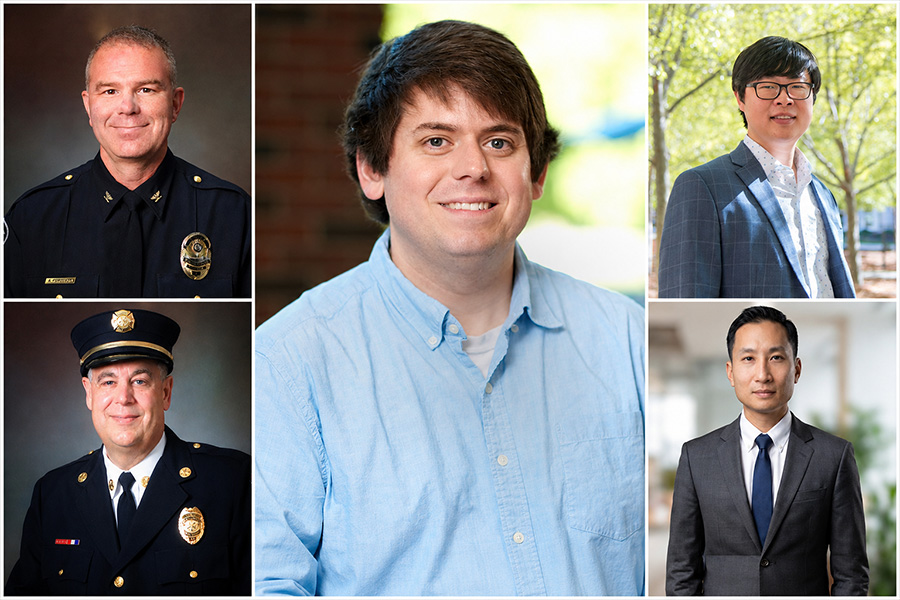
Purdue University researchers have received a $4.8 million grant from the National Science Foundation to develop technology that could help first responders make faster, better-informed decisions during disasters.
The project, called HEIDRA, short for Heterogeneous Edge Intelligence for Disaster Response Analytics, is led by Christopher Brinton, Elmore Associate Professor in Purdue’s Elmore Family School of Electrical and Computer Engineering. The goal is to create a system that can collect, share and analyze critical information in real time, even when cell towers, internet connections or other infrastructure are damaged or unavailable.
During wildfires, floods, tornadoes or other emergencies, responders often need to make decisions in unfamiliar, dangerous and rapidly changing environments. HEIDRA is designed to help by connecting devices such as phones, drones, emergency vehicles and sensors into a temporary intelligent network. Instead of relying on distant cloud servers, the system will process information closer to where it is needed.
“First responders are often operating in situations where every second matters and connectivity cannot be taken for granted,” Brinton said. “Our vision for HEIDRA is to give them timely, trustworthy information from the devices already around them, while keeping people firmly in control of the decisions that matter most.”
The project will focus on three major areas: distributed artificial intelligence that can work across different field devices, networking tools that prioritize the most important information, and responder-in-the-loop decision-making that allows emergency personnel to validate or reject AI recommendations.
Yin Sun, the Godbold Associate Professor of electrical and computer engineering at Auburn University, and Purdue’s Shreyas Sundaram, the Marie Gordon Professor of ECE, co-lead Thrust 2, which focuses on delivering timely information across the network.
“Because disaster response is highly time-sensitive, critical information must be collected, processed, and delivered to first responders while it can provide the greatest operational value,” Sun said.
Saab Inc. will help combine the project’s AI and networking advances into an integrated system and evaluate how well it performs under realistic operating conditions.
“The challenge is not simply to develop new AI and networking technologies, but to make them work together reliably in tough field conditions,” said Christopher Vo, director of autonomy at Saab Inc. “Saab will lead the integration and realistic end-user testing needed to transform the HEIDRA research into a practical capability for first responders.”
HEIDRA will be tested through phased demonstrations, culminating in field exercises at the Indiana National Guard’s Muscatatuck Training Center, a 1,000-acre facility in southern Indiana that can emulate severe disaster conditions. The West Lafayette fire and police departments and the Indiana National Guard are among the stakeholders helping guide and demonstrate the work.
“WLPD has always embraced emerging public safety technologies, and this collaboration gives our WLPD and WLFD a unique opportunity to not only help shape the future of public safety technology but also enhance our own preparedness for complex emergencies,” West Lafayette Police Chief Adam Ferguson said. “By pairing the real-world experience of our first responders with Purdue’s innovation and research expertise, we can help ensure these new technologies are practical, effective, and designed around the needs of those responding when our communities need us most.”
West Lafayette Fire Chief Jeff Need said the department welcomes the opportunity to help guide the project from a first responder’s perspective.
“We’re looking forward to exploring how we can collaborate with Brinton and his team as they develop this potentially life-saving technology,” Need said.
The team also will develop training materials, open tools and pathways for future technology transfer to public safety, defense and emergency management organizations.
The project includes funded participants from Purdue, the University of Virginia, Auburn University, Saab Inc. and Nokia Bell Labs. Purdue investigators include Brinton; Ayman Habib, professor of civil engineering; James Krogmeier, professor of electrical and computer engineering; David Love, the Nick Trbovich Professor of ECE; and Sundaram.