
Purdue researchers win Best Paper Award at ACM SoCC 2026
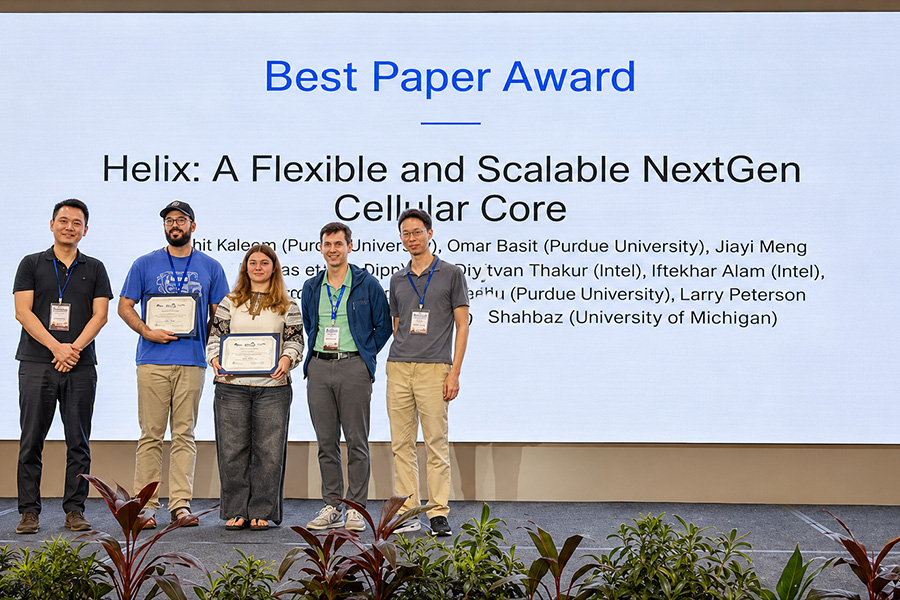
A team of researchers with roots in Purdue University’s Elmore Family School of Electrical and Computer Engineering (ECE) and Department of Computer Science has developed a new approach to making next-generation cellular networks faster, more flexible and more reliable. The technology, called Helix, processes network requests up to 11.6 times faster than existing 5G cellular core systems while maintaining the ability to scale as demand grows. The research earned the Best Paper Award at the 2026 ACM Symposium on Cloud Computing (SoCC).
The paper, “Helix: A Flexible and Scalable NextGen Cellular Core,” was presented at the conference, held Nov. 18-20 in Singapore. SoCC, jointly sponsored by ACM SIGOPS and SIGMOD, is one of the premier international conferences in cloud computing, Of the 376 paper submissions this year, SoCC accepted just 79, or approximately 21%.
The research grew out of a collaboration initiated several years ago at Purdue by ECE professor Y. Charlie Hu and then-Purdue Computer Science professor Muhammad Shahbaz, who is now at the University of Michigan. The research team includes PhD students Bilal Saleem of Purdue Computer Science and Omar Basit of Purdue ECE, along with Jiayi Meng of the University of Texas at Arlington; Ajay Lotan Thakur, Iftekhar Alam, and Christian Maciocco of Intel; and Larry Peterson of Princeton University.
Rethinking next-generation cellular networks
As cellular networks evolve from 5G toward 6G, they must support increasingly demanding applications, including autonomous vehicles, augmented reality, and massive numbers of connected devices. To meet these needs, cellular networks are adopting cloud-native architectures that divide the core network into independently deployable software services. While this approach improves flexibility, it can introduce communication overhead and performance bottlenecks.
Existing solutions often address these challenges by consolidating services into tightly integrated systems, sacrificing flexibility for performance. Helix takes a different approach, using novel mechanisms for load balancing, state management, and failure recovery to achieve high performance while preserving the modularity of cloud-native architectures.
Evaluated on a real edge-cloud testbed, Helix demonstrated substantial performance improvements over existing 5G cellular core systems, processing network requests up to 11.6 times faster while maintaining the flexibility and scalability of a cloud-native architecture.
The research demonstrates that high performance, scalability, resilience, and flexibility can coexist in next-generation cellular networks, opening new possibilities for more adaptable and efficient 5G and 6G infrastructure.