
Five Years of Impact: CSME Celebrates 2026 Annual Review with Spotlight on Student Innovation and Ecosystem Growth
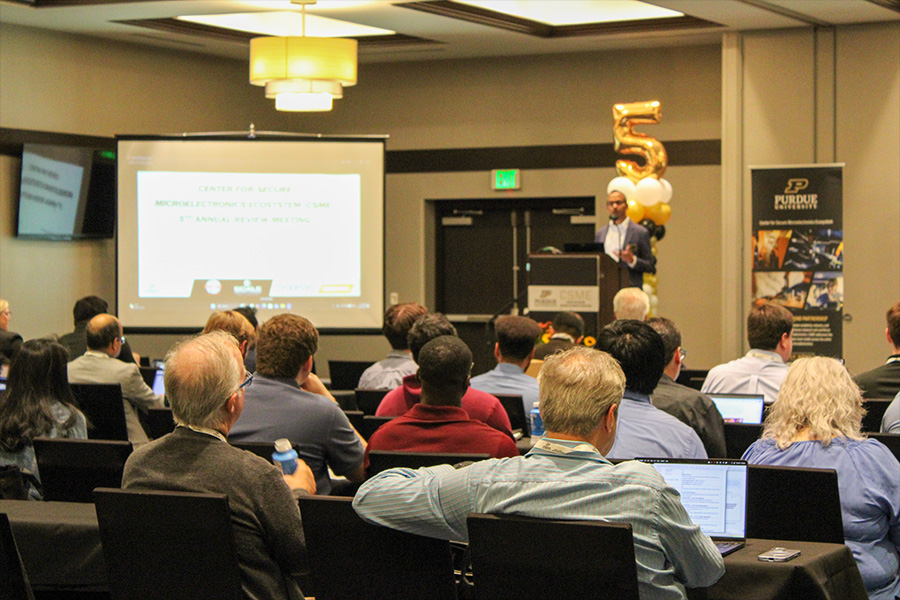
The Center for Secure Microelectronics Ecosystem (CSME) recently held its fifth Annual Review Meeting in Lafayette, Indiana, bringing together researchers, university partners, industry sponsors, and government stakeholders. Marking five years since its founding in 2021, the milestone event celebrated the center's expanding research portfolio, key industry milestones, and most importantly, the students whose innovative work is shaping the future of trusted and secure microelectronics.
Led by Purdue University under Co-Directors Joerg Appenzeller and Anand Raghunathan, both professors in the Elmore Family School of Electrical and Computer Engineering, CSME brings together academic research, industry and government partners to advance secure microelectronics. Working in partnership with the Department of War-supported SCALE program, CSME includes foundry partner TSMC, fabless semiconductor leader MediaTek, and electronic design automation (EDA) leader Synopsys, alongside NSWC Crane representing government stakeholders. The consortium encompasses seven universities across the nation: Purdue University, Arizona State University, Georgia Institute of Technology, University of Florida, Texas A&M University, Washington State University, and Worcester Polytechnic Institute.
A highlight of the two-day review was a vibrant student poster session showcasing twenty technical projects spanning various topics in secure microelectronics, including side-channel resilience, machine learning security, post-quantum cryptography, and advanced packaging verification. The competition highlighted the next generation of hardware security leaders tackling critical vulnerabilities across the full semiconductor lifecycle. This year's judges recognized three standout projects/posters for their technical depth, innovation, and relevance to the center's mission.
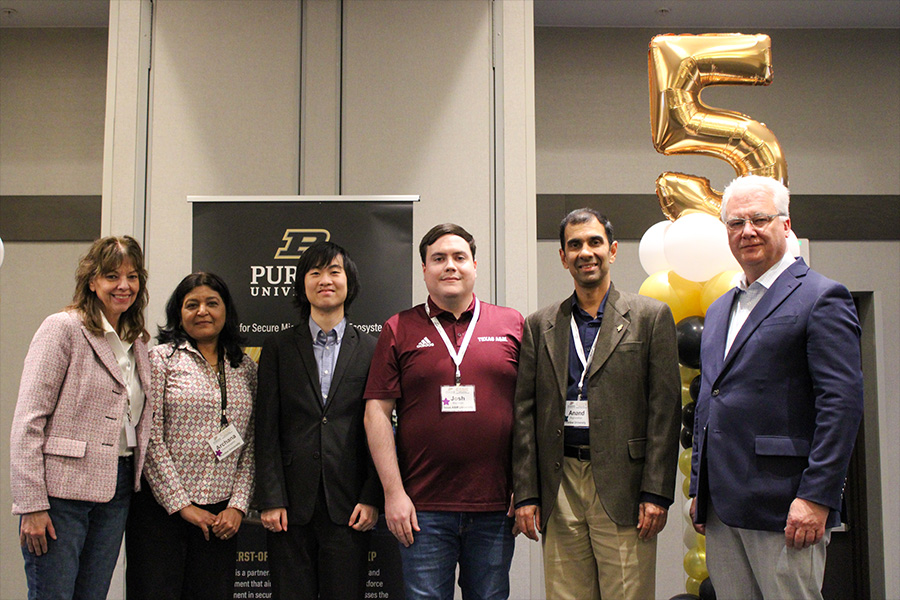
First place was awarded to Joshua Mashburn of Texas A&M University for his research, "Targeted Wearout Attacks in Microprocessor Cores" (advised by PIs Paul Gratz, Jeyavijayan Rajendran, and Jiang Hu). Second place went to Archana Dharanipragada of Purdue University for "An Intrinsic Odometer Approach for FPGA PLL Aging and Reliability Prediction" (advised by PIs Muhammad Ashraf Alam and Saeed Mohammadi). Third place was awarded to Hubert Liu of Worcester Polytechnic Institute for "A Post-Silicon Side-Channel Validation Framework for Cryptographic Accelerators" (advised by PI Patrick Schaumont).
The poster competition reflects a cornerstone of CSME's mission: developing a highly skilled domestic workforce equipped to protect future generations of semiconductor products. That goal aligns closely with SCALE (SCalable Asymmetric LIfecycle Engagement), a national workforce development program that prepares students for careers in defense microelectronics and the semiconductor industry. Through partnerships among universities, industry and government organizations, SCALE provides students with hands-on education and experience. Since 2021, CSME has supported 112 students across its partner institutions, with 58 currently active in cutting-edge research and hands-on laboratory experiences.
"CSME has done far more than fund our research: it has helped launch students, ideas, and careers," said Sandip Ray, Warren B. Nelms Endowed Professor at the University of Florida. "Behind every research result are students who were given the opportunity to pursue ambitious ideas, and CSME has provided that opportunity consistently over the last five years."
The meeting also highlighted CSME's strong momentum as it enters its second five-year chapter. TSMC reaffirmed its commitment to CSME with a five-year renewal of support, demonstrating sustained industry confidence in the center's collaborative model. CSME also welcomed special observers Jaesik Lee, VP of Package Engineering, and Sunghwan Hwang, PKG R&D Management Lead, from SK Hynix America, highlighting growing regional collaboration following SK Hynix's groundbreaking on an advanced packaging facility in the Purdue Research Park.
During the evening dinner, attendees heard brief remarks from Mark Lundstrom, John A. Edwardson Dean of Engineering and Chief Semiconductor Officer at Purdue, and Mikel Berger, President and CEO of Greater Lafayette Commerce. Berger emphasized the critical role of community, trust, and cross-sector relationships in creating a durable semiconductor hub. Addressing the students directly, he noted that through their research and work, they are not simply preparing to enter the industry someday but are already helping shape where it goes next.
As semiconductor complexity accelerates through 2.5D/3D packaging, AI-generated hardware, and heterogeneous architectures, CSME continues to evolve. With six new research projects launched this fall and deepened ties between academia, industry, and the defense community, the center remains committed to engineering security from the device level to the full system stack.