
Purdue ECE's Tongcang Li elected 2027 Optica Fellow
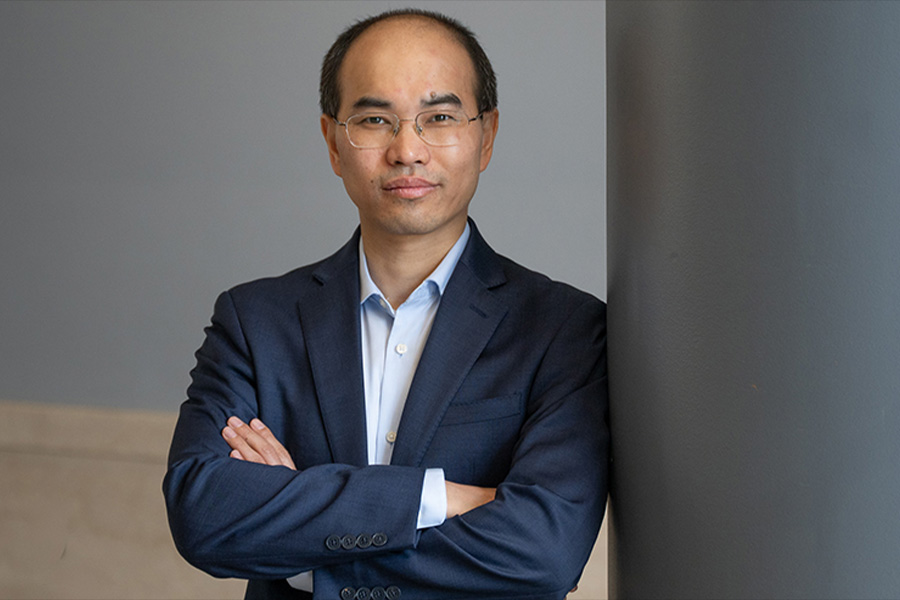
Optica has announced their 2027 Fellows class on October 23, 2026. Tongcang Li, of Purdue University, was elected a fellow for pioneering contributions to nanoscale optical quantum sensing using spin defects in two-dimensional materials and levitated optomechanics. Li is a professor in the Elmore Family School of Electrical and Computer Engineering and the Department of Physics and Astronomy in the College of Science. He is also director of the Center for Quantum Technologies, a National Science Foundation Industry-University Cooperative Research Center. He will be honored at an upcoming Optica conference.
"Congratulations to the 2027 Optica Fellows,” said Gisele Bennett, Optica's 2026 President. “These members exemplify excellence in our field. Their election by their peers is a testament to the significant contributions they have made and the impact of their work. We thank them for their dedication, service, and continued commitment to advancing our field."
Optica fellows are members who have served with distinction in the advancement of optics and photonics. Optica has elected 116 members from 23 countries to the Society’s 2027 Fellow Class.
“My research explores how light interacts with matter at the atomic and nanometer scales, with the goal of developing highly sensitive sensors and new quantum technologies,” said Li. “In particular, my work recognized by Optica focuses on optical detection and control of single nuclear spins in atomically thin materials, as well as using laser beams to trap and control microscopic particles for ultrasensitive measurements of forces, torque, motion, and other physical phenomena.”
Optica, Advancing Optics and Photonics Worldwide, is the Society dedicated to promoting the generation, application, archiving and dissemination of knowledge in the field. Founded in 1916, it is the leading organization for scientists, engineers, business professionals, students and others interested in the science of light.
“Becoming an Optica Fellow is a tremendous honor and an important recognition of our research,” said Li. “I am grateful to my students, collaborators, mentors, and colleagues, whose invaluable contributions and support over the years have made this achievement possible.”