
Purdue ECE research headed to space aboard Purdue 1 mission
A Purdue ECE-led quantum experiment could help pave the way for spacecraft to navigate without GPS
Purdue University is preparing to take research to new heights with Purdue 1, an all-Boilermaker spaceflight scheduled for 2027. Five astronauts will travel aboard a Virgin Galactic spacecraft, carrying five research experiments designed to advance technologies for future space exploration.
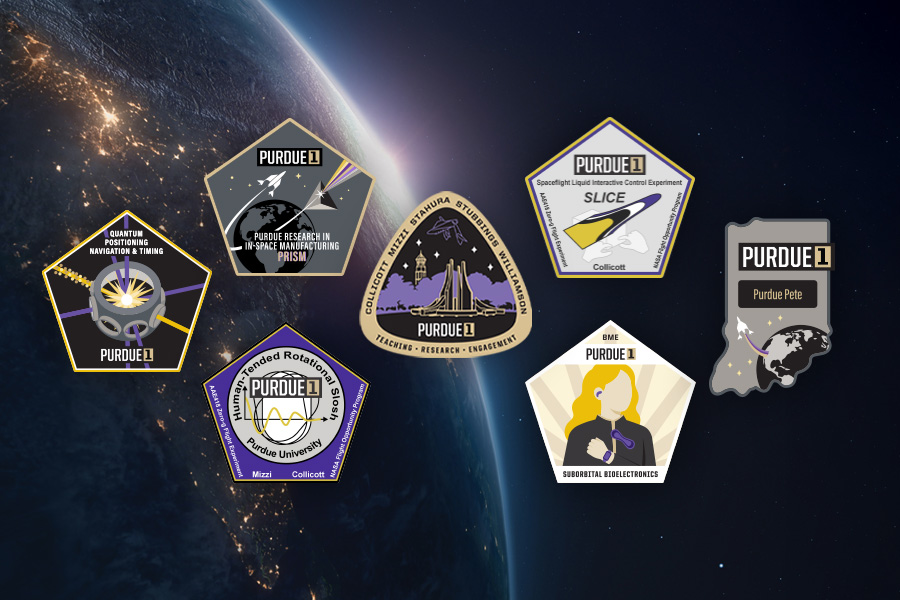
The experiments span everything from astronaut health and the behavior of liquids in space to advanced manufacturing and quantum technology. Each is represented by a specially designed mission patch highlighting the people and science behind the research.
Among those projects is an experiment led by Shengwang Du, the Scifres Family Professor in Purdue's Elmore Family School of Electrical and Computer Engineering (ECE), that could help spacecraft navigate when GPS isn't available.
Du's research focuses on quantum positioning, navigation and timing. His team uses lasers to cool atoms to extremely low temperatures, allowing researchers to control and measure their behavior with remarkable precision. The goal is to develop technologies that could eventually help spacecraft determine their position, movement and time without relying on GPS signals.
“Our Purdue 1 experiment is an early step toward future quantum positioning, navigation and timekeeping systems that could support navigation when GPS is unavailable, including on missions beyond Earth,” Du said.
The spaceflight will also provide an opportunity to learn how these delicate quantum technologies can operate under the challenging conditions of space travel.
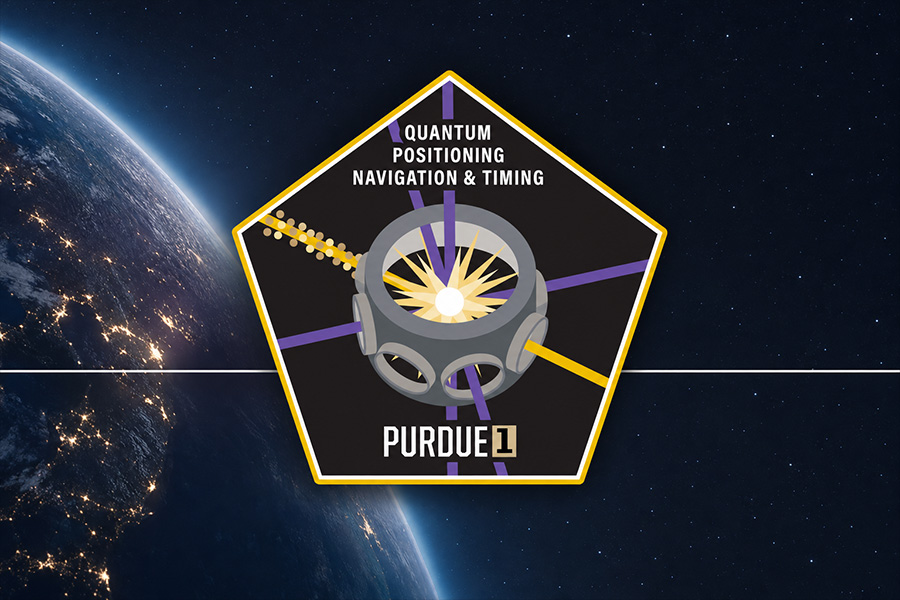
Du's experiment has its own Purdue 1 mission patch, featuring a vacuum chamber surrounded by purple laser beams and gold lines representing different functions of the lasers. The design celebrates the work of Purdue students, faculty collaborators and industry partner Infleqtion.
Read the full Purdue Engineering story to learn more about the Purdue 1 mission, its research experiments and the stories behind all seven mission patches.