
Purdue ECE professor helps spark a thriving semiconductor ecosystem in Bangladesh
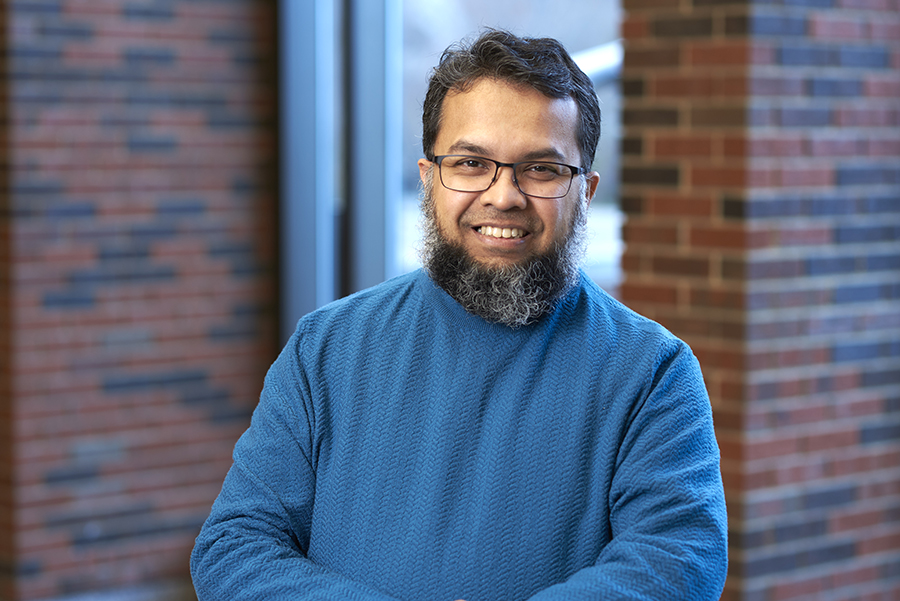
When Muhammad Mustafa Hussain talks about giving back, he means building something that lasts.
Born in Bangladesh and now a professor in Purdue University’s Elmore Family School of Electrical and Computer Engineering, Hussain has spent the past several years helping transform his home country into an emerging player in the global semiconductor landscape. What began as a personal commitment has grown into a coordinated national effort, linking universities, industry, government and the Bangladeshi scientific diaspora.
From vision to execution
Hussain is widely recognized as one of the architects of Bangladesh’s “Silicon River” vision, a national framework designed to integrate biotechnology, electronics, artificial intelligence and robotics into a single innovation ecosystem. The goal is not just education, but execution: building real research capacity, training a skilled workforce and attracting global industry partnerships.
A major milestone came in late 2025 with the launch of the Centre of Research Excellence in Semiconductor Technology (CREST) at BRAC University. The center serves as a national research hub focused on advanced semiconductor technologies, including AI-driven chip design, materials, packaging, testing and next-generation hardware platforms.
Speaking at the inauguration, Hussain emphasized that Bangladesh’s future would be defined not by population size, but by “impactful ideas, focused execution and the ability to build world-class technology.”
Building an ecosystem, not a single lab
Beyond CREST, Hussain has helped connect multiple pieces of the semiconductor pipeline. National initiatives now include workforce training programs, access to global-standard chip design tools, student fellowships and industry–academia partnerships. Events such as the BEAR Summit and National Semiconductor Symposium have drawn thousands of students, researchers, policymakers and representatives from leading global semiconductor companies.
A defining feature of the effort has been the active role of non-resident Bangladeshi scientists and engineers. Through mentorship, curriculum development and international collaboration, diaspora experts are helping ensure that Bangladesh’s semiconductor growth is globally connected and locally grounded.
Impact that reaches students and industry
The results are tangible. Graduate and undergraduate students across Bangladesh are now conducting advanced semiconductor research. Universities are aligning programs with industry needs. Private-sector partners are investing in local capability. And the country is beginning to position itself as a credible participant in the global semiconductor supply chain.
For Hussain, the work is deeply personal, but also deeply practical.
“This is about creating opportunity,” he said. “If we build the right ecosystem, talent will thrive, innovation will follow, and the impact will extend far beyond one generation.”
As Bangladesh’s semiconductor momentum continues to build, Hussain’s leadership stands as a powerful example of how global expertise, and a strong connection to home, can help shape the future of technology on a national scale.