
Purdue–Anello collaboration advances broadband light modulation on silicon nitride photonic chips
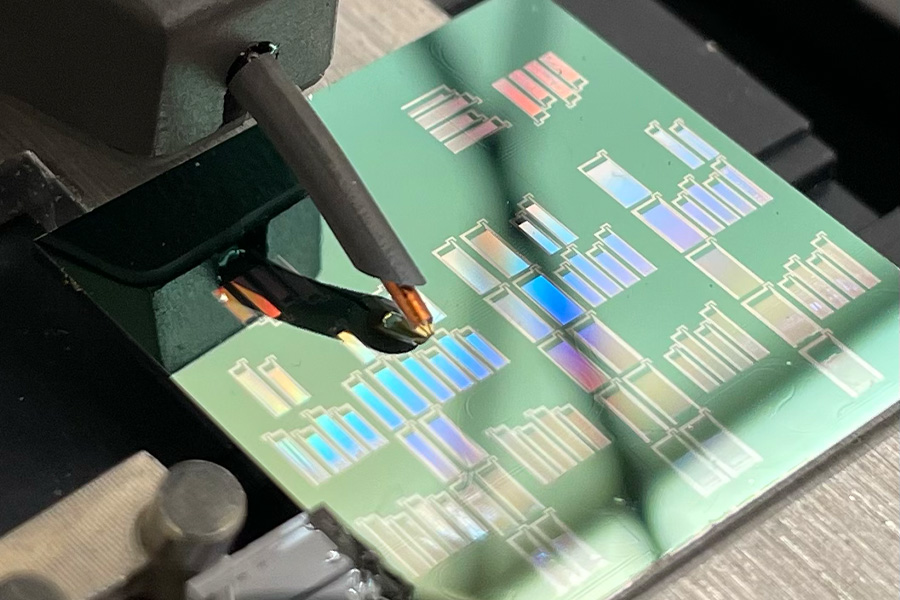
Researchers from Purdue University and Anello Photonics have demonstrated a new way to control light on silicon nitride photonic chips, overcoming a long-standing challenge in integrated optics. The work, led by Scott Kenning, a PhD student in the Elmore Family School of Electrical and Computer Engineering, was done in collaboration with Purdue Distinguished Science Alum Dr. Mario Paniccia and the Anello Photonics R&D team, and presents a compact acousto-optic modulator that achieves strong and broadband modulation performance without compromising the ultra-low-loss benefits of silicon nitride.
The findings are documented in a paper recently published in Nature Communications.
A new solution to a decades-old photonics challenge
Silicon nitride is one of the most widely used materials in integrated photonics because of its ability to guide light with ultra-low optical losses across a wide optical transparency window. This property makes it ideal for integrated lasers, inertial sensors, and miniaturized optical-atomic clocks. However, the techniques and material properties that enable these applications preclude a crucial component: on-chip phase modulators.
“High frequency, optically broadband phase modulators are a crucial part of the control loops in emerging applications for photonic chips,” Kenning said. “Previously, there was no on-chip option and many cutting-edge applications have been inhibited through reliance on bulk components or complicated heterogeneous integration techniques.”
The Purdue–Anello team approached the problem from a new direction that complements the ultra-low optical losses of silicon nitride. The inherent difficulty of modulating silicon nitride waveguides can be compensated for by substantially increasing the length over which the light passes through a single acoustic wave. This extended interaction is achieved with geometrically optimized spirals, which pass the light through a single acoustic wave up to 38 times. With correctly optimized geometry, the modulation strength can be multiplicatively increased without requiring complicated fabrication procedures that often reduce yield, drive up cost, and increase optical losses.

According to the research, the modulators:
- maintain broadband optical performance across more than 90 nanometers,
- operate at frequencies up to 704 megahertz,
- achieve strong phase modulation with low insertion loss, and
- function entirely within an unreleased, foundry-compatible silicon nitride platform.
These results present a “plug-and-play” on-chip modulator and open the door to near-term miniaturization of devices previously reliant on bulk optical components.
“The architecture developed here represents a meaningful advancement for next-generation optical sensors and silicon nitride photonics in general,” Paniccia said. “It offers a straight-forward path toward high-performance photonic systems in real-world applications.”
Demonstrated impact on sensing and laser control
To show the modulators’ practical value, the team utilized them as part of an optomechanical accelerometer. They demonstrated how the new modulator architecture can be used as part of a Pound-Drever-Hall lock—a ubiquitous technique in optical physics reliant on phase modulators that is also utilized in state-of-the art optical and atomic clocks—to read out the accelerometer.
This demonstration highlights the potential for fully integrated photonic inertial measurement units, next-generation navigation systems, and other compact photonic systems.
About the publication
The full study, “Broadband acousto-optic modulators on Silicon Nitride,” is available in Nature Communications and details the device design, operating principles, experimental demonstrations, and implications for future integrated photonic systems.
Research was sponsored by the Army Research Laboratory with SEMI-PNT.
Source: Broadband acousto-optic modulators on Silicon Nitride