
Purdue researcher Nicholas Chimitt earns IEEE Signal Processing Society Best PhD Dissertation Award
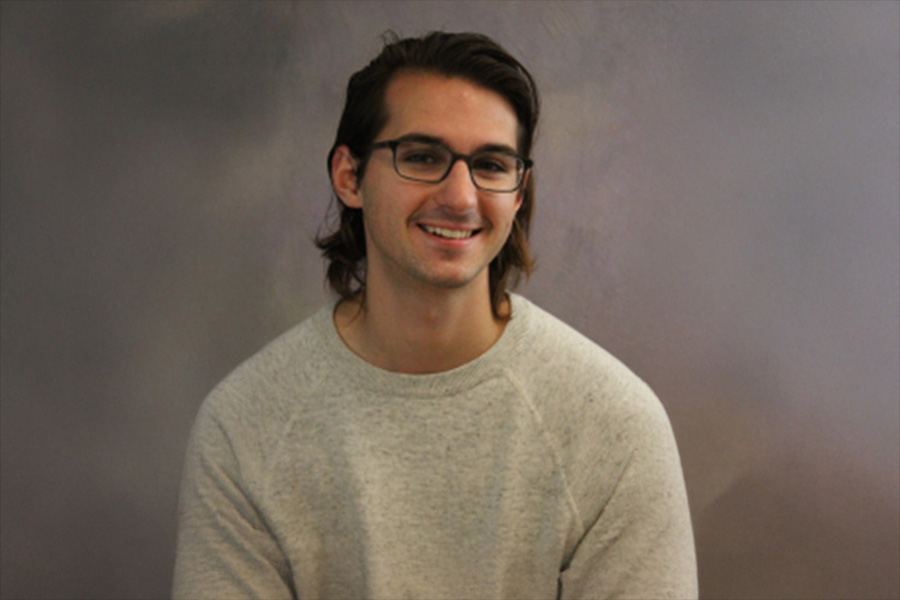
Nicholas Chimitt, a research scientist at Purdue University, has received the IEEE Signal Processing Society Best PhD Dissertation Award, one of the society’s highest honors recognizing exceptional doctoral research in the field of signal processing.
Chimitt earned his PhD from Purdue’s Elmore Family School of Electrical and Computer Engineering in 2023 under the supervision of Stanley H. Chan, Elmore Professor of Electrical and Computer Engineering. His award-winning dissertation, Computational Imaging Through Atmospheric Turbulence, addresses a challenge familiar to anyone who has tried to photograph an object over long distances: the blurring and distortion caused by air in motion.
“Receiving the IEEE Signal Processing Society Best PhD Dissertation Award is a tremendous honor,” Chimitt said. “There was a very conscious effort to map imaging through turbulence into a signal processing framework, which makes this recognition especially meaningful. I’m grateful to the mentors, collaborators and colleagues who contributed to this work, and to the Purdue research community that made it possible.”
When light travels through the atmosphere, small fluctuations in temperature and air density bend and delay it in subtle ways. Over long distances, those effects add up, producing images that appear warped or unstable, similar to the visual shimmer seen above hot pavement. Chimitt’s research focuses on developing fast, accurate computational tools to model and correct these distortions, making it possible to recover clearer images from degraded data.
At the heart of his work is a new simulation framework that translates the physics of atmospheric turbulence into a signal-processing-based model. This approach allows researchers to generate realistic training data for modern image reconstruction algorithms, including machine learning methods, at speeds far faster than traditional optical simulations. The result is a practical bridge between classical physics and today’s data-driven imaging techniques.
“Nick’s doctoral dissertation is the best representation of physical AI and has an enormous impact on future long-range imaging systems for robotics, autonomy, space missions and biometrics,” Chan said. “He is creating a new chapter of imaging through atmospheric turbulence, moving from the classical physics-only regime to a hybrid physics-neural regime. Because of the differentiable forward imaging models Nick brought to the field, researchers can now integrate atmospheric turbulence simulators into deep learning to develop learning-based image restoration algorithms.”
Beyond its theoretical contributions, the research has real-world implications. Improved imaging through turbulence can benefit applications ranging from remote sensing and surveillance to scientific imaging and astronomy, where clear visuals are critical but atmospheric conditions cannot be controlled.
The IEEE Signal Processing Society Best PhD Dissertation Award recognizes dissertations that demonstrate exceptional scientific impact and overall quality, including originality, rigor, publication influence and relevance to the field. Chimitt’s selection highlights both the impact of his research and Purdue ECE’s strength in computational imaging and signal processing. Chimitt’s PhD dissertation has been expanded into a book, published by Now Publisher in 2023. A free online copy can be downloaded at https://arxiv.org/abs/2411.00338.