
Purdue ECE seniors help reimagine in-flight Wi-Fi through industry-sponsored design project
Reliable in-flight Wi-Fi has become an expectation for travelers, whether they’re sending a last-minute work email, streaming a movie or making a video call at 35,000 feet. But delivering fast, seamless internet access in the air is far more complex than it looks.
A team of seniors from Purdue University’s Elmore Family School of Electrical and Computer Engineering tackled that challenge through an industry-sponsored senior design project with global satellite operator SES, developing new software-based approaches to make in-flight connectivity faster, smoother and more reliable.
The student team — James Mareachen, Seth Eom, Andrew Schlabach, Benjamin Sykes and Christopher Tan — focused on improving how aircraft route internet traffic through satellites while in flight. Their work explored how planes can intelligently route traffic between different satellite networks to reduce lag, avoid dropped connections and make better use of available bandwidth.
“In simple terms, we’re figuring out the best way to use multiple satellite ‘pipes’ instead of forcing everything through just one,” said Benjamin Sykes, a graduating electrical engineering senior. “Some internet traffic needs to be fast right now, like a FaceTime call, while other things, like streaming a video, can be handled differently without the user ever noticing.”
To test their ideas, the students built a custom simulation environment that mirrored real airline internet use, from video streaming and social media to business communications and research-heavy browsing. Their results showed that smarter, software-driven routing could significantly improve performance without adding unnecessary complexity or cost, a finding with direct implications for commercial aviation.
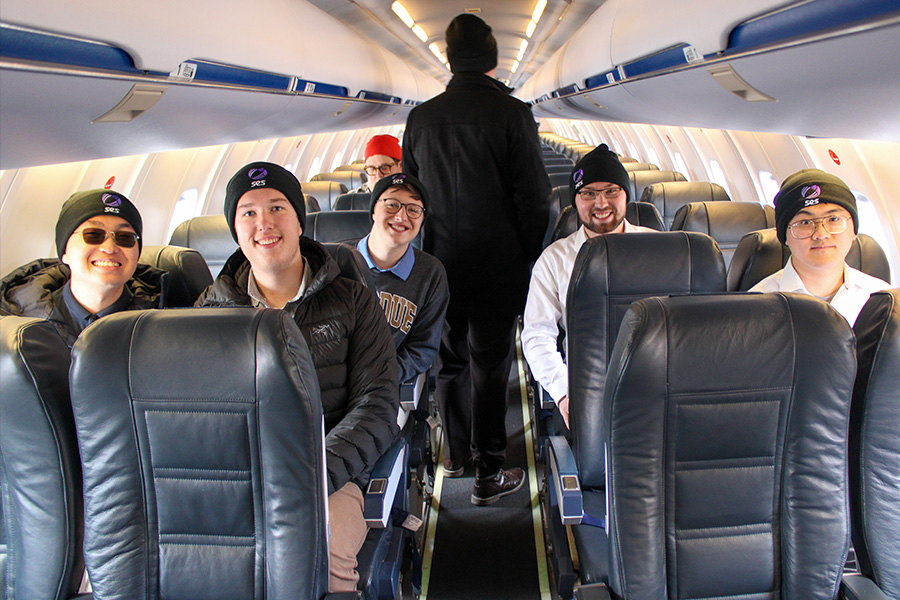
The project came to life during an in-flight demonstration, when SES brought a test aircraft to Purdue to show the students how their work would ultimately be used. The team tested live video calls and internet applications while airborne, seeing firsthand how their software performed in a real-world environment.
“Seeing something you built actually work in the real world is incredibly rewarding,” said Sykes.
For SES, the project addressed a pressing industry need. Traditional in-flight Wi-Fi systems typically rely on a single type of satellite, which can limit speed and capacity, especially in high-traffic areas.
“By using multiple satellite orbits, you get improved latency, increased capacity and a much better passenger experience,” said Patrick Walsh, senior vice president of engineering at SES. “But those orbits all behave very differently, and traditional networking solutions aren’t optimized for that. This project was about developing smarter ways to route traffic and take advantage of each link’s strengths.”
Walsh, a Purdue engineering alumnus, said working with the students reinforced the value of hands-on, industry-connected education.
“This was a real-world project solving a real problem we’re working on today at SES,” he said. “The students brought energy, creativity and novel ideas, and in some cases, they thought of things we hadn’t. That’s exactly what you want to see from the next generation of engineers.”
For the students, the experience highlighted one of the biggest advantages of industry-sponsored senior design projects: exposure to professional engineering expectations long before graduation. Weekly meetings with SES engineers gave the team regular feedback, encouraged iteration and helped bridge the gap between classroom theory and deployed technology.
“This wasn’t just a class assignment,” Sykes said. “We were working on something that’s going to be used by real people, on real airplanes. That changes how you think about engineering.”
SES has expressed interest in continuing its partnership with Purdue, including future demonstrations and deeper collaboration with ECE, the College of Engineering and university leadership.
For the students involved, the project offered more than a capstone requirement, it offered a glimpse into the impact they can have as engineers.
“When industry and education come together like this,” Sykes said, “you realize just how far a senior design project can go.”