BME News

November 7, 2013

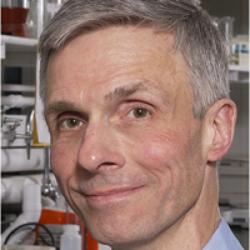
Pedro Irazoqui's group chosen as one of four preeminent teams

Purdue University's College of Engineering has named four research teams that will be a priority for faculty hiring during the coming year. The teams were chosen because the work they do has the potential for dramatic impact and international pre-eminence. They are part of the college's strategic growth plan that will add as many as 107 faculty over five years.
October 31, 2013

Drug may reduce chronic pain for spinal cord injuries

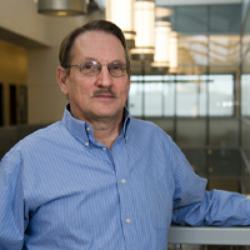
Researchers, including Weldon School's Riyi Shi, have discovered that a known neurotoxin may cause chronic pain in people who suffer from paralysis, and a drug that has been shown to remove the toxin might be used to treat the pain.

October 29, 2013

Collagen-Based Medical Products Are Subjects of Proposed New ASTM Standard

Sherry Voytik-Harbin serves as the technical expert for a proposed new ASTM International standard that will be used in the design, development, quality control and comparison of a variety of collagen-based medical products, including surgical implants, delivery vehicles for therapeutic cells or molecules and substrates for tissue engineered medical products.
October 15, 2013

Device speeds concentration step in food-pathogen detection

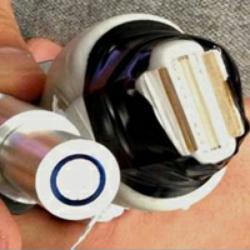
Researchers, including Weldon School's Michael Ladisch, Kirk Foster, and Jim Jones, have developed a system that concentrates foodborne salmonella and other pathogens faster than conventional methods by using hollow thread-like fibers that filter out the cells, representing a potential new tool for speedier detection.

October 14, 2013

David Umulis Inducted into Purdue Teaching Academy

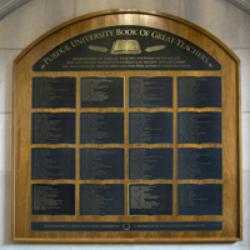
The Purdue University Teaching Academy welcomed Assistant Professor David Umulis, along with 12 additional new members, in an induction and recognition ceremony. The Academy recognizes outstanding Purdue faculty and staff who contribute to the learning environment.
October 2, 2013

Cell-detection system promising for medical research, diagnostics

Researchers are developing a system that uses tiny magnetic beads to quickly detect rare types of cancer cells circulating in a patient's blood, an advance that could help medical doctors diagnose cancer earlier than now possible and monitor how well a patient is responding to therapy.

September 23, 2013

Eugenio Culurciello Authors Book

Eugenio Culurciello, an associate professor of biomedical engineering at Purdue University, has authored a book entitled "Biomedical Circuits and Systems," a field that requires an interdisciplinary background ranging from electrical engineering to biology and neuroscience.
< Previous 10 | Viewing 951 to 960 of 1501 | Next 10 >