
Seminars in Hearing Research, October 5
| Event Date: | October 5, 2023 |
|---|---|
| Hosted By: | Speech, Language and Hearing Sciences |
| Time: | 12:00 noon |
| Location: | Nelson Hall, Room 1215 |
| Priority: | No |
| School or Program: | Non-Engineering |
| College Calendar: | Show |
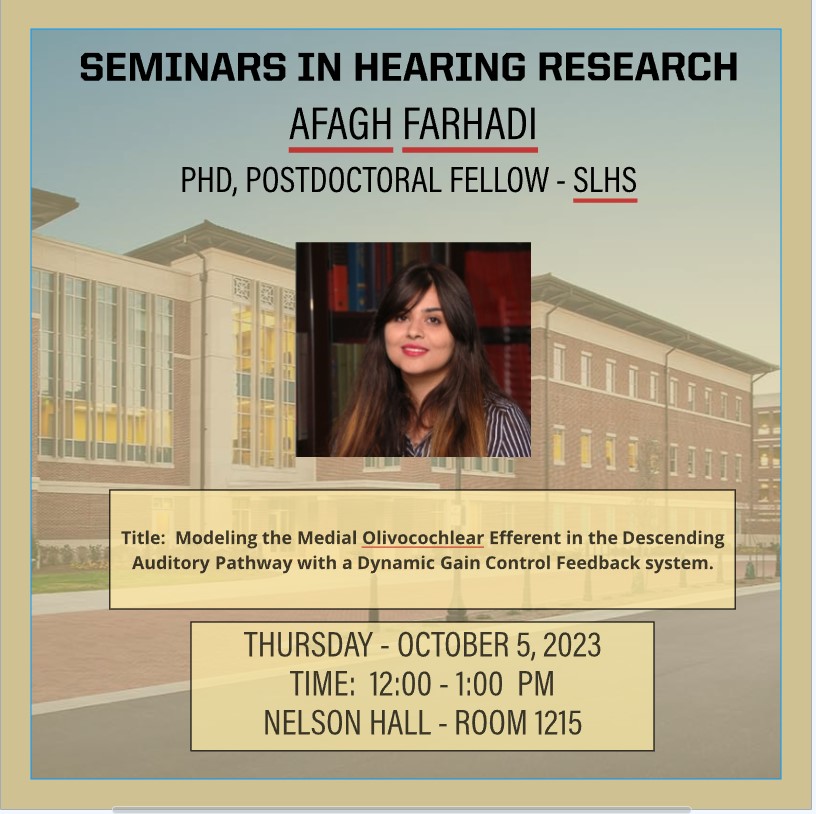
Abstract: Computational modeling is a powerful tool in hearing research, as it helps to test hypothesis regarding the underlying mechanisms involved in different auditory scenes, including speech in noise. The medial olivocochlear (MOC) efferent system is suggested to play a crucial role in enhancing auditory processing in noisy backgrounds. The MOC system is a part of the descending auditory system that includes pathways that ultimately project to the outer hair cells (OHCs) in the cochlea, which are responsible for cochlear amplification. Auditory models have mostly been focused on the ascending pathway of the auditory system, which is responsible for transmitting sensory information from the cochlea to higher areas. However, the descending pathway or efferent system has received relatively little attention. The subcortical auditory model proposed in this study incorporated a feedback projection from MOC neurons which dynamically adjusted cochlear gain based on inputs received by the MOC. The two primary inputs to the MOC that were examined in the model were the projections from wide-dynamic-range cells in the cochlear nucleus, and the fluctuation-driven information from IC cells in the midbrain. The model parameters were optimized using neural recordings from IC cells in awake rabbits responding to AM noise. The model with efferents and the optimized set of parameters successfully simulated the trend observed in recorded neural responses, whereas the model without efferent did not simulate the same trend. The optimized parameters also matched the physiological evidence for the dynamics of the MOC efferent system. The proposed model with efferents was tested using several psychoacoustical detection experiments and was found to predict human listener thresholds better than the model without efferents. These results demonstrate the significance of the efferent system in analyzing the mechanisms underlying various psychoacoustic phenomena, including not only simultaneous masking but also forward masking and auditory enhancement. Finally, using the proposed model, the effect of MOC efferent activity on the neural coding of speech-like signals was explored. Simulation results demonstrated that the efferent system enhanced neural fluctuation patterns for vowel-like sounds, which can potentially improve speech perception.
This year’s SHRP schedule is available here: https://purdue.edu/TPAN/hearing/shrp_schedule
Titles and abstracts of all SHRP talks are here: https://purdue.edu/TPAN/hearing/shrp_abstracts
2023-10-05 12:00:00 2023-10-05 13:00:00 America/Indiana/Indianapolis Seminars in Hearing Research, October 5 Afagh Farhadi, Postdoctoral Fellow in SLHS will present "Modeling the Medial Olivocochlear Efferent in the Descending Auditory Pathway with a Dynamic Gain Control Feedback System" on Thursday, October 5, 12:00 noon in Nelson Hall, Room 115 as part of the Seminars in Hearing Research. Nelson Hall, Room 1215