
Purdue researchers uncover unexpected changes in tungsten under extreme radiation
Findings could help improve materials for future fusion energy systems
WEST LAFAYETTE, Ind. — Researchers in Purdue University's School of Materials Engineering have discovered that extreme radiation and heat can change tungsten in ways scientists did not previously expect, offering new insights into materials being developed for future fusion energy reactors.
The team's findings, recently published in Materials Today, challenge a long-held understanding of how tungsten responds to radiation. Rather than simply accumulating damage over time, the material can undergo localized structural changes at the atomic level when exposed to radiation and high temperatures.
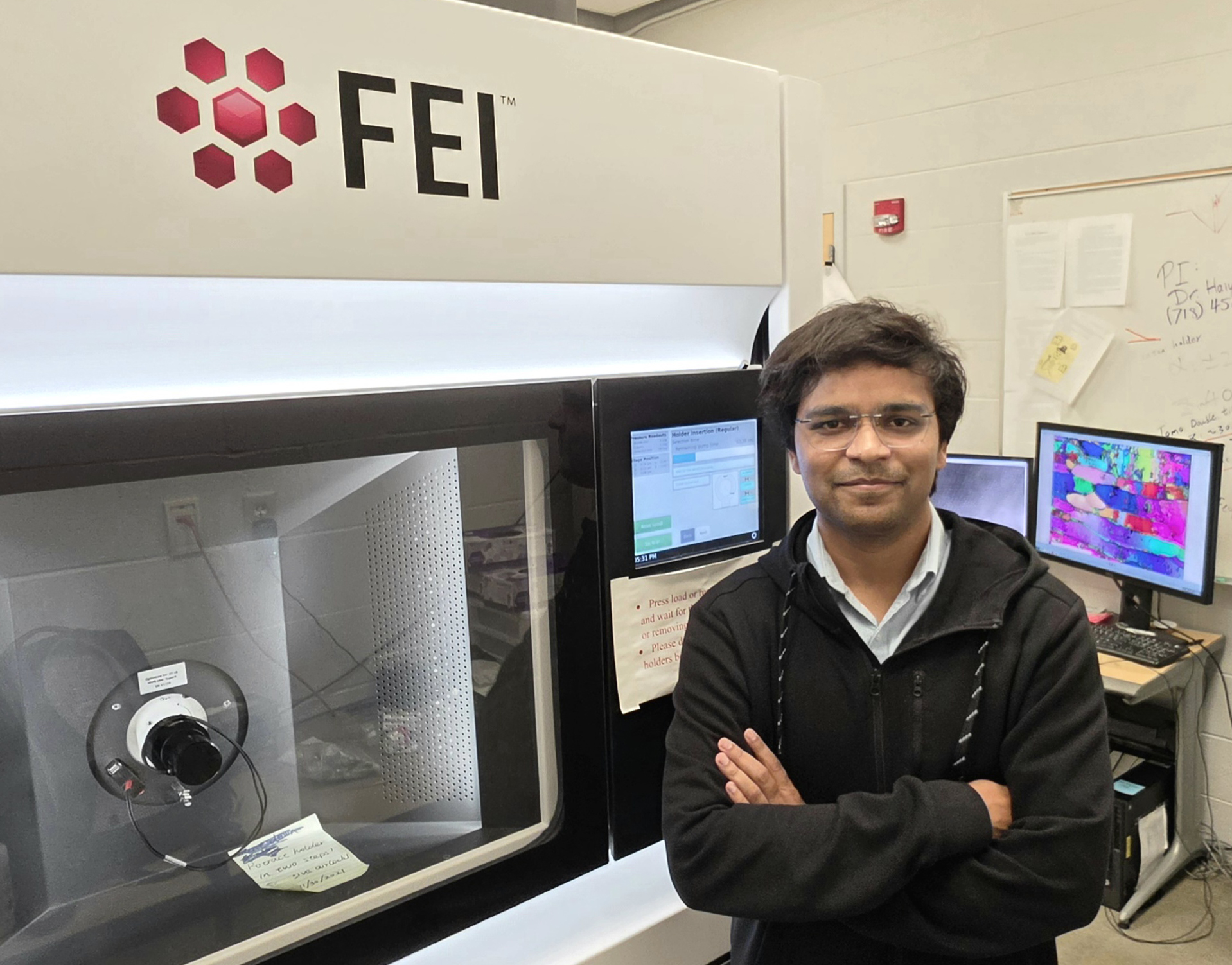
Purdue MSE PhD candidate Adil Wazeer from Prof. Xinghang Zhangs lab performs transmission electron microscopy experiments on a Talos 200X TEM at the Purdue Electron Microscopy Center.
"Tungsten is one of the most promising materials for future fusion reactors because it can withstand incredibly harsh conditions," said Xinghang Zhang, professor of materials engineering at Purdue. "What surprised us is that radiation appears capable of doing more than creating defects. Under certain conditions, it can actually change the material's local structure."
Scientists have long studied how radiation affects materials by creating tiny defects within them. Those defects can gradually alter a material's properties and performance. Purdue researchers wanted to understand whether radiation could cause even more fundamental changes, particularly in areas where damage tends to accumulate.
To investigate, the team observed tungsten in real time while it was exposed to radiation at high temperatures. Their experiments revealed evidence of small-scale structural transformations that had not previously been associated with tungsten under these conditions.
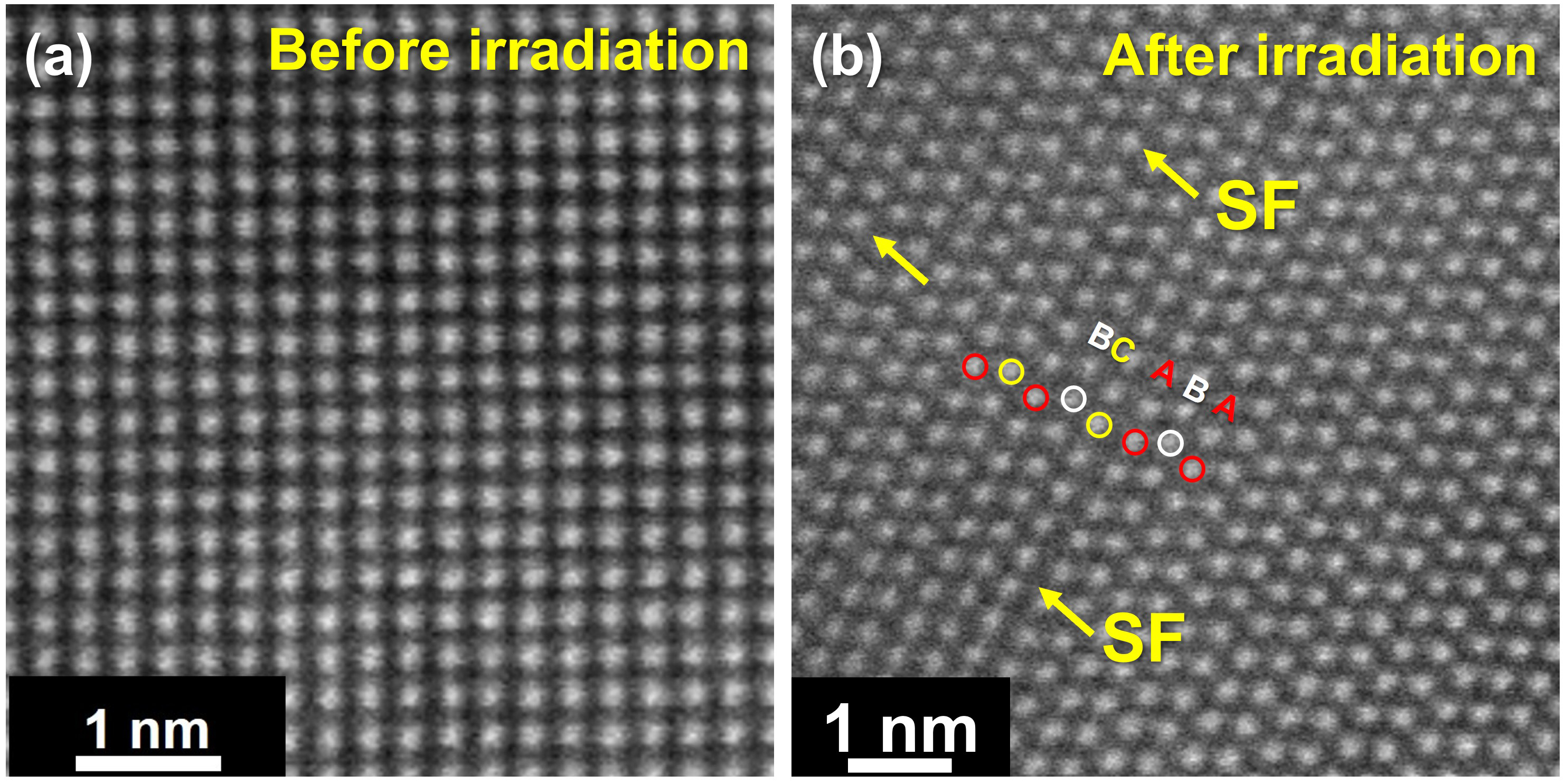
The ordered tungsten lattice before irradiation (left) develops defects known as stacking faults after irradiation (right).
The discovery is significant because tungsten is expected to play an important role in future fusion energy systems. Fusion reactors are designed to recreate the same process that powers the sun, but doing so requires materials capable of enduring intense heat, radiation and other extreme operating conditions.
"If the internal structure of tungsten changes over time, it could influence how the material performs in a reactor environment," Adil Wazeer said, who is Zhang’s graduate student and the first author of the article. "Understanding those changes is critical for designing materials that can operate safely and reliably for long periods."
Beyond fusion energy, the findings could provide broader insights into how materials behave in extreme environments. Researchers say the work may help engineers develop more resilient materials for a variety of advanced energy and nuclear technologies.
The study also highlights the importance of interactions between radiation damage and impurities such as oxygen. The researchers found that defects created by radiation and small amounts of oxygen can work together to promote structural changes that otherwise would not occur.
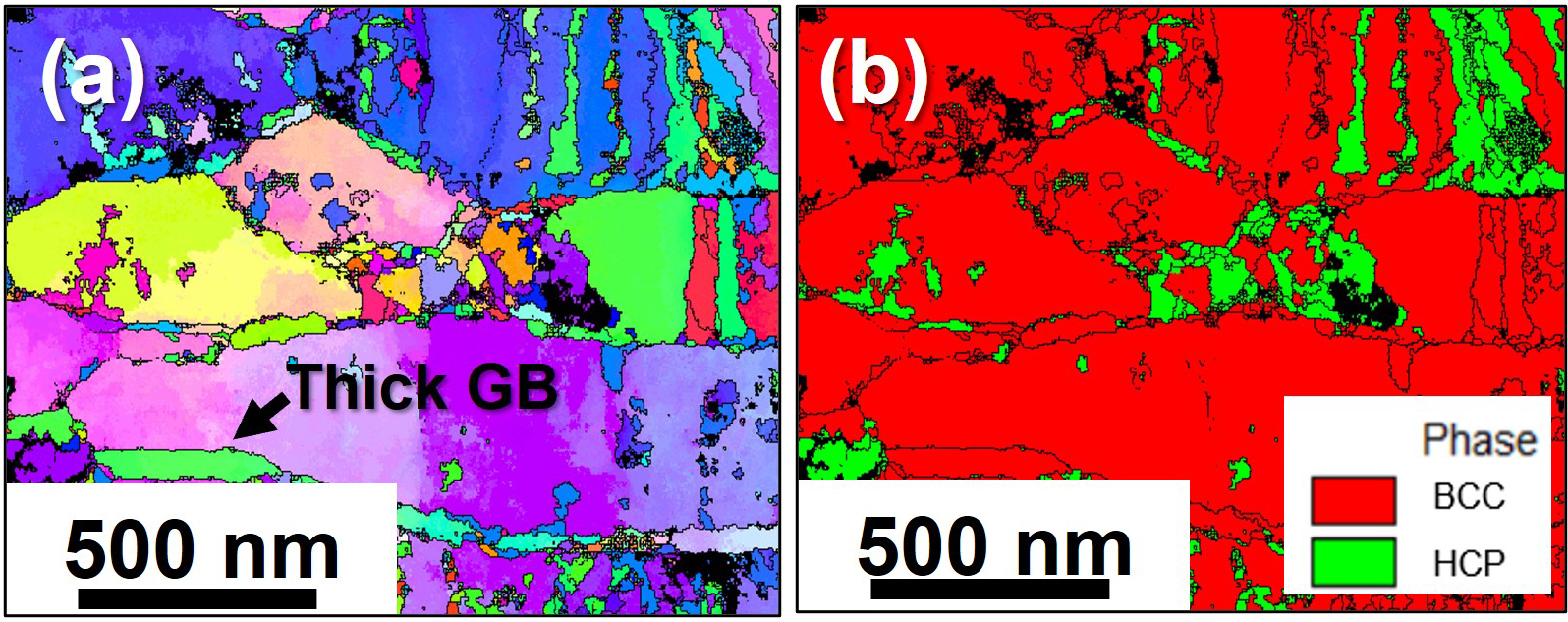
(a) Inverse Pole Figure mapping reveals substantial grain restructuring and thickened grain boundaries following irradiation. (b) Phase mapping identifies regions of the normal BCC tungsten structure (red) alongside localized HCP-like regions (green).
"What excites us most is that we observed something beyond the conventional understanding of radiation damage in tungsten," Zhang said. "The results open new questions about how materials behave under extreme conditions and how we can use that knowledge to design better materials for future technologies."
The research relied on advanced microscopy and characterization tools that allowed scientists to examine tungsten at the atomic scale. Purdue facilities provided critical capabilities for analyzing changes in the material and understanding how those changes evolved during irradiation.
The irradiation experiments were conducted at Argonne National Laboratory's Intermediate Voltage Electron Microscope-Tandem Facility, while Purdue researchers led much of the advanced characterization and analysis. The work was conducted in collaboration with experts in AI from the Department of Computer Science (Prof. Yexiang Xue) and School of Mechanical Engineering (Prof. Guang Lin), fusion materials at Oak Ridge National Laboratory (Drs. Xiao-Ying Yu and Tim Graening), density function theory at University of Michigan (led by Prof. Fei Gao), and transmission electron microscopy from the School of Materials Engineering (Prof. Haiyan Wang).
Next, the team plans to investigate the conditions that trigger these structural changes and determine how they affect properties such as strength, heat transfer and long-term durability. Researchers also hope to learn whether similar behavior occurs under conditions even closer to those expected in future fusion reactors.
The research was supported by the U.S. Department of Energy Office of Fusion Energy Sciences. Michael Halfmoon served as the program manager for the project.
In situ studies on heavy ion irradiation and partial oxidation induced stacking faults and nanograins in tungsten nanolaminates, Adil Wazeer, Debargha Paul, Xuanyu Sheng, Lihao Shi, Yinghang Liu, Zhongxia Shang, Chang Xia, Vaibhav Singh, Wei-Ying Chen, Fei Gao,
Haiyan Wang, Yexiang Xue, Guang Lin, Tim Graening, Xiao-Ying Yu, Xinghang Zhang, Materials Today, 100 (2026) 103494. https://www.sciencedirect.com/science/article/pii/S1369702126003408; DOI: 10.1016/j.mattod.2026.103494
ABOUT THE SCHOOL OF MATERIALS ENGINEERING
The Purdue University School of Materials Engineering is a global leader in education, research, and innovation across all major classes of engineered materials.
As part of the 3rd ranked College of Engineering, our students, faculty, and industry partners are advancing materials and manufacturing for Aerospace, Computing, Health, Energy, Infrastructure, and Extreme Environments. Learn more at Purdue School of Materials Engineering.