Purdue researchers create transistor that learns more like the human brain
Purdue-led research demonstrates dual-memory transistor that could enable faster, more efficient edge AI using existing semiconductor manufacturing processes
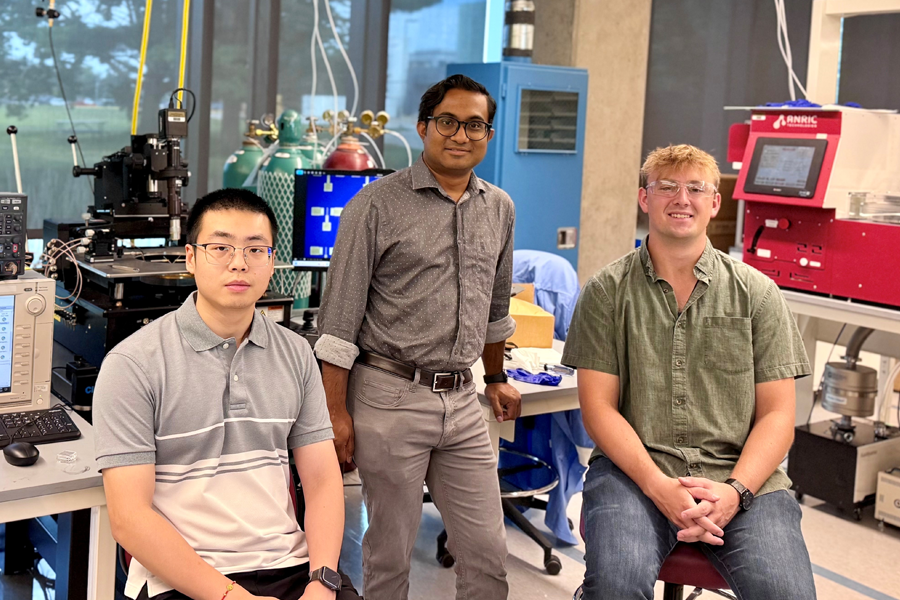
From left to right: Yifan Wang, a second-year PhD student in Purdue University's Elmore Family School of Electrical and Computer Engineering; Raisul Islam, assistant professor in the School of Materials Engineering and, by courtesy, the Elmore Family School of Electrical and Computer Engineering; and Noah Vaillancourt, a second-year master's student in the School of Materials Engineering, pose in Principal Investigator Raisul Islam's lab in the FLEX Building.
Researchers at Purdue University have demonstrated a new type of silicon transistor that can store and process two forms of memory simultaneously, a breakthrough that could help bring brain-inspired AI hardware from the laboratory into real-world devices.
The research, led by Raisul Islam, assistant professor in Purdue University's School of Materials Engineering and, by courtesy, the Elmore Family School of Electrical and Computer Engineering, demonstrates how a single CMOS-compatible transistor can combine long-term and short-term memory while allowing one to control the other. The work introduces a compact, manufacturable building block for next-generation AI systems designed to process time-dependent information such as speech, heart rhythms, vibration signals and sensor data.
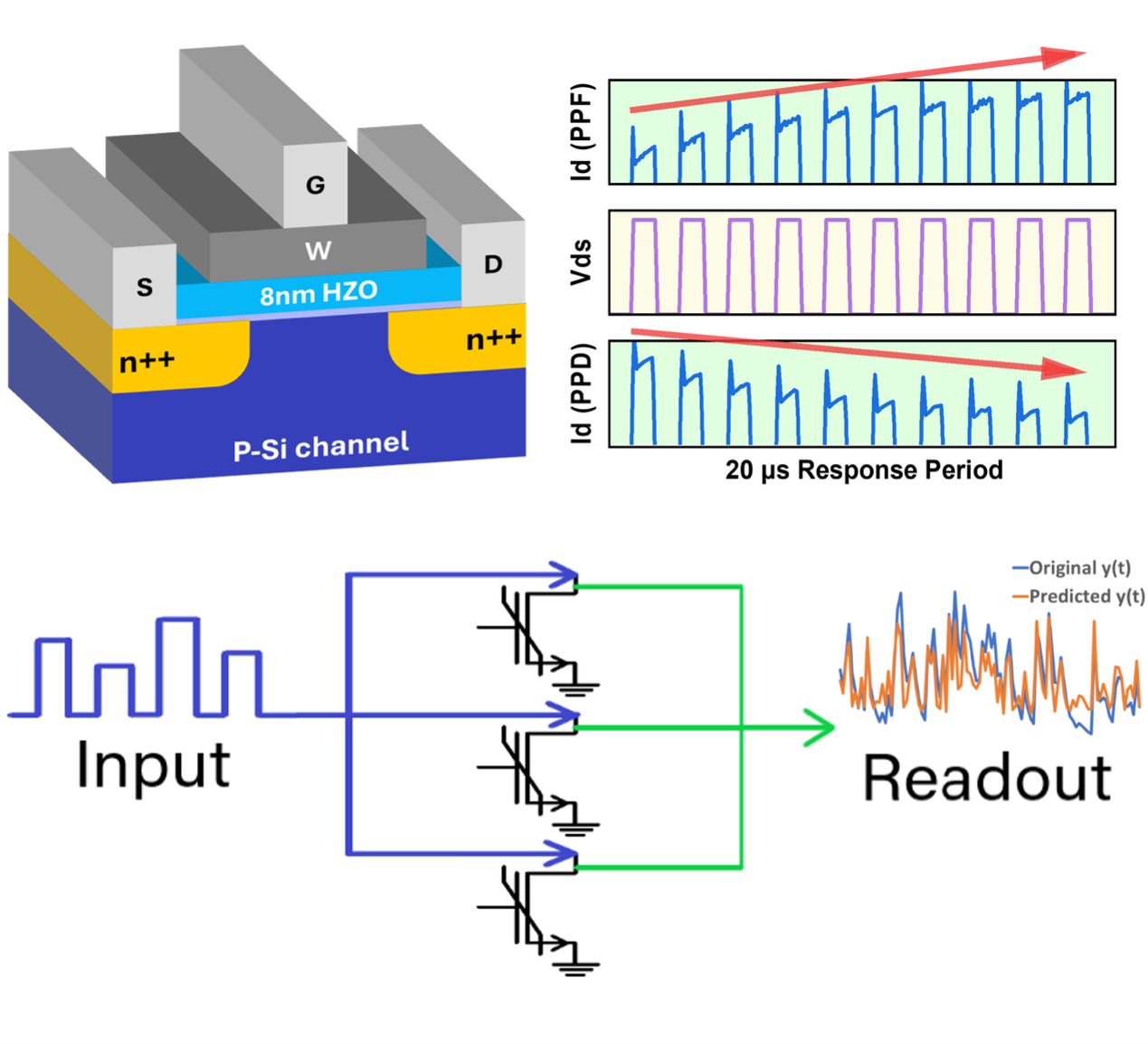
At the heart of the discovery is a ferroelectric field-effect transistor (FeFET) built using materials already common in commercial semiconductor manufacturing. The device contains a long-term, nonvolatile memory that remains stored even when power is removed, alongside a volatile short-term memory that fades within microseconds.
"What makes this device unique is not simply that it contains two different forms of memory," Islam said. "The more important result is that the nonvolatile memory can program how the short-term memory behaves. In neuroscience, this concept is known as metaplasticity, which is essentially the brain's ability to regulate how easily it learns in the future."
Metaplasticity is considered one of the mechanisms that allows the human brain to remain adaptable without constantly overwriting previously learned information. Rather than changing a connection's strength directly, it influences how readily that connection can strengthen or weaken in response to future experiences.
"One of the remarkable aspects of the brain is that it can continuously learn while preserving what it already knows, all within a power budget of roughly 20 watts," Islam said. "Our device reproduces an important aspect of that behavior in a CMOS-compatible silicon platform."
The designed transistor combines a lasting memory with a brief, fading memory, similar to the way a brain cell can be influenced by both past experience and recent activity, enables a physical reservoir computer that solves complex temporal tasks 1000 faster and at significantly lower energy " advancing efficient edge AI.
The discovery emerged from an unexpected source. Engineers have traditionally treated gate-to-source and gate-to-drain overlap capacitance as a parasitic effect that slows transistor performance and should be minimized. Instead, the Purdue-led team intentionally explored whether that overlooked characteristic could be useful.
They found that the overlap capacitance creates a transient, short-term memory effect that operates on a microsecond timescale. More importantly, the transistor's ferroelectric state determines how the short-term memory responds to incoming signals. Under identical operating conditions, one memory state produces a strengthening response while another produces a weakening response.
"The useful function was found in something the field has spent decades trying to eliminate," Islam said. "The overlap capacitance is described as a parasitic in every device textbook. We showed that, when engineered intentionally for the right application, it becomes a tunable memory resource at no additional process cost."
The advance addresses a major challenge in edge AI. Many modern AI applications must analyze data that evolves over time, including electrocardiograms, voice commands, industrial sensor signals and robotic feedback systems. Conventional recurrent neural networks can perform these tasks effectively but often require significant computational resources and energy.
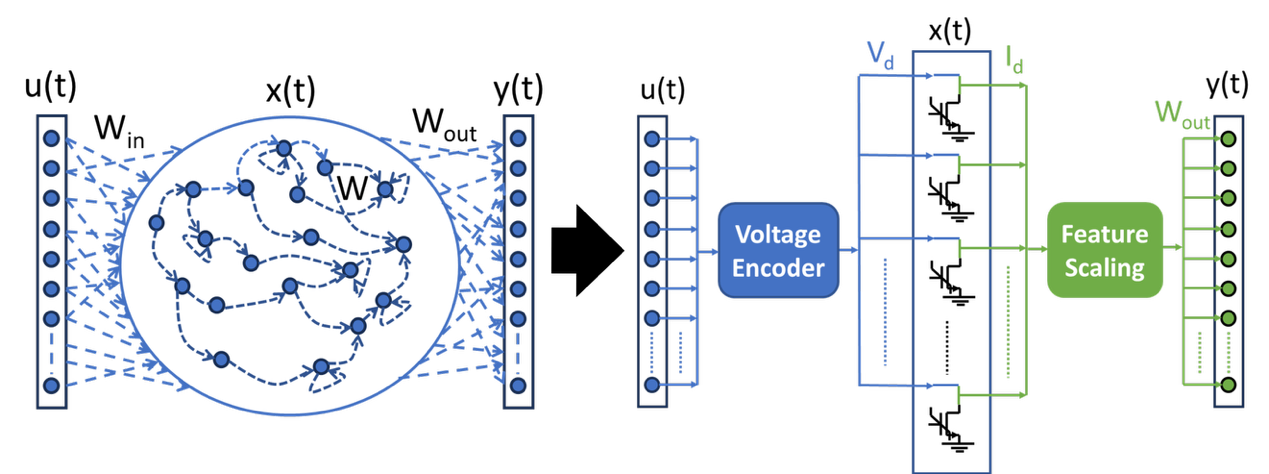
The Purdue team's approach leverages a framework known as physical reservoir computing, which uses the natural dynamics of a physical device as the computing system itself. Because only a small output layer requires training, reservoir computing dramatically reduces computational overhead, making it attractive for battery-powered and resource-constrained applications.
Using an array of just 16 devices, the researchers demonstrated rapid processing of a nonlinear dynamic task with a response time of just 20 microseconds while consuming very little energy. Compared to physical reservoir computing systems previously reported for similar tasks, Professor Islam’s new system achieved substantially faster response times and required fewer reservoir states.
The findings could have implications across multiple industries. Potential applications include wearable and implantable medical devices that analyze cardiac rhythms locally, always-on voice-recognition systems, predictive maintenance sensors for industrial equipment, and low-latency control systems for robotics and autonomous platforms.
Because the device relies on silicon, hafnium-zirconium oxide, tungsten and silicon dioxide, all of which are already used in commercial CMOS fabrication, the technology may be easier to manufacture than many alternative neuromorphic hardware concepts that depend on emerging materials.
"When a new functionality is needed, researchers often introduce a new material," Islam said. "The challenge is that introducing a new material into manufacturing creates concerns about contamination, uniformity, yield and process compatibility. In this work, we obtained a new function from geometry and interface engineering using materials industry already understands."
The project brought together collaborators from four institutions. Purdue researchers included Islam; Yifan Wang, a doctoral student in electrical and computer engineering and first author of the paper; and Noah Vaillancourt, a master's student in materials engineering. Additional collaborators came from the University of Mississippi, the Georgia Institute of Technology, Università di Modena e Reggio Emilia and Applied Materials.
The electrical characterization that enabled the discovery was performed in Islam's Purdue laboratory using specialized instrumentation funded through startup support from Purdue's College of Engineering.
Looking ahead, the researchers plan to optimize the transistor design to create devices with memory timescales ranging from microseconds to milliseconds, improve long-term endurance, and explore architectures that combine conventional silicon electronics with advanced oxide semiconductor channels.
"We would like people to remember that improving AI hardware does not necessarily require exotic materials," Islam said. "Sometimes the opportunity comes from looking more carefully at materials and device features that are already there and asking them to perform a function they were never originally designed to do."
This illustration shows how a physical reservoir computing (PRC) network of specially designed transistors can process changing signals over time, with only the final step needing to be trained for a specific task.
Y. Wang, M. S. Shahriar, S. Soliman, et al. “ A Dual-Memory Ferroelectric Transistor Emulating Synaptic Metaplasticity for High-Speed Reservoir Computing.” Advanced Electronic Materials 12, no. 13 (2026): e00844. https://doi.org/10.1002/aelm.202500844
ABOUT THE SCHOOL OF MATERIALS ENGINEERING
The Purdue University School of Materials Engineering is a global leader in education, research, and innovation across all major classes of engineered materials.
As part of the 3rd ranked College of Engineering, our students, faculty, and industry partners are advancing materials and manufacturing for Aerospace, Computing, Health, Energy, Infrastructure, and Extreme Environments.