The School of Materials Engineering recently celebrated the long and distinguished career of Dr. Richard Grace with the creation of an endowment and dedication of a conference room and library in his honor.
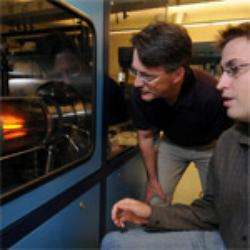
The goal of the project is to develop a new approach to the fabrication of high-temperature diboride-based ternary composite ceramics, with a higher heat and oxidation resistance than materials presently available.
The Purdue Board of Trustees ratified this professorship on Thursday November 20, 2008. Professor Schuhmann was the first Head of the School and a leader in many aspects of research, education and policy at Purdue. Professor Handwerker joined Purdue in 2005 having previously served as Chief of the Metallurgy Division at the National Institute of Science and Technology.
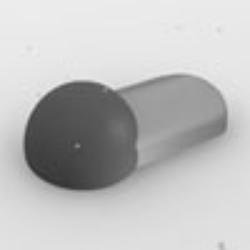
Researchers from IBM and Purdue University have discovered that tiny structures called silicon nanowires might be ideal for manufacturing in future computers and consumer electronics because they form the same way every time.
Professor Carol Handwerker will receive the leadership award of TMS and Professor Alejandro Strachan will receive the Early Career Award. University of Michigan Professor Tresa Pollock, BSMetE 1984 and a 2008 Distinguished Engineering Alumna of Purdue's College of Engineeering, will become a Fellow of TMS. If you can, join us in congratulating them in San Francisco February 15-19, 2009 at the TMS Annual Meeting!
In this presentation, we shall look at the ways in which the U.S. obtains and uses its energy, in order to identify the opportunities for making changes that might help to ensure the future of our quality of life. We will show how today’s technological choices may have unexpected, though fully predictable outcomes, and illuminate these with examples from the fairly recent past.
Professor Jeff P. Youngblood of Purdue MSE and Professor Nancy R. Sottos of the University of Illinois at Urbana-Champaign served as guest editors for the August 2008 Materials Research Society Bulletin. The topics of self-cleaning and self-healing materials provide a new paradigm for design and fabrication of engineering materials.
MSE researchers have overcome a major obstacle in reducing the cost of "solid state lighting," a technology that could cut electricity consumption by 10 percent if widely adopted.