
Purdue researchers pioneer “outside-looking-in” neural interface using DNA nanotechnology
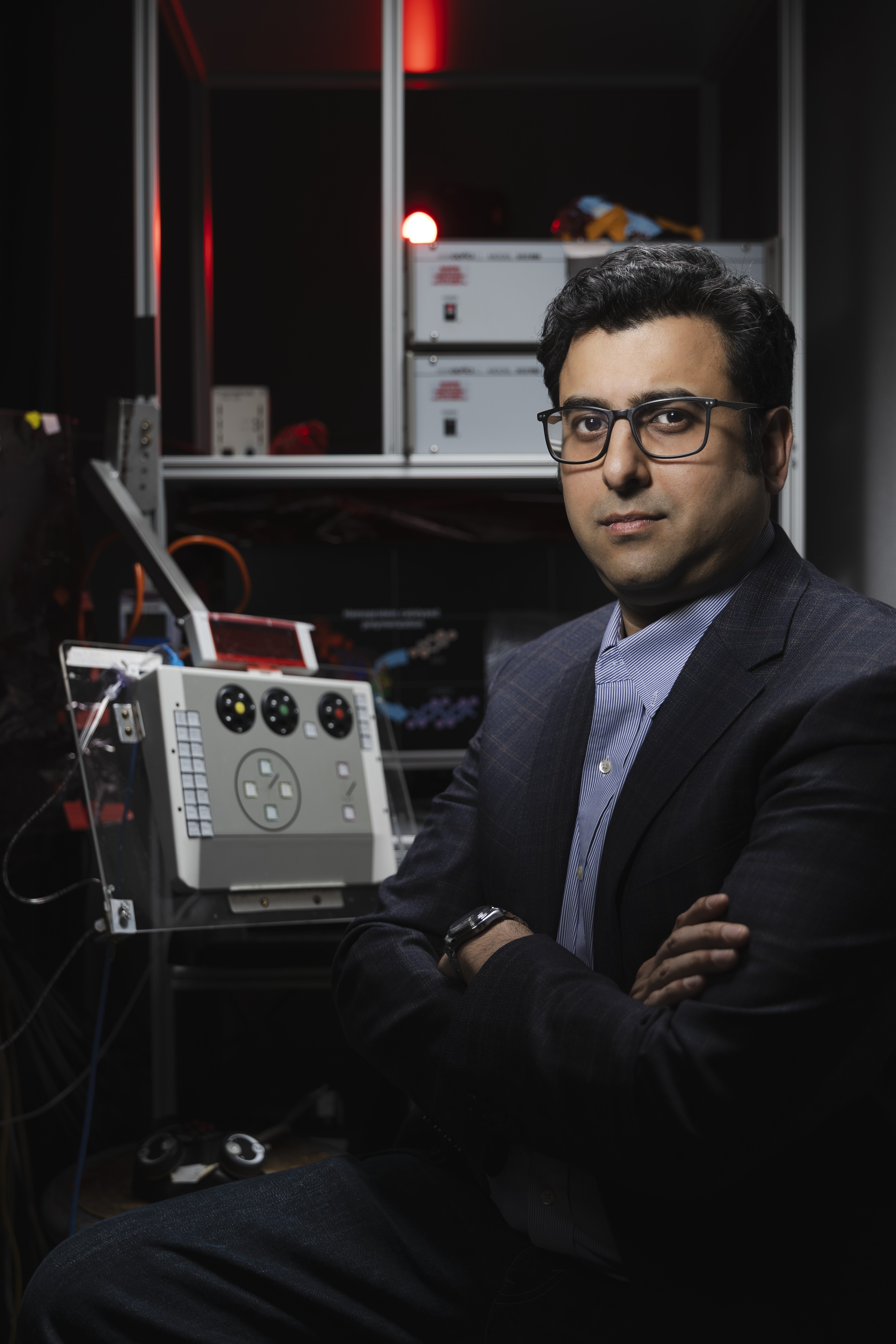
A multidisciplinary team led by Krishna Jayant, the Leslie A. Geddes Assistant Professor in the Weldon School of Biomedical Engineering at Purdue University, has developed a new method for interfacing with individual neurons using synthetic DNA nanostructures. Published today in Nature Nanotechnology, the research introduces DNA origami tiles as stable, artificial ion channels that allow scientists to record a cell’s internal electrical activity without the membrane rupture required by traditional methods.
The findings address a decades-old challenge in neuroscience: how to access the intracellular environment of a neuron, the command center where electrical signals are integrated, without causing permanent damage or washout of the cell’s internal machinery. By leveraging the precision of DNA nanotechnology, the Purdue-led team has created a foundation for a new generation of bio-integrated electronic interfaces that can integrate seamlessly with living neuronal membranes over extended periods.
Traditional electrophysiology relies on glass micropipettes or sharp glass nanoelectrodes that must pierce or rupture the cell membrane to gain access. While effective, these methods often lead to cell death or disrupt the very physiological processes researchers wish to observe.
"In this research, we show that 0.8-nanometer-diameter DNA tiles self-insert into live neuronal membranes to form stable nanopores," Jayant said. "In short, we introduce a new technique of 'outside looking in.' It is a method where one may not need to break the membrane to gain intracellular access but could instead listen in on intracellular chatter via a small hole in the wall, with the bilayer being the wall."
Unlike previous artificial pore-formers that can be toxic to the cell, these DNA nanostructures self-assemble into biocompatible channels that mimic natural ion pores. This spontaneous insertion allows for repeatable intracellular access. Researchers showed that they can now record intracellularly from a cell, sitting outside the neuron, retract the recording probe, and return to the same neuron later to record once again, a capability that was previously infeasible.
The breakthrough was the result of meticulous experimentation in the Jayant Nano Neurotechnology Lab. The team performed two-photon-guided dual-patch-clamp recordings from cortical Layer 5 neurons and demonstrated stable insertion of DNA nanostructures across neuronal membranes — remarkably, even from thin dendritic processes as narrow as ~1 μm, which are inaccessible to standard electrodes.
"After about 15 minutes of incubation, the cell-attached trace suddenly shifted," Jayant recalled. "Capacitive extracellular spikes transformed into sharp, ohmic intracellular-like action potentials without any suction or break-in. It was electric; we knew we'd cracked stable access from nanopores. Finding that we could come back to the same cell and record repeatedly is a game-changer in our ability to map intracellular electrical dynamics."
Jayant describes the DNA tile as a tiny Lego bridge made from folded DNA strands. “These 11-nanometer-long structures stick into the cell membrane to create a safe tunnel for ions and molecules to pass through without harming the cell’s delicate structure” remarked Jayant.
“The implications of this technology extend far beyond capturing electrical signals”, remarked Shulan Xiao, a postdoctoral researcher in the Jayant laboratory, and first author of the study. “Our study demonstrated that these DNA tiles could also act as programmable gates for microscopic drug delivery,” she added. The team successfully transported QX-314, a membrane-impermeable anesthetic, directly into specific neurons, silencing their electrical activity without affecting the surrounding tissue.
This level of precision could transform the treatment of neurological conditions. Currently, many treatments for epilepsy, Alzheimer’s, Parkinson’s, and other conditions rely on systemic drugs that broadly affect the entire brain, often with significant side effects, Xiao noted.
"I foresee a future in which such technologies could enable sub-millisecond, cell-specific dosing via localized nanostructures," Jayant said. "Instead of systemic drugs, these tiles could deliver therapeutics directly to disease-hotspot neurons or dendrites, guided by imaging or genetics."
The project is a testament to the collaborative spirit at Purdue and beyond. The research was spearheaded by Jayant’s group with critical contributions from Leopold Green’s lab in the Weldon School of Biomedical Engineering, which provided expertise in DNA tile design. Jong Hyun Choi’s lab in the School of Mechanical Engineering assisted with the characterization of Giant Unilamellar Vesicles, while Aleksei Aksimentiev’s lab at the University of Illinois at Urbana-Champaign provided molecular dynamics simulations to give the recordings a mechanistic basis.
"Work like this catapults Purdue BME’s interdisciplinary stature to even greater heights," Jayant said. "We hope to reach both academia and industry, elevating Indiana's biotech ecosystem with real-world neural interfaces. The goal is to create a future where we can track intracellular dynamics over extended time frames, enabling us to study phenomena such as learning and adaptation with unprecedented detail."
The researchers plan to coordinate with the Purdue Innovates Office of Technology Commercialization in the near future to explore patents and paths to market for this technology.
The research was supported by the National Institutes of Health New Innovator Award, the National Science Foundation through the Biology Integration Institute (EMBRIO Institute), the Office of Naval Research and the U.S. Department of Energy.
This research aligns with Purdue's presidential One Health initiative, which involves research at the intersection of human, animal and plant health and well-being.
Read the paper in Nature Nanotechnology.