
Purdue ECE’s Matt Lee receives ARPA-E award to advance electric technology
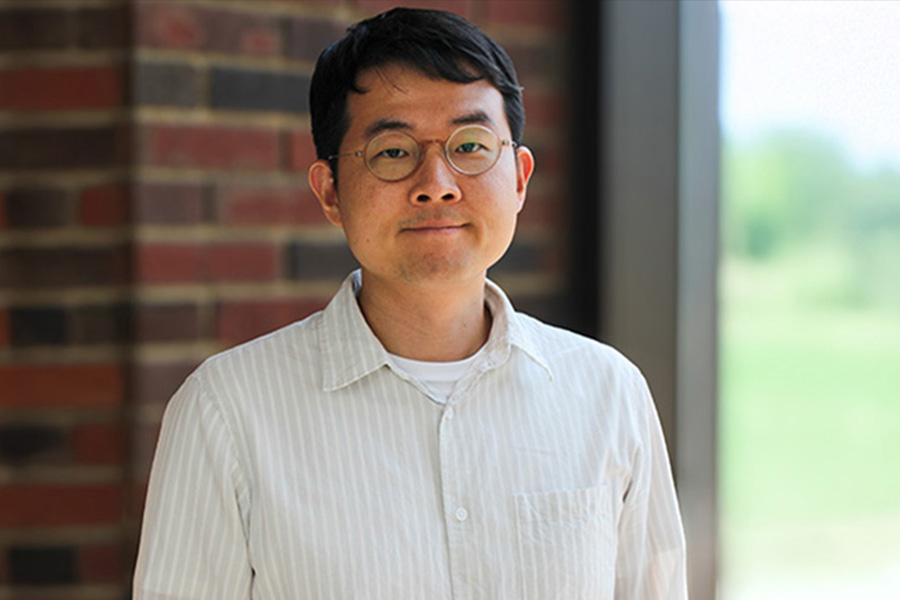
Matt Woongkul Lee, assistant professor in Purdue University's Elmore Family School of Electrical and Computer Engineering, has received a $250,000 Director's Award from the U.S. Department of Energy's Advanced Research Projects Agency-Energy (ARPA-E) to continue developing a new generator designed for uncrewed aircraft.
Lee was originally selected in 2024 through ARPA-E's Inspiring Generations of New Innovators to Impact Technologies in Energy, or IGNIITE, program, receiving a $500,000 award. The initiative supports early-career researchers working to turn unconventional ideas into technologies that could transform the production, storage and use of energy.
The new Director's Award — a one-year, $250,000 extension granted to a select cohort of only four awardees from the 2024 IGNIITE class — recognizes the exceptional progress and promise of Lee's project and will allow the team to further advance the technology.
His project, “Optically Powered Ultra-High-Speed Wound-Field Synchronous Generators,” will explore a lighter, more reliable and more sustainable way to produce electrical power aboard uncrewed aircraft.
Known as OPUS, the proposed generator would use light to deliver power to its rotating components, replacing conventional electrical connections that can wear down or create reliability challenges at extremely high speeds. The system also would incorporate an optical encoder to accurately determine the generator’s rotational position, helping maximize its power density, performance and power-handling capability.
“This award gives us an exciting opportunity to rethink how electrical power can be generated aboard next-generation aircraft,” Lee said. “By combining optical power delivery with an ultra-high-speed, rare-earth-free generator, we aim to create a system that is lighter, more reliable and capable of producing more power in a smaller package. Those improvements could help expand the range and capabilities of electric uncrewed aircraft.”
The Purdue team will first develop, test and validate a low-power prototype. Researchers will then use the results to build a higher-power generator, integrate it with an optical encoder and evaluate the complete system’s performance.
The generator will use a high-efficiency solar cell and will not rely on rare-earth materials, which are commonly used in many high-performance electric machines. Reducing that dependence could improve supply-chain security while lowering the technology’s environmental footprint. If successful, the research could support more sustainable power generation from renewable sources and strengthen U.S. energy security.
ARPA-E recognized Lee and 3 other scientists and engineers during an IGNIITE Director’s Award ceremony in Washington DC highlighting emerging researchers whose work addresses important challenges facing the nation’s energy future.