
Purdue ECE undergraduate researchers honored with Amit & Rashee Rohatgi Awards
Two Purdue University students have received awards recognizing their exceptional efforts in research.
The Amit & Rashee Rohatgi Excellence in Undergraduate Research Awards recognize outstanding undergraduate researchers in the Elmore Family School of Electrical and Computer Engineering for creativity, independence and achievement.
The award was established by Purdue ECE alumnus and Advisory Board member Amit Rohatgi and his wife, Rashee Rohatgi, to recognize and encourage undergraduates who demonstrate technical excellence, curiosity and initiative through meaningful research and innovation.
“Purdue ECE played a foundational role in both of our lives — not only in shaping how I think as an engineer and entrepreneur, but also in bringing Rashee and me together,” Amit Rohatgi said. “One of the things I value most about Purdue, especially in ECE, is its emphasis on moving beyond the classroom and giving students the opportunity to work on ambitious, hands-on problems with real-world impact. Through this award, we hope to recognize and encourage undergraduates who demonstrate technical excellence, curiosity, initiative, and the willingness to push boundaries through meaningful research and innovation.”
This year’s award recipients are Arjun Gupte and Michael Xianzhe Zhang.
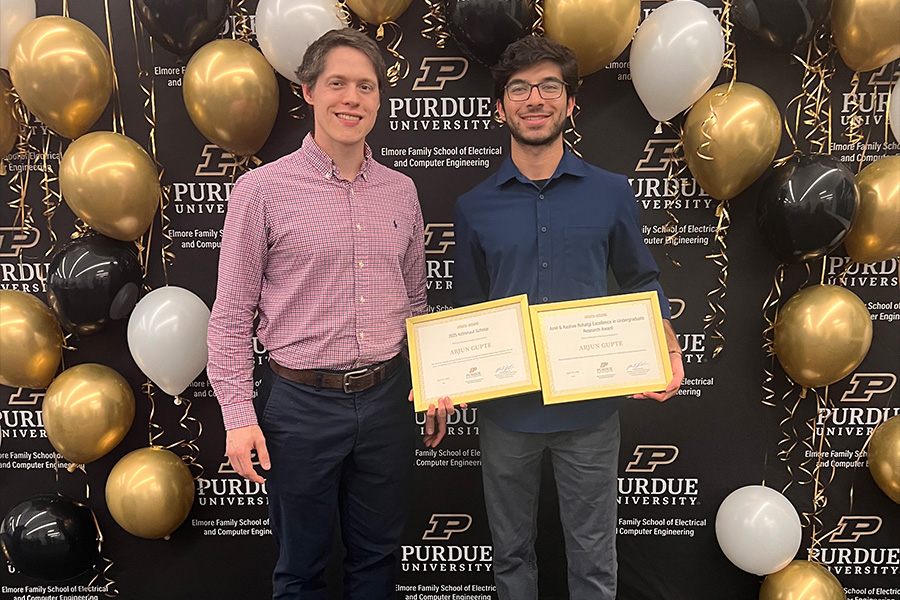
Gupte’s research focuses on human-robot collaboration and software system optimization. He has explored how large language models can improve task allocation in human-robot teams by incorporating multiple human preferences, moving beyond the limitations of traditional reinforcement learning approaches. The work is motivated by future environments where people and robots will need to work together effectively. He also has developed systems that use large language models and reinforcement learning to perform multi-objective software optimization, helping developers balance competing computing goals and produce more efficient software.
“Doing undergraduate research has given me valuable experience in understanding and tackling important unsolved real-world problems,” Gupte said. “Beyond deepening my technical knowledge, it has shaped how I approach open-ended challenges, from defining problems to designing solutions and communicating key findings.”
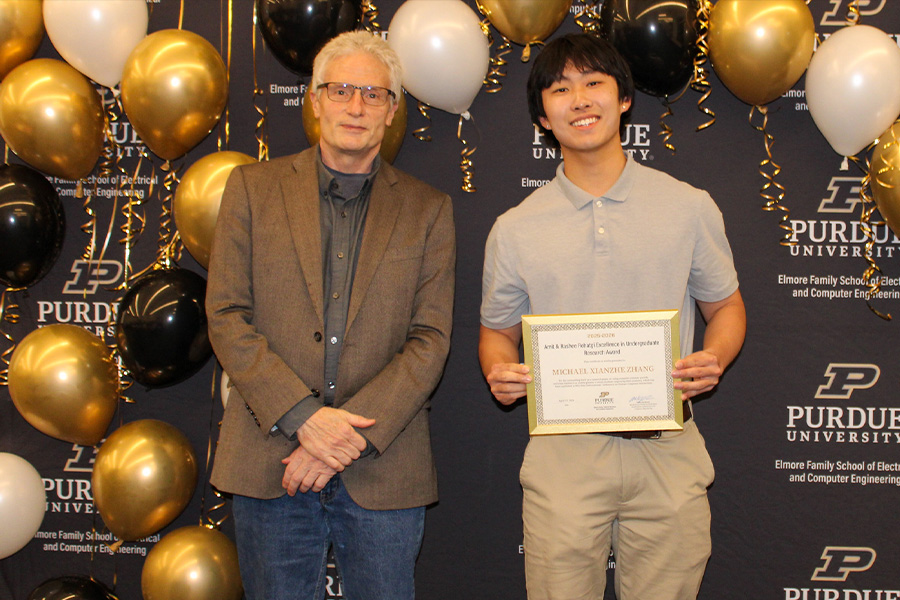
Zhang’s research focuses on developing an accessible computer vision application that analyzes the posture of cellists and provides useful feedback in real time. Incorrect posture can contribute to chronic musculoskeletal injuries and poor sound quality, especially when musicians develop habits during practice sessions between lessons. The app, called the Cello Evaluator, examines the position of the wrist, elbow and cello bow, then suggests adjustments using on-device computer vision. More broadly, the research explores how artificial intelligence may support musicians and how willing musicians are to incorporate AI into practice and performance.
“Participating in research as an undergrad has given me invaluable real-world experience and has been an integral component of my professional and personal development at Purdue,” Zhang said.
As home to one of the university’s largest research programs, Purdue ECE gives undergraduate students opportunities to contribute to work that advances technology and addresses real-world challenges. Undergraduate researchers help design and conduct experiments, develop new systems, write papers and contribute to Purdue’s nationally recognized research enterprise.
“Undergraduate research is one of the most powerful ways students learn what engineering can do,” said Milind Kulkarni, the Michael and Katherine Birck Head and Professor of Electrical and Computer Engineering. “It gives them the chance to move beyond the classroom, work side by side with faculty and graduate students, and contribute to discoveries that can have real impact. These experiences help students build confidence, creativity and the problem-solving skills that define Purdue engineers.”
The Amit & Rashee Rohatgi Excellence in Undergraduate Research Awards highlight the role undergraduate students play in Purdue ECE’s research mission and the school’s commitment to preparing students to lead in emerging areas of technology.