
Purdue ECE students showcase hands-on innovation at spring SPARK Challenge
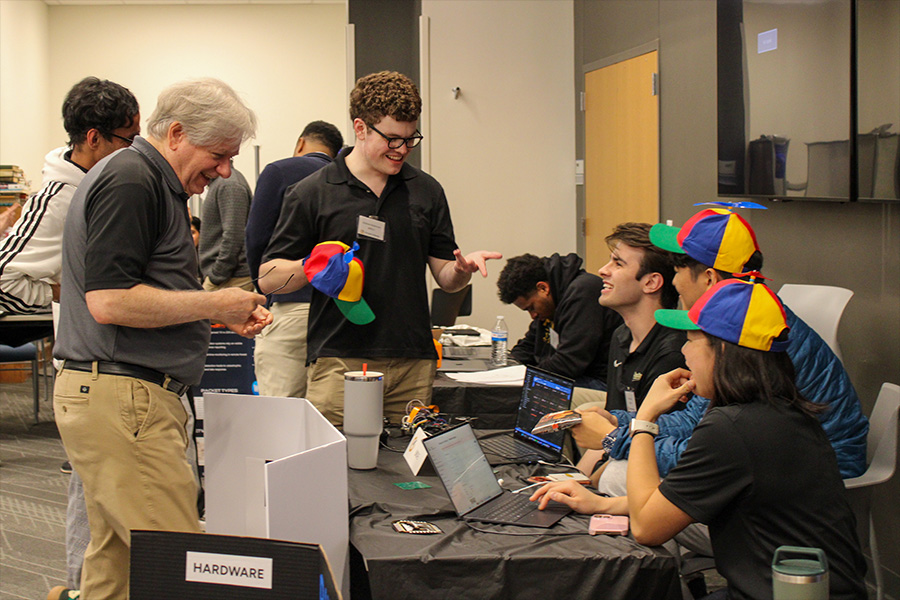
Students in Purdue University’s Elmore Family School of Electrical and Computer Engineering put their ideas, skills and problem-solving abilities on display during the spring 2026 SPARK Challenge, a biannual design competition that highlights student innovation across both the Indianapolis and West Lafayette locations.
Hosted by Purdue ECE and the Electrical and Computer Engineering Student Society, the SPARK Challenge gives students an opportunity to move beyond coursework and demonstrate what they can design, build and explain. Projects ranged from embedded systems and robotics to assistive technology, interactive games, communications tools and student-led passion projects.
The spring 2026 competition featured three categories: Senior Design, Course Projects, and Student Organization and Personal Projects. Awards recognized projects for technical execution, creativity, presentation quality and real-world potential.
Indianapolis:
Senior Design
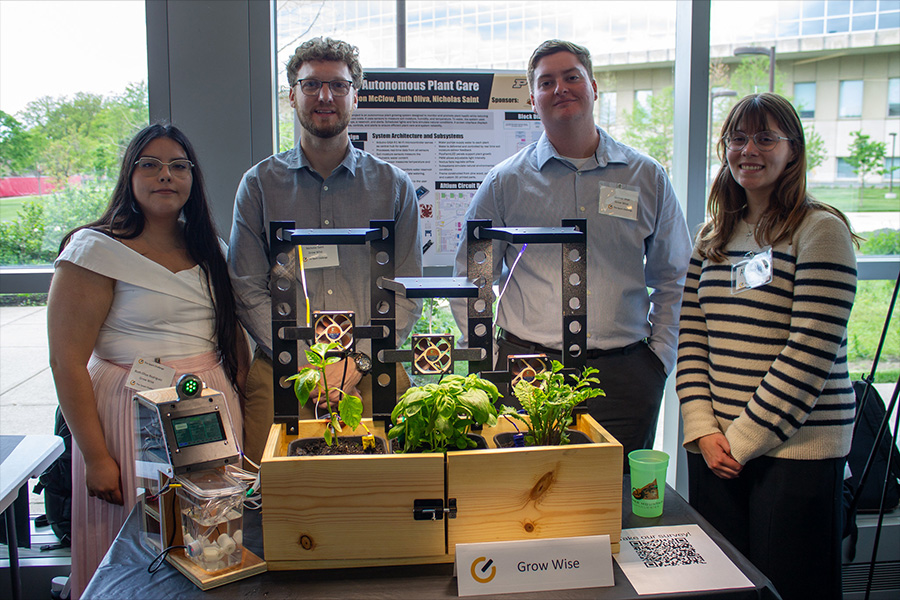
1st Place: Grow Wise
Ruth Rodriguez, Gunner Imel, Nicholas Saint, Alison McClow
This autonomous plant growing station monitors and supports plant growth while helping users grow produce more easily and affordably. It uses sensors to track soil moisture, humidity and temperature, along with pumps, tubing and a low-water sensor to manage watering. Programmed lights and fans run on a set schedule to simulate ideal growing conditions. A screen interface displays sensor readings, plant status, system alerts and manual controls, making plant care simple and effective.
2nd Place: SpeechShield
Logan Orosco-Murphy, Sebastian Wetzel, Adam Scholl, Eric Raymond
SpeechShield is designed to muffle/jam out microphones using recording software to protect the user/company from having someone being able to record a conversation. The dimensions of the project is 1 cubic foot.
Indianapolis:
Course Projects
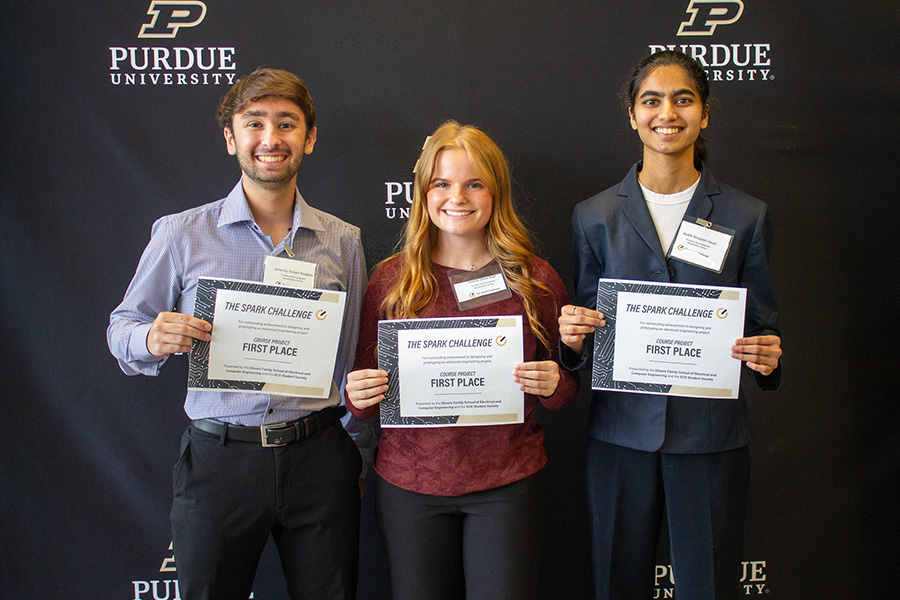
1st Place: Touchless Electromagnetic Rehabilitation Device
Soterios Steven Koukios, Aaditi Anupam Vaval, Chelsie Drew Rayl
This touchless rehabilitation device helps users improve fine motor skills at home. Users select shapes with a keypad and draw them in the air above a grid, building stability and precision. The system tracks motion with a coil array and stylus, displays the target shape and live drawing on a screen, and scores performance based on accuracy.
2nd Place: Wingman
Myles Querimit, Celine Lu, Alexia del Cuvillo, Krish Patel
Wingman is a multi-minigame defusal-style game inspired by Keep Talking and Nobody Explodes. It serves two purposes: as a player-facing experience, it builds intuition for concepts such as signal processing and forces critical thinking through time-pressured play and as an engineering project demonstrating embedded system design on an RP2350 microcontroller.
West Lafayette:
Senior Design
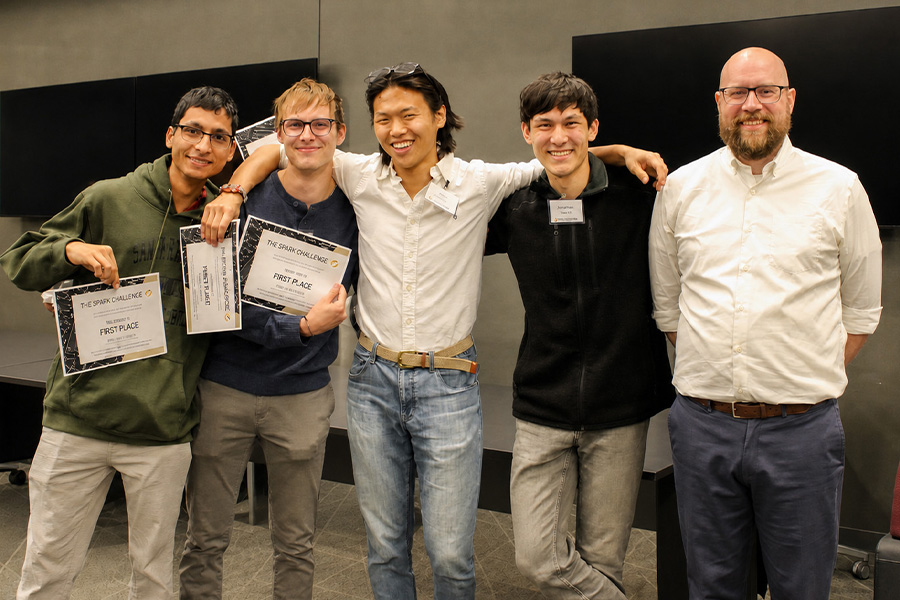
1st Place: StereoBoy
Shubham S. Kumar Agarwal, Emri F. Eshtrefi, Andrew J. Larkins, Jihong Min
StereoBoy is a portable, modular stereo system built inside a GameBoy shell. Songs are stored on removable cartridges, similar to a cassette player, but with more flexibility. Users can add custom software or hardware to the cartridges, allowing StereoBoy to connect with sensors, work with electronic music devices or even play games.
2nd Place: TRIC (Tactical Robotics for Intelligent Cardplay)
Nathan Gollins, Jacob Termaat, Ian Cox, Henry Greenwood
TRIC is an autonomous robot designed to play complex trick-based card games with minimal human interaction. It combines precision card handling, real-time card recognition and AI-driven strategy. The system uses a card wheel, scanner, ejectors, pushing arm and rotating base to identify, select and play cards in the correct locations. Its software manages card selection, identification and motor control, connecting digital decision-making with the physical experience of playing cards.
West Lafayette:
Course Projects
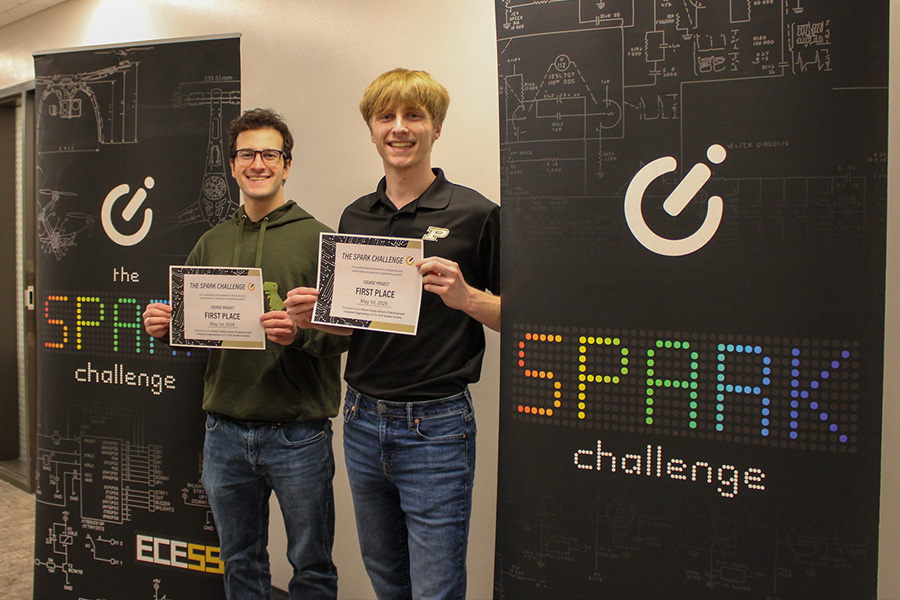
1st Place: Atomic Dial
Yonathan Gur, Ryan Gelston, Cody Fuh, Ty Bequette
The Atomic Dial is an open-source, haptic-enabled smart knob powered by the RP2350B architecture. It provides software-defined mechanical feedback—such as detents, virtual end-stops, and magnetic resistance—using a brushless DC motor. An adaptation of the SmartKnob project by Scott Bezek, this project adapts the original device to work smoothly with the RP2350B microcontroller. The board was designed to include header pins to plug in the Proton development board designed by staff for ECE 36200: Microprocessor Systems and Interfacing.
2nd Place: Time of Flight
Jacob Prior, Nick Martel, Weijing Chen, Joshua Wallwork
Inspired by the local police department, the team designed a simple LiDAR speed gun that can measure the speed of an oncoming vehicle and alert the user when the vehicle is driving faster than the speed limit.
West Lafayette:
Student Organization and Personal Projects
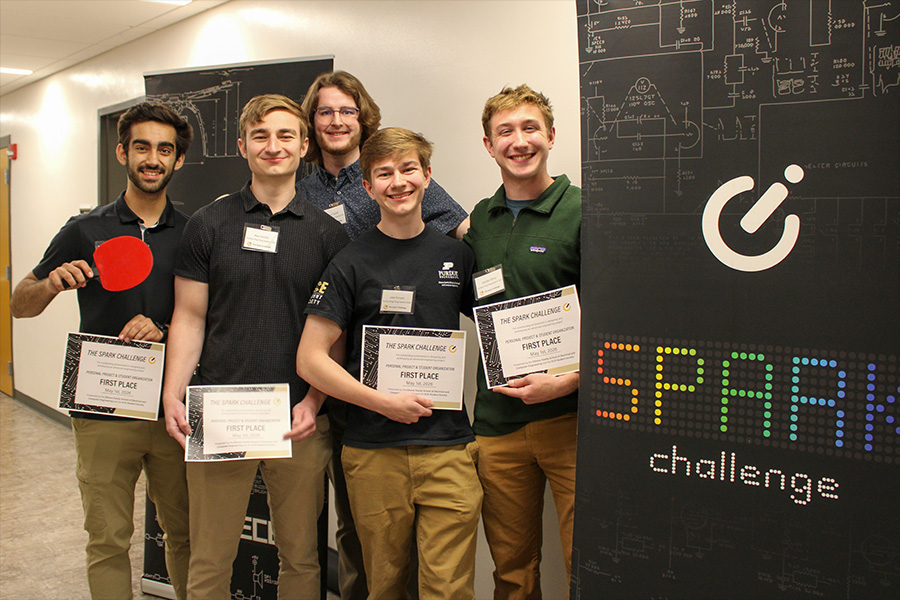
1st Place: Purdue Ping Pong System Club
Alex Forrest, Carson Castle, Camden Kilroy, David Racovan, Jake Forrest
The Purdue Ping Pong System Club’s Paddle Bot is an autonomous robot designed to play ping pong against a human opponent. It uses high-speed cameras, infrared light and physics-based prediction to track the ball and estimate where it will land. A gantry system moves the paddle in 3D space, while a gimbal adjusts the paddle angle to control each return. A custom PCB keeps response time under 20 milliseconds, and a variable launcher allows the robot to serve and play a full game.
2nd Place: Project Tracks
Jack Thornton
Project tracks is a fully custom electric tank. It is built on a custom steel chassis and includes 4 independently controlled 800W motors producing 680lbs of tractive force, custom QML-based GUI, autonomous capabilities, a custom controls board to interface with 11 different motors and more. It can be manned or controlled by external joystick or laptop. It also includes a deployable “mini tank” that charges inductively and can be controlled autonomously by the main tank.
A key part of the SPARK Challenge is the involvement of Purdue ECE Corporate Partners Program, whose representatives serve as judges and offer students feedback from an industry perspective. That connection helps students see how their technical work translates to engineering challenges beyond the classroom.
The event reflects Purdue ECE’s emphasis on experiential learning and hands-on discovery. Through SPARK, students gain experience designing, building, testing, presenting and refining their ideas — the same skills that prepare them to lead in electrical and computer engineering.