
Purdue ECE researchers use AI to help quantum systems remain stable
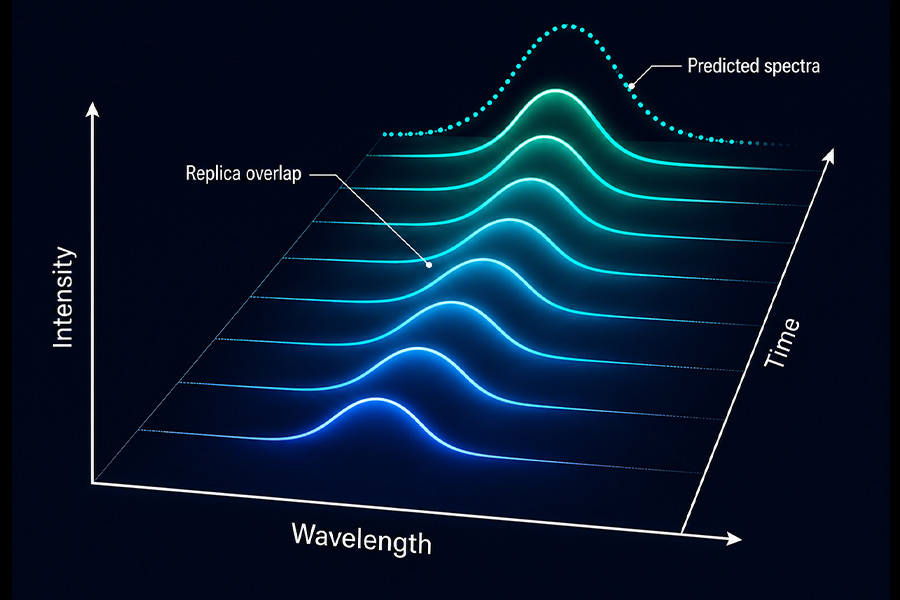
Researchers at Purdue University’s Elmore Family School of Electrical and Computer Engineering have proposed an advanced statistical and machine-learning-based anticipatory framework for anticipating instability in quantum systems. The study, “Anticipating Decoherence in Quantum Systems,” led by PhD candidate Pranshu Maan together with faculty members Alexander V. Kildishev, Vladimir M. Shalaev, and Alexandra Boltasseva, has been published in Nature Communications.
The paper focuses on one of the major challenges facing quantum technology: decoherence. In simple terms, decoherence happens when a quantum system loses the delicate state that makes it useful for applications such as secure communication, advanced computing, precision imaging and highly sensitive sensors. Rather than waiting for that instability to happen and then trying to correct it, the researchers found that some of the changes are not entirely random. By studying how the emitters changed over time, they identified patterns that could be used to anticipate their future behavior.
Maan, the paper’s first author, led the development of the framework. The work grew out of discussions with Kildishev, the corresponding author, on natural anticipatory systems and advanced statistical physics. Alexandra Boltasseva, the Ron and Dotty Garvin Tonjes Distinguished Professor of Electrical and Computer Engineering, contributed to the material platform.
“This work changes how we think about noise in quantum systems,” said Shalaev, the Bob and Anne Burnett Distinguished Professor of Electrical and Computer Engineering. “Rather than treating decoherence only as something to correct after the fact, we show that some of its dynamics can be learned, anticipated and eventually controlled. That opens an exciting path toward more scalable quantum networks.”
Kildishev, professor of electrical and computer engineering, said the work points toward quantum systems that are not only corrected after problems occur, but designed to anticipate them. “The long-term goal is to give quantum hardware a kind of predictive awareness of its environment,” Kildishev said. “If a system can anticipate where it is going, rather than simply react to where it has been, we can begin designing quantum platforms that are more scalable, synchronized and resilient.”
“By analyzing the trajectory of a quantum system, we can identify patterns in its environment and use them to anticipate instability,” Maan said. “Looking ahead, I am excited to explore how statistical physics and hardware-implemented AI can work together to enable real-time stabilization of quantum devices.”
The team also includes Hadiseh Alaeian, faculty in Purdue's Elmore Family School of Electrical and Computer Engineering and the Department of Physics and Astronomy; Benjamin Lawrie and Alexander Puretzky of Oak Ridge National Laboratory; and Yuheng Chen, a former Purdue ECE PhD student in the group.