
Purdue ECE researchers move closer to quantum sensors that can work in extreme magnetic fields
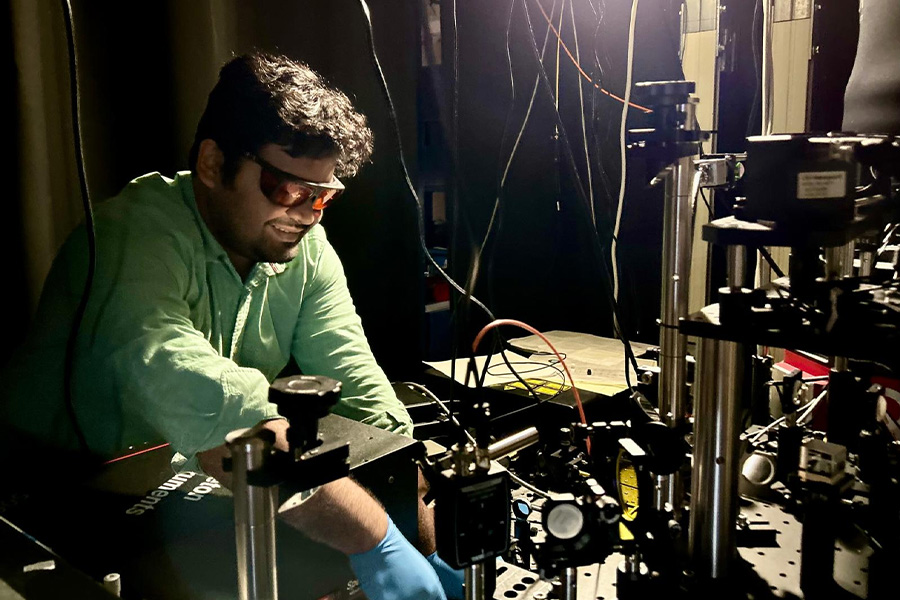
Researchers in Purdue University’s Elmore Family School of Electrical and Computer Engineering have demonstrated a new way to use quantum sensors in a hard-to-reach but scientifically important frequency range: sub-terahertz spectroscopy.
The research, which was published in Nano Letters, focuses on tiny atomic-scale imperfections, or defects, in hexagonal boron nitride, a very thin material made of boron and nitrogen. These defects, called negatively charged boron vacancies, can act like ultra-sensitive probes. When scientists shine light on them, the defects give off signals that reveal information about their surroundings.
The Purdue-led team showed that these defects can keep working as sensors in very strong magnetic fields, up to 7 tesla, and at frequencies approaching 0.2 terahertz, or 200 gigahertz. This places them in the sub-terahertz range, a region that is important for studying fast magnetic and electromagnetic behavior but is difficult to access with many existing tools.
“Quantum sensors give us a way to listen to the very small signals that materials give off,” said Abhishek Solanki, first author of the study and a postdoctoral research associate in Purdue ECE. “What is exciting here is that we showed these sensors can still give us useful information in very strong magnetic fields, opening a route to sub-terahertz spectroscopy that has been very challenging with conventional approaches.”
Sub-terahertz spectroscopy allows researchers to study how materials behave at extremely fast time scales. That matters for understanding next-generation magnetic materials, quantum materials and advanced electronic systems. However, reliable sources and detectors in this frequency range remain limited, making new sensing approaches especially valuable.
In the study, researchers measured how quickly the spins in the boron-vacancy defects returned to equilibrium as the magnetic field and temperature changed. At lower magnetic fields, nearby spin interactions played a larger role. At higher fields, the behavior changed, suggesting that vibrations inside the material, called phonons, become an important part of how the defects respond.
Understanding that behavior is a key step toward designing quantum sensors that can work in extreme environments and help scientists explore materials in ways that were previously difficult.
The research was conducted by collaborators from Purdue and Oak Ridge National Laboratory. In addition to Solanki, authors of the study include Hamza Ather, Priyo Adhikary, Aravindh Shankar, Owen Matthiessen, Ian Gallagher, Demid Sychev, Alexei Lagutchev, Tongcang Li, Yong P. Chen, Vladimir M. Shalaev, Benjamin Lawrie and Pramey Upadhyaya, from Purdue, and Yueh-Chun Wu, from Oak Ridge National Laboratory.