
Purdue ECE research wins ACM e-Energy best paper for faster data center grid connections
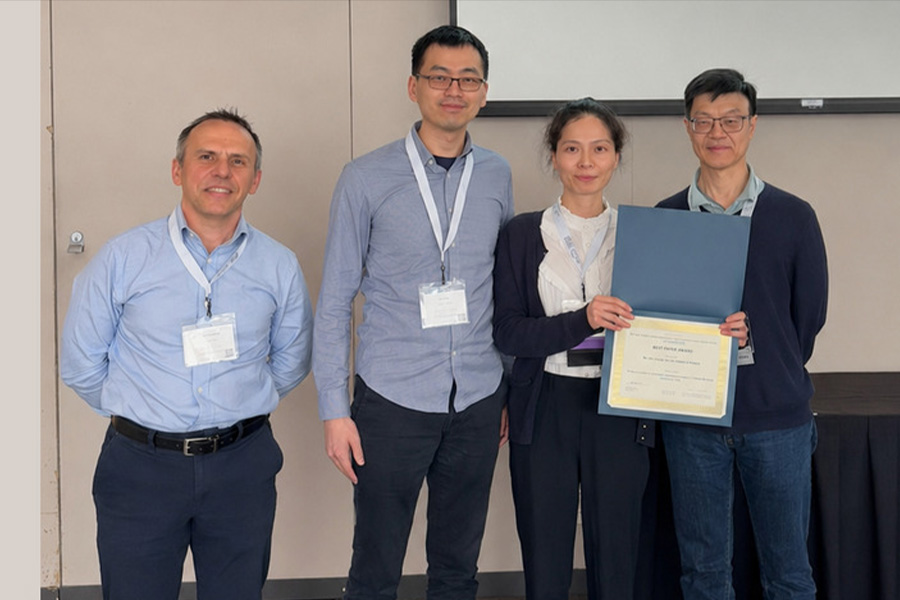
A Purdue University research paper on helping large electricity users connect to the power grid faster has won the best paper award at ACM e-Energy 2026.
The paper, “Flexible Connection to Accelerate Load Interconnection in Partially Measured Distribution Grids,” was recognized at the 17th ACM International Conference on Future and Sustainable Energy Systems (ACM e-Energy 2026), held June 22-25 in Banff, Alberta, Canada. ACM e-Energy is a leading conference for research at the intersection of computing, communication and smart, sustainable energy systems.
Nan Gu, a postdoctoral researcher in Purdue University’s Elmore Family School of Electrical and Computer Engineering, is first author on the paper. Co-authors are Junjie Qin, assistant professor of electrical and computer engineering, and Vassilis Kekatos, associate professor of electrical and computer engineering.
The research addresses a growing challenge for utilities: how to safely connect major new sources of electricity demand, including data centers and electric vehicle charging stations, when building new grid infrastructure can take years. This challenge makes the paper’s award especially relevant to current grid needs.
Instead of assuming the grid must be ready to always serve every new load at full power, the team studied a more flexible approach. Under “flexible connection,” a large customer could connect sooner by agreeing to limited, real-time reductions in power use during periods when the grid is under stress. The paper develops a framework to help utilities determine how much new demand the grid can safely accommodate, even when operators lack complete real-time measurements.
“As electricity demand grows, we need tools that help utilities make faster but still reliable decisions,” Gu said. “Our work shows how flexible connections can unlock more capacity from existing distribution grids, even when only part of the system is measured in real time.”
Qin said the research is aimed at a practical and urgent grid challenge.
“Data centers, electric vehicles and other large loads are growing faster than traditional grid expansion timelines,” Qin said. “Flexible connection offers a way to connect customers sooner while maintaining reliability, and this work provides a foundation for doing that in a data-limited grid.”
Using realistic load data and a standard test feeder, the researchers showed that targeted meter placement can help utilities unlock more grid capacity than broad, less strategic sensing.