
Purdue ECE professor Qi Guo earns NSF CAREER Award for passive 3D imaging research
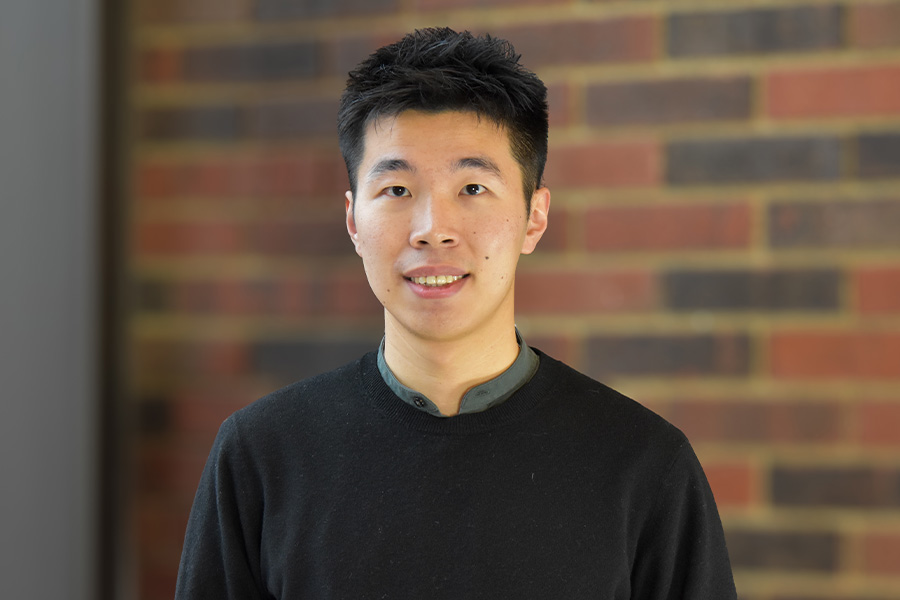
Qi Guo, assistant professor in the Elmore Family School of Electrical and Computer Engineering at Purdue University, has received a National Science Foundation CAREER Award for research that could help devices see the world in 3D more efficiently and in more challenging environments.
The NSF CAREER Award is among the foundation’s most prestigious honors for early-career faculty. It supports researchers who show strong potential to advance both scholarship and education.
Guo’s project, “CAREER: Computational Passive 3D Imaging,” which will be carried out at the FLEX Lab in Purdue's Discovery Park, centers on a type of 3D imaging that estimates the distance of objects from photographs without emitting light into the environment. Unlike active 3D technologies such as LiDAR, passive 3D imaging relies on naturally available light, which can make it more discreet, more energy efficient, and more robust towards adversarial attacks.
Those advantages make passive 3D imaging especially attractive for applications in national defense, robotics, wearable devices, underwater platforms and space exploration. But today’s systems still face major hurdles. They often work only at short range, require significant computing power, struggle in low-light conditions and can be difficult to combine with other imaging functions.
Guo’s research will develop a new family of technologies called computational passive 3D imaging. The approach combines advanced optical hardware with algorithms that work together to process environmental light more effectively during and after image capture.
The project will explore imaging methods that use tools such as metasurfaces, microelectromechanical systems and programmable optics, paired with both physics-based and learning-based algorithms. Guo and his team will also create mathematical models, simulation tools and experimental prototypes to evaluate how these systems perform in real-world conditions.
“Passive 3D imaging has enormous potential because it can recover depth information without actively illuminating a scene, but existing solutions still face important practical limitations,” Guo said. “Through this project, we hope to develop new imaging methods that can operate at longer distances, use less power, perform better in low light and expand what passive 3D imaging can do in real-world applications.”
The project also includes an educational component. Guo will create and share camera-themed learning activities for students from middle school through graduate school, helping strengthen the hands-on experimental skills needed in the future engineering workforce.