
Purdue ECE Prof. Vijay Raghunathan receives Intel 2025 Outstanding Researcher Award
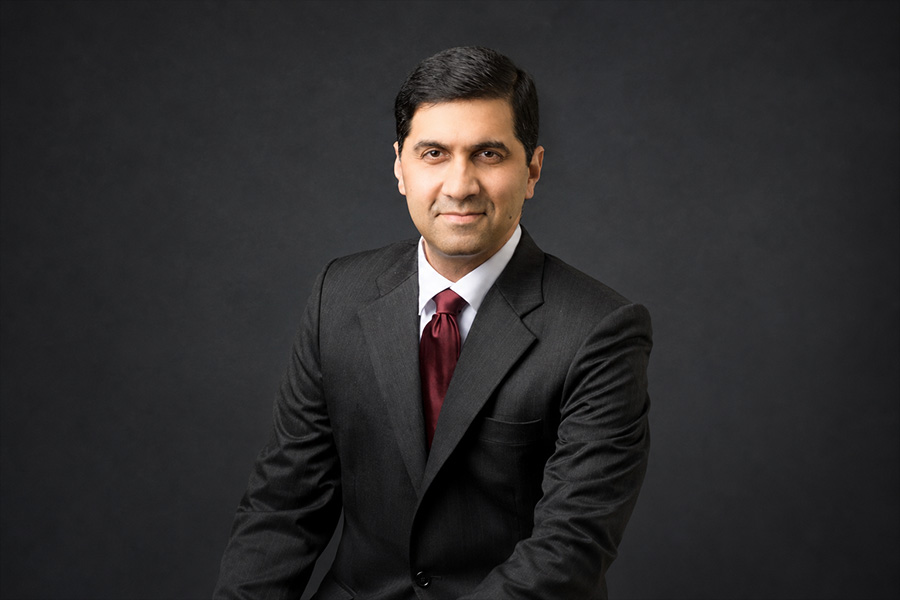
Vijay Raghunathan, vice president and university ambassador to India and professor in the Elmore Family School of Electrical and Computer Engineering at Purdue University, has received an Intel 2025 Outstanding Researcher Award.
The annual awards recognize academic researchers whose Intel-sponsored university research is helping shape the future of technology. Raghunathan was one of 10 researchers honored in 2025 by Intel’s Corporate Research Council.
Raghunathan was recognized for his work in multimodal AI systems and heterogeneous AI computing across CPUs, GPUs and NPUs. His research helps artificial intelligence systems use the right type of computing engine for the right task, making them faster, more efficient, and better suited for real-world applications.
“I have been fortunate to work with an exceptional group of students, postdoctoral researchers and collaborators whose creativity, dedication and partnership have made this work possible," said Raghunathan. "This recognition reflects a decade of impactful collaboration with Intel, and I look forward to building on that partnership in the years to come.”
Modern AI systems often need to process many kinds of information at once, such as text, images, video, sensor data and physical actions. These systems power emerging applications in areas such as robotics, autonomous systems, smart devices and embodied AI, where machines must understand and respond to the world around them.
To handle these demanding tasks, next-generation AI platforms increasingly rely on multiple types of processors working together. CPUs are general-purpose processors, GPUs are especially useful for handling large amounts of data in parallel, and NPUs are domain-specific processors designed specifically to accelerate AI workloads. Raghunathan’s work introduced new techniques to better coordinate the execution of AI workloads on these different computing engines, improving both performance and energy efficiency.
The research applies to a wide range of advanced AI models, including transformers, vision-language models, vision-language-action models, graph neural networks and newer AI architectures such as Mamba and state space networks. According to Intel, Raghunathan’s work also helped inform the evolution of its next-generation AI platforms and system architectures.
Raghunathan is also a faculty member in Purdue’s Institute of Chips and AI and is a Co-PI on two DARPA/SRC JUMP 2.0 centers, the Center for the Co-design of Cognitive Systems (CoCoSys) and the Center on Cognitive Multispectral Sensors (CogniSense). His broader work focuses on energy-efficient computing, embedded systems, Internet of Things technologies, edge AI, and the hardware and software foundations needed to support future intelligent systems.