
Purdue ECE PhD student wins first place at IEEE WAMICON for paper about more efficient radio technology
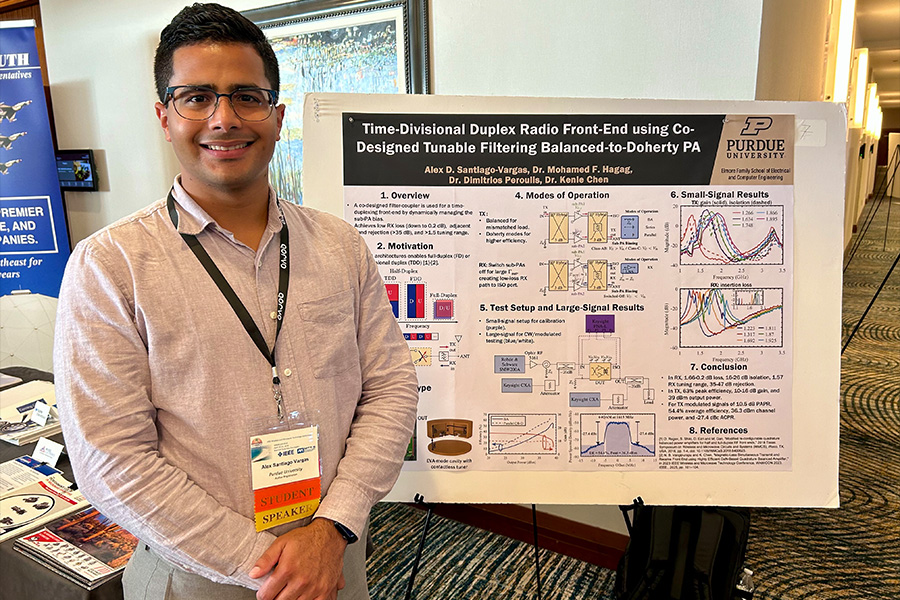
Purdue University electrical and computer engineering PhD candidate Alex Santiago-Vargas earned first place in the student paper competition at the 2026 IEEE Wireless and Microwave Technology Conference, or WAMICON, for research that could help make future wireless radios smaller, more efficient and less complex.
Santiago-Vargas, who is co-advised by Dimitrios Peroulis, the Reilly Professor in the Elmore Family School of of Electrical and Computer Engineering at Purdue, and Prof. Kenle Chen at Northeastern, presented the paper “Time-Divisional Duplex (TDD) Radio Front-End using Co-Designed Tunable Filtering Balanced-to-Doherty Power Amplifier” at the conference.
The research tackles a basic challenge faced by many wireless devices: A radio needs to both transmit and receive signals, but switching between those jobs typically requires additional components that can waste energy, take up space and reduce performance.
“We designed a high-efficiency power amplifier combined with a filter that can change the frequency of operation,” Santiago-Vargas said. “The innovation in this paper is a mode which allows for received signals to be routed without a high-power transmit/receive switch. This reduces the losses of the transmitter, improves the noise figure of the receiver, and minimizes the number of components and size of the radio hardware.”
The team found a way for several functions that normally require separate hardware to work together within a single integrated design. The prototype can also be tuned across a range of frequencies and demonstrates peak efficiency of 63.3%.
“This work is a strong example of how rethinking the architecture of a radio can lead to improvements at the system level,” Peroulis said. “Alex brought together filtering, power amplification and switching functions in a way that reduces unnecessary hardware and energy loss. Receiving first place at WAMICON is excellent recognition of both the technical quality of the research and Alex’s ability to communicate its importance.”
The technology could eventually be useful in applications including satellite communications, aerospace telemetry, military data links and software-defined radios.
The project was a collaboration with two Purdue alumni: Kenle Chen, now an associate professor at Northeastern University, and Mohamed F. Hagag, now an associate professor at Military Technical College in Egypt.
“This research shows the value of co-design rather than treating each part of the radio as an independent component,” Chen said. “By allowing the power amplifier and filtering network to work together, we can improve efficiency while also simplifying the overall radio front end. Alex did an outstanding job turning that concept into a working system and demonstrating its performance experimentally.”
The 27th WAMICON focused on advances in radio-frequency, microwave and millimeter-wave devices, circuits and systems, with the theme “Intelligent Heterogeneous Radio Hardware and Emerging Devices for Next-G Wireless and Beyond.”