
Purdue ECE PhD candidates earn top U.S. finish in global AI wireless challenge
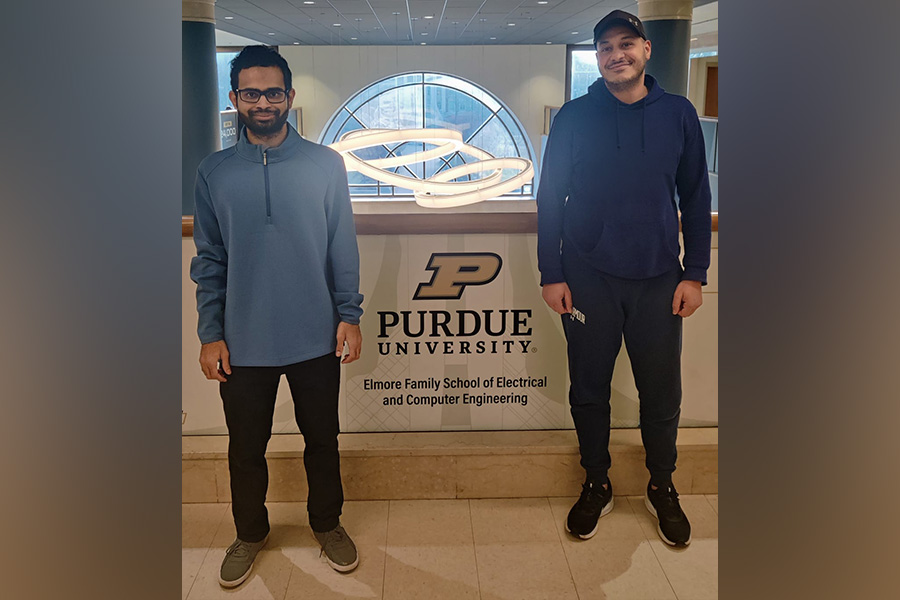
Two doctoral students from Purdue University’s Elmore Family School of Electrical and Computer Engineering have finished fourth in the world — and first among U.S. teams — in an international artificial intelligence competition focused on improving wireless communication.
Manish Kumar Krishne Gowda and Ahmed P. Mohamed, competing as Team BoilerSignal, earned the recognition in the “Estimation of Site-Specific Radio Propagation Loss with Minimal Information” challenge, hosted through the AI for Good initiative under the International Telecommunication Union framework and organized by KDDI Research.
The competition centered on a complex but critical problem: how to predict how radio waves travel through real-world environments when only limited measurement data is available. Signal attenuation is strongly influenced by building geometry, terrain profiles and frequency-dependent propagation mechanisms. Accurately modeling these effects is fundamental to reliable network design, particularly as deployments expand into higher frequency 5G and beyond.
Traditionally, engineers rely on dense field measurements to build these propagation maps, which requires significant time and cost. In this challenge, teams were asked to replace that measurement-heavy process with artificial intelligence and machine learning models capable of reconstructing signal behavior across an entire area using only sparse samples along with environmental information such as 3D building data.
“Our goal was to make accurate predictions with as little data as possible,” Gowda said. “In the real world, collecting thousands of measurements isn’t always practical. We focused on building a geometry-based model that could learn from a small number of signal measurements and still understand how radio waves behave in a complex multipath environment.”
The team designed its own AI approach, selecting key data points and optimizing the model to balance physics-based understanding of radio waves with data-driven learning. Choosing the right transmission and reception points for training the mode, a central challenge highlighted in the competition, proved critical to their success.
“The main challenge was to identify the minimal set of measurements needed to estimate site-specific path loss,” Mohamed said. “Radio signals are influenced by terrain, building geometry, and frequency-dependent effects, which together create complex, site-specific path loss patterns. Our approach integrates propagation-aware feature engineering with data-driven learning to enable accurate propagation estimation, even with limited measurement data. This approach is essential for scalable network planning in modern wireless systems”
Their fourth-place global finish places BoilerSignal among the top research teams worldwide working at the intersection of wireless communications, signal processing and AI-driven modeling.
“We’re proud to represent Purdue ECE on a global stage,” Gowda said. “Being the highest-ranked U.S. team reflects the strength of the research community and mentorship we have received from Purdue ECE professors James V. Krogmeier and David J. Love, and Prof. Yaguang Zhang from the School of Agricultural and Biological Engineering here at Purdue.”
The work underscores how artificial intelligence can help build smarter, more efficient wireless networks, a key priority as demand for faster and more reliable connectivity continues to grow.