
Purdue ECE graduate student Runwei Zhou wins IEEE Best Student Paper Award
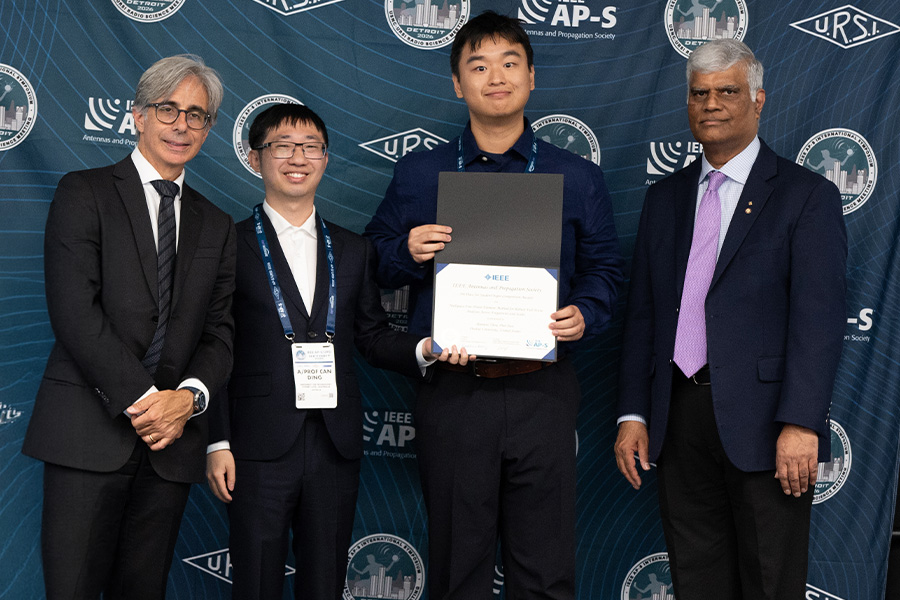
Purdue University graduate student Runwei Zhou received a Best Student Paper Award at the 2026 IEEE International Symposium on Antennas and Propagation for research that could help engineers reliably simulate multiscale electromagnetic problems, such as integrated circuits and systems, from DC to optical frequencies across length scales ranging from nanometers to centimeters.
Zhou, a graduate student in Purdue’s Elmore Family School of Electrical and Computer Engineering, received the honor during the symposium, held July 12-17 in Detroit.
His award-winning paper, “Nullspace-Free Finite-Element Method for Robust Full-Wave Analysis Across Frequencies and Scales,” was advised by Dan Jiao, Synopsys Professor of Electrical and Computer Engineering.
The research addresses a persistent problem in the computational solution of Maxwell’s equations, which is used in technologies ranging from antennas and wireless communication systems to computer chips and medical imaging devices.
Engineers use modeling and simulation to predict electrical and electromagnetic performance before building and testing physical devices. However, these computations can break down or become inaccurate when engineers examine a broadband of frequencies or work across small and large physical scales.
Zhou and Jiao developed an exact and efficient method for removing a numerical problem known as “low-frequency breakdown” in full-wave electromagnetic analysis. The approach eliminates the root cause of the problem, which is the inherent nullspace of a full-wave numerical system, allowing computers to produce solutions across a wider range of conditions which previously cannot be found.
The IEEE International Symposium on Antennas and Propagation is the flagship annual conference of the IEEE Antennas and Propagation Society. The event traditionally attracts more than 1,600 researchers, engineers and students from over 30 countries.
Students entering the symposium’s paper competition must be the first and only student author on their submission. Papers undergo independent, double-blind reviews by experts from universities, industry and research laboratories.
The competition recognizes exceptional student-led research in antennas, electromagnetic wave propagation and related technologies.