
New class of optical materials opens new possibilities for controlling light
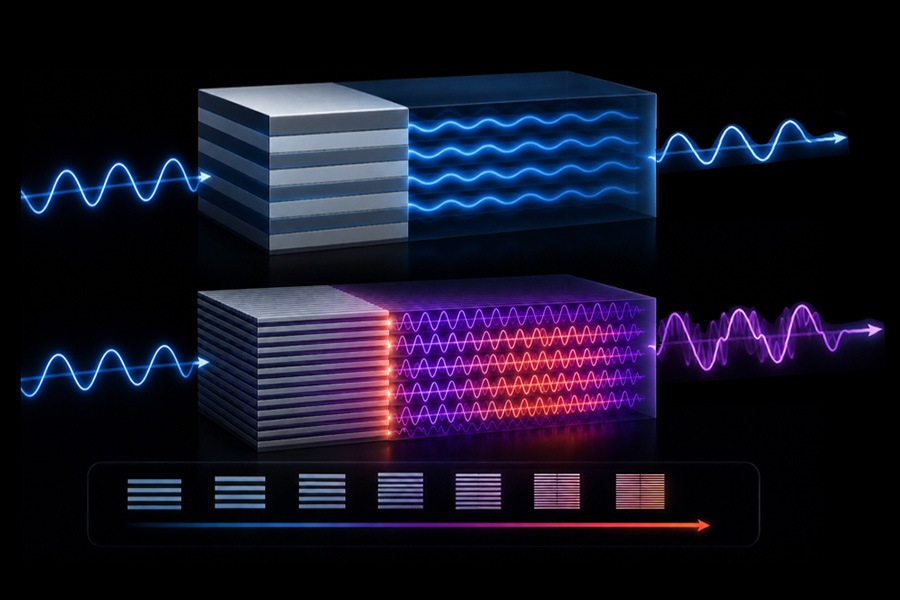
A new class of engineered materials proposed by researchers at Purdue University and the University of Massachusetts Lowell has now moved from theory to reality, potentially creating new ways to control light for sensing, communications and other advanced technologies.
The materials, known as intrinsically nonlocal metamaterials, were experimentally created and tested by a multi-university research team. The results, published in Nature Communications, confirmed theoretical predictions developed by Evgenii Narimanov, the Elmore Professor in Purdue’s Elmore Family School of Electrical and Computer Engineering, and Viktor Podolskiy, professor of physics and applied physics at UMass Lowell.
Metamaterials are made by combining and arranging existing materials to produce properties not normally found in nature. They have helped researchers manipulate light in unusual ways, enabling advances such as compact optical components and improved sensors.
Traditionally, scientists describe a material as responding to the electromagnetic field at each point. This is known as a “local” response. In a nonlocal material, however, what happens at one point is also influenced by the field in the surrounding area.
That behavior is usually so weak that it can be treated as a small correction. Narimanov and Podolskiy showed that carefully arranging materials at extremely small scales could bring this normally hidden behavior to the forefront. Instead of simply correcting a material’s conventional optical response, nonlocality could become the dominant factor determining how light moves through it.
“This work reveals a part of a material’s behavior that has usually remained hidden,” Narimanov said. “By designing the structure at the right scale, we can make those underlying interactions strong enough to shape how light travels through the material. That gives us an entirely new tool for controlling light and its interaction with matter.”
Narimanov and Podolskiy introduced the theoretical foundation for the concept in an ACS Photonics paper published earlier this year. They originally called the new class “primordial materials” because the approach uncovers optical behavior that is already inherent within the materials’ basic physical properties.
During review of the experimental paper, the terminology was changed to “intrinsically nonlocal materials.” The two names describe the same class of materials.
The Nature Communications study reports the experimental realization of the concept through a collaboration involving Purdue, UMass Lowell, The University of Texas at Austin and the University of Illinois Urbana-Champaign. Researchers fabricated a layered semiconductor structure and measured how light passed through it.
The measurements revealed the distinctive optical behavior predicted by Narimanov and Podolskiy’s theory. Importantly, the effect was observable at room temperature and in a practical, macroscopic sample rather than only under highly controlled or idealized laboratory conditions.
A new class of engineered materials proposed by researchers at Purdue University and the University of Massachusetts Lowell has now moved from theory to reality, potentially creating new ways to control light for sensing, communications and other advanced technologies.
The materials, known as intrinsically nonlocal metamaterials, were experimentally created and tested by a multi-university research team. The results, published in Nature Communications, confirmed theoretical predictions developed by Evgenii Narimanov, the Elmore Professor in Purdue’s Elmore Family School of Electrical and Computer Engineering, and Viktor Podolskiy, professor of physics and applied physics at UMass Lowell.
Metamaterials are made by combining and arranging existing materials to produce properties not normally found in nature. They have helped researchers manipulate light in unusual ways, enabling advances such as compact optical components and improved sensors.
Traditionally, scientists describe a material as responding to the electromagnetic field at each point. This is known as a “local” response. In a nonlocal material, however, what happens at one point is also influenced by the field in the surrounding area.
That behavior is usually so weak that it can be treated as a small correction. Narimanov and Podolskiy showed that carefully arranging materials at extremely small scales could bring this normally hidden behavior to the forefront. Instead of simply correcting a material’s conventional optical response, nonlocality could become the dominant factor determining how light moves through it.
“This work reveals a part of a material’s behavior that has usually remained hidden,” Narimanov said. “By designing the structure at the right scale, we can make those underlying interactions strong enough to shape how light travels through the material. That gives us an entirely new tool for controlling light and its interaction with matter.”
Narimanov and Podolskiy introduced the theoretical foundation for the concept in an ACS Photonics paper published earlier this year. They originally called the new class “primordial materials” because the approach uncovers optical behavior that is already inherent within the materials’ basic physical properties.
During review of the experimental paper, the terminology was changed to “intrinsically nonlocal materials.” The two names describe the same class of materials.
The Nature Communications study reports the experimental realization of the concept through a collaboration involving Purdue, UMass Lowell, The University of Texas at Austin and the University of Illinois Urbana-Champaign. Researchers fabricated a layered semiconductor structure and measured how light passed through it.
The measurements revealed the distinctive optical behavior predicted by Narimanov and Podolskiy’s theory. Importantly, the effect was observable at room temperature and in a practical, macroscopic sample rather than only under highly controlled or idealized laboratory conditions.
“The agreement between theory and experiment shows that intrinsic nonlocality can be intentionally used in material design. We are no longer discussing only what might be possible - we now have a physical platform that demonstrates it,” Podolskiy said.
The new materials could give researchers more precise control of electromagnetic fields at scales much smaller than the wavelength of light. Although the research remains foundational, the concept could eventually influence technologies involving integrated photonic circuits, optical communications, sensing, imaging and interactions between light and quantum systems.
The research was supported by the U.S. National Science Foundation’s Designing Materials to Revolutionize and Engineer our Future, or DMREF, program.
The new materials could give researchers more precise control of electromagnetic fields at scales much smaller than the wavelength of light. Although the research remains foundational, the concept could eventually influence technologies involving integrated photonic circuits, optical communications, sensing, imaging and interactions between light and quantum systems.
The research was supported by the U.S. National Science Foundation’s Designing Materials to Revolutionize and Engineer our Future, or DMREF, program.