
Beyond the Purcell effect: Purdue ECE researchers extend quantum nanophotonic engineering beyond light emission
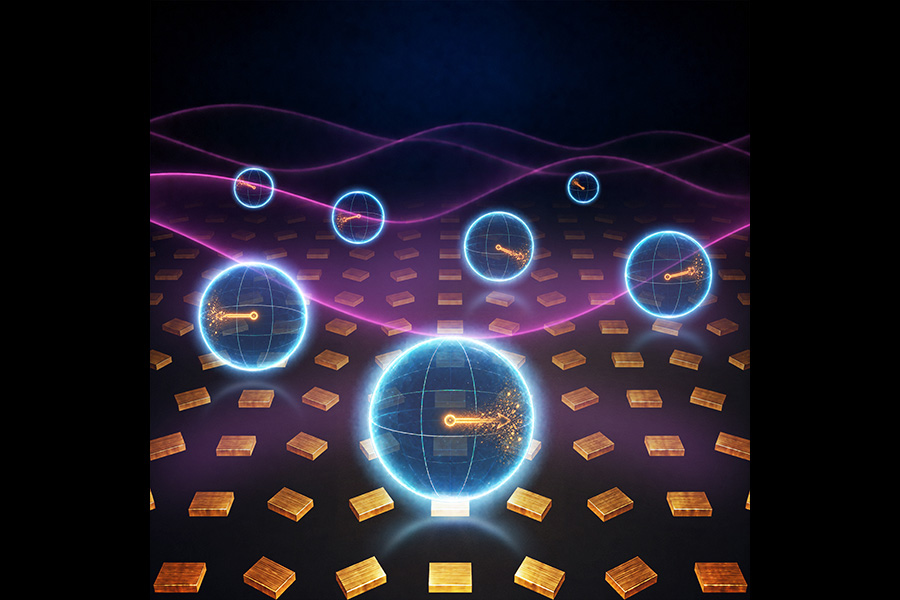
For nearly 80 years, scientists have known how to change the way an atom emits light - surrounding it with the right structure. That discovery, the Purcell effect of 1946, grew into a pillar of quantum photonics, with cavities, waveguides, and photonic crystals all built to speed up or slow down emission.
But emission is only half of how a quantum system talks to its electromagnetic surroundings. The other half is quieter. Random fluctuations in those surroundings gradually knock the parts of a quantum state out of step with one another, scrambling the stored information even though no energy is lost. This process is called pure quantum dephasing. Could structured electromagnetic environments control it too?
Led by Zubin Jacob, the Elmore Professor of Electrical and Computer Engineering, and Dan Jiao, the Synopsys Professor of Electrical and Computer Engineering, the Purdue team developed patterned magnetic surfaces, “spin noise metasurfaces,” to shape the pure quantum dephasing dynamics of defect spins in diamond. The results are described in a paper published recently in Optica, by co-first authors Wenbo Sun, Shoaib Mahmud and Wei Zhang, with other Purdue ECE researchers.
“For decades, the Purcell effect has taught us to design photon emission from quantum emitters,” said Jacob. “This work reveals a complementary regime in which the quantum dephasing noise in electromagnetic environments can also be engineered.”
A key challenge, however, is that this paradigm shift brings an extreme mismatch of frequency and scale.
“Light emission and dephasing of a quantum system involve interactions between quantum systems and environments at very different frequencies,” said Sun, Mahmud and Zhang. “Purcell engineering works at the transition frequency of emitters typically around Terahertz or optical frequencies, while the quantum dephasing measured here is driven by broadband fluctuations in the megahertz range.”
At those low frequencies, the free-space wavelength is many orders of magnitude larger than the nanometer-scale pattern size and the distance to the diamond spins. Yet the EM environment that matters is confined close to the surface, creating an ultra-subwavelength problem that conventional wavelength-scale photonic engineering approaches can hardly handle.
“This introduces a complex electromagnetic design and engineering problem spanning drastically different length scales unlike conventional quantum photonic problems,” said Jiao.

To bridge this gap, the Purdue team developed two differently patterned magnetic surfaces near quantum spins in diamond. Small thermal fluctuations in the magnetic surfaces create magnetic noise in the region just near them. Changing the pattern changes how that noise reaches the spins. The geometry acts as a filter, selecting which spatial textures of the magnetic noise survive the short trip to the qubits.
To test the idea, the team patterned an ultrathin film of a magnetic material into two metasurfaces with different geometries, placed directly above nitrogen-vacancy centers, atomic-scale defects in diamond that act as robust room-temperature qubits. Near the metasurfaces, the diamond spins lost their rhythm several times faster than far away, and at different rates near the two different patterns. Listening to the noise itself with sequences of microwave pulses, the team found that each geometry left its own distinct fingerprint in the frequency-by-frequency spectrum of noise that the qubits feel, qualitatively different from the diamond's intrinsic background.
“The important point is that each metasurface geometry left a different fingerprint in the dynamics and noise spectrum,” said Jacob. “This gives researchers a new design knob in engineering electromagnetic environments surrounding quantum systems for future applications.”
This knob may matter more than it first appears. Dephasing is usually the enemy of quantum information, but controlled dephasing can also be a resource. Carefully tuned noise is known to help energy flow through disordered quantum systems, a mechanism studied in quantum energy transfer and proposed for fast charging quantum batteries.
At this stage, Jacob says, the current work “demonstrates an interesting fundamental phenomenon,” showing the capabilities of photonic structures in engineering quantum dephasing.
“Looking ahead, the long-term goal is to develop controlled electromagnetic environments for desired noise engineering in next-generation spin qubit quantum devices,” he said.
And, Sun added, by extending this approach to multiple interacting quantum spins, as recent theoretical works from the team have suggested,
“We could employ the engineered electromagnetic environment to shape collective behaviors of dephasing processes in different spins, which can potentially protect entanglement and enable new quantum sensing capabilities,” said Sun.
The research team also included Runwei Zhou and Pronoy Das. The Purdue researchers are affiliated with the Elmore Family School of Electrical and Computer Engineering and Birck Nanotechnology Center. The work was supported by the U.S. Army Research Office.