
What If Your Dog’s Jacket Could Detect Illness?
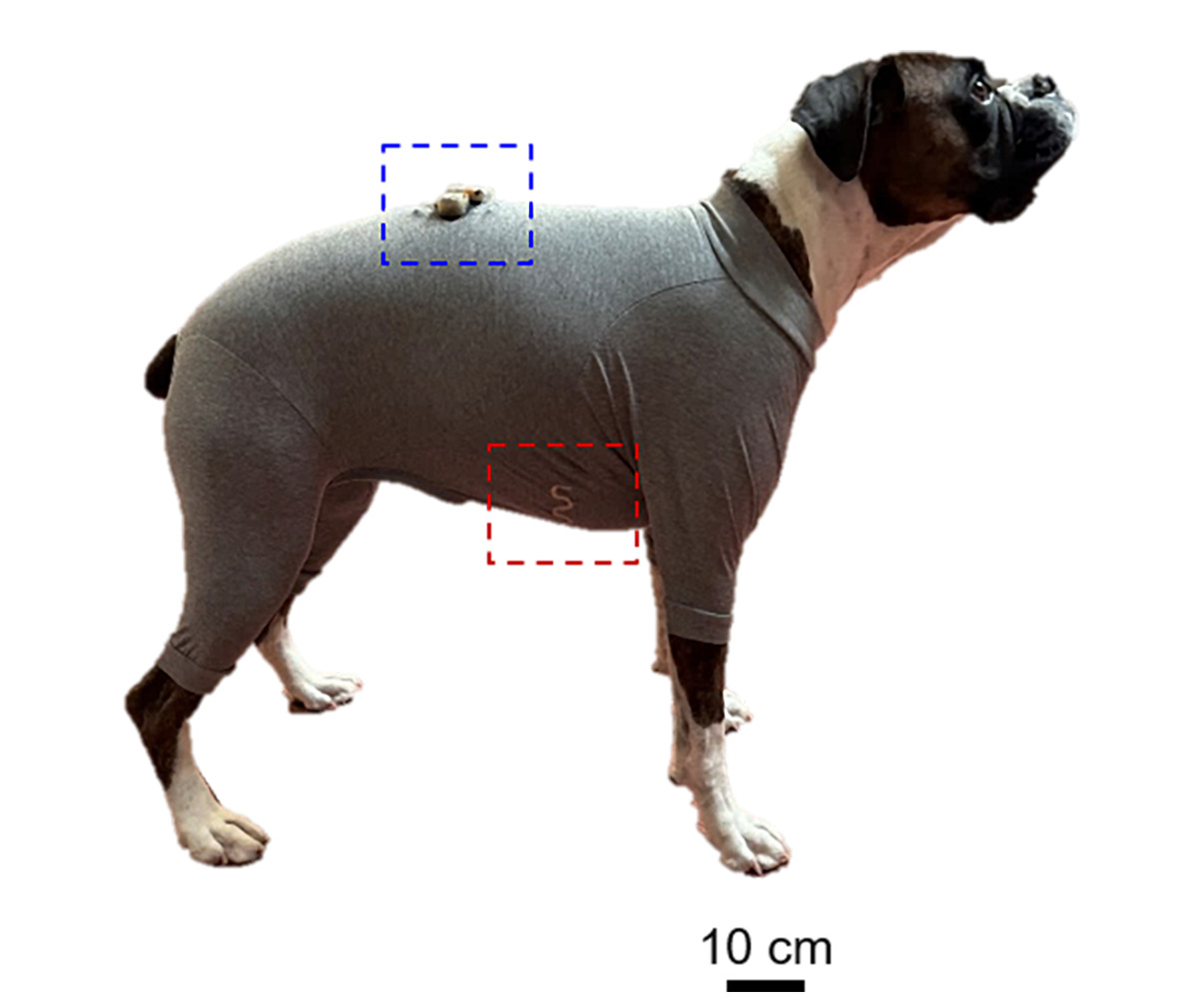
A Boxer wearing the smart garment developed by Purdue University researchers. The blue box indicates the data acquisition module, and the red box indicates the spongy-like strain sensor used to monitor respiration in real time. (Caption, Figure 1)
Chi Hwan Lee, Professor of Biomedical Engineering and Mechanical Engineering, has spent years developing wearable medical devices, from smart bandages to Bluetooth health sensors for large animals, including horses. His latest work brings that expertise to veterinary care: a sensor-embedded jacket that tracks a dog's respiration, body temperature, and physical activity without disrupting its daily routine.
"We wanted a solution that fits naturally into a dog's life, not something that causes stress or limits their movement," said Seokkyoon Hong, co-lead author of the study. "By building directly into commercially available apparel, the garment stays comfortable."
The garment achieves this by integrating three key components directly into the fabric: a spongy-like strain sensor that detects subtle breathing movements, serpentine interconnectors that distribute mechanical stress during motion, and a compact data acquisition (DAQ) module that wirelessly transmits respiratory, temperature, and activity data to a smartphone in real time.
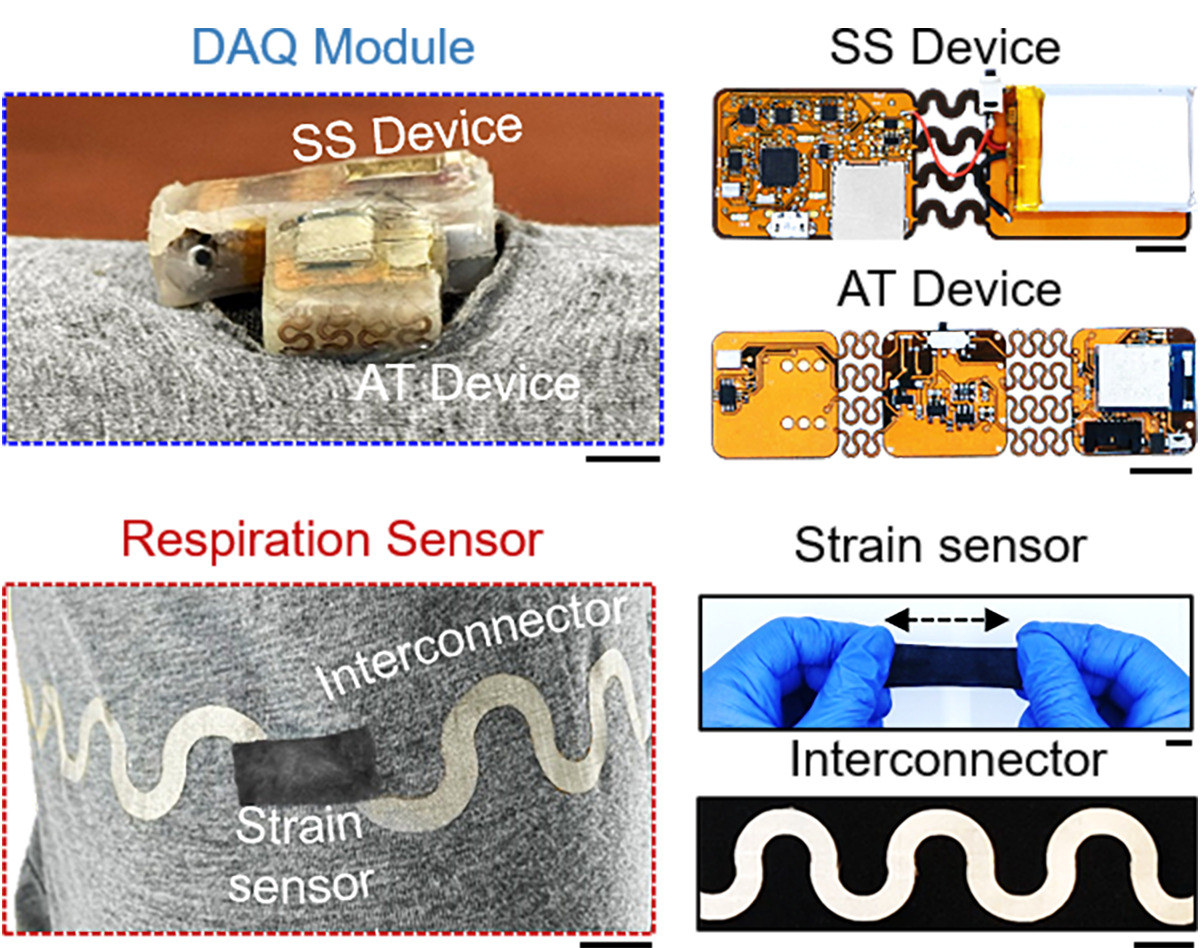
Detailed views of the smart garment's key components: the DAQ module (blue), consisting of the strain sensor (SS) device and accelerometer/temperature (AT) device, and the spongy-like strain sensor with serpentine interconnectors (red), which detects subtle breathing movements and transmits data wirelessly in real time. All scale bars, 1cm. (Caption, Figure 2)
To validate the garment in real conditions, a team led by Luis Dos Santos, Assistant Professor of Veterinary Clinical Sciences, oversaw testing on two breeds (a Labrador Retriever and a Boxer) across resting, walking, and running activities.
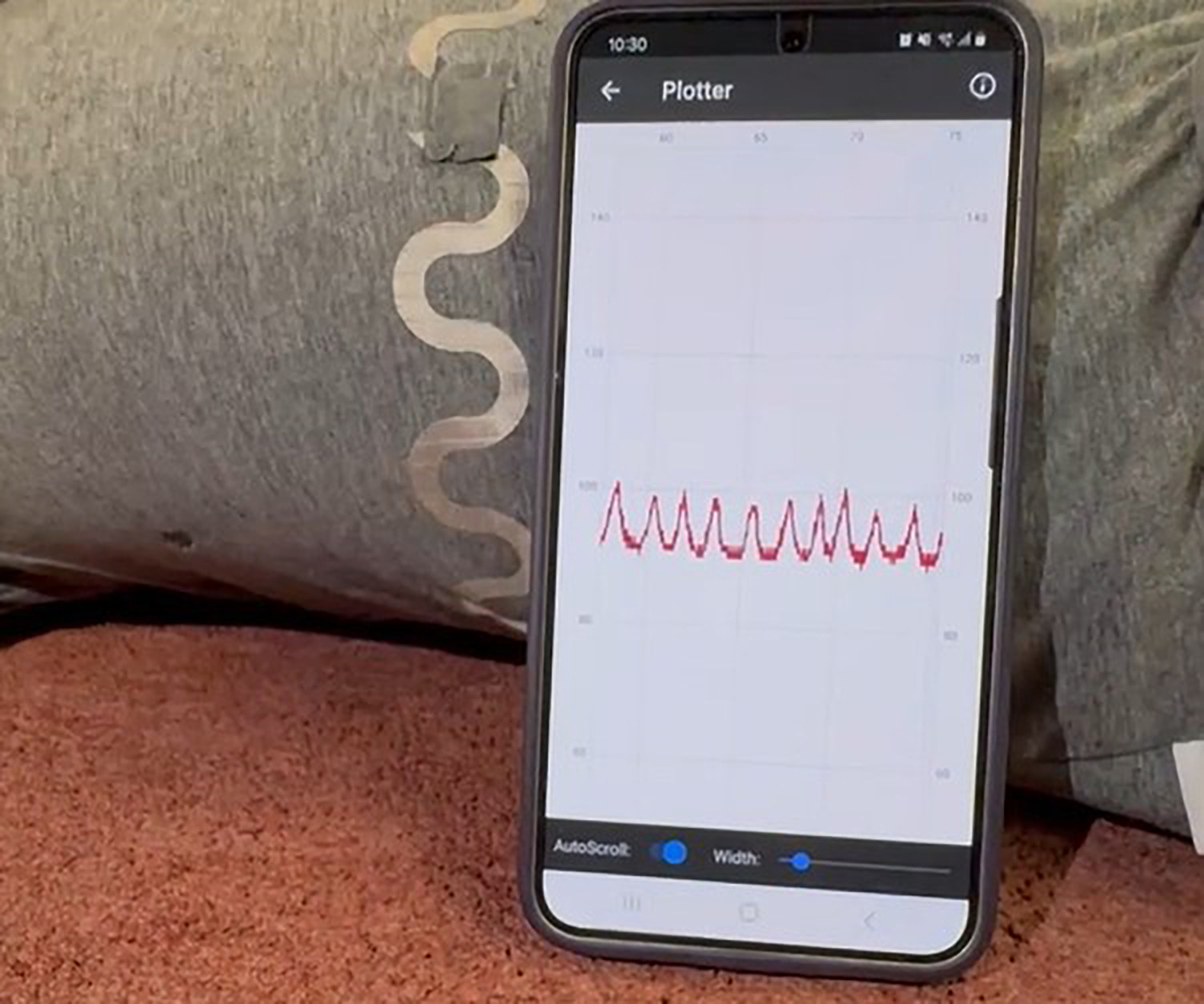
Real-time respiratory monitoring of a Labrador Retriever at rest. The waveform, captured by the smart garment, is wirelessly transmitted and visualized through a paired smartphone application. (Caption, Figure 3)
But raw data alone tells only part of the story. Prof. Rachel K. Surowiec, Assistant Professor of Biomedical Engineering, brought her expertise in AI and data analytics to make sense of the signals. Using machine learning models, the system classifies respiratory patterns across breeds and activity levels with more than 94% accuracy.
So, what's next?
Health for All
"We want to test the smart garment on more diverse dog breeds," said Hong. "Ultimately, we hope to scale this platform beyond companion animals to livestock and animals of all kinds by adapting the garment to different body sizes and species. Our goal is a future where every animal has access to continuous health monitoring regardless of location."
The research was published in ACS Sensors and supported in part by the National Institutes of Health (Award No. R21EB034879).
Smart Garment for Continuous Respiration Monitoring in Canines
Seokkyoon Hong, Taewoong Park, Youngjun Lee, Juan C Mesa, Tianhao Yu, Yuhyun Ji, Junsang Lee, Jinheon Jeong, Seok-Won Kang, Dong Rip Kim, Young L Kim, Hyowon Lee, Rachel K Surowiec, Luis Dos Santos, Chi Hwan Lee
https://doi.org/10.1021/acssensors.5c03783
ABSTRACT: There is a growing need for at-home respiration monitoring in canines, who are prone to respiratory issues due to breed-specific anatomy and active lifestyles. Continuous monitoring of respiration provides critical insight into stress and illness; however, current solutions—ranging from clinical instruments to wearable devices—are either accurate but invasive and episodic or limited in fit and comfort. Here, we introduce a smart garment that integrates a spongy-like strain sensor and compact data acquisition module into commercially available canine apparel, enabling continuous, non-invasive monitoring of respiration, body temperature, and physical activity. Validation with two breeds, Labrador and Boxer, confirmed its ability to capture breed- and activity-specific respiration patterns, including differences in breathing rate, amplitude, and panting behavior. Using a convolutional neural network (CNN)-assisted machine learning (ML), the system classified respiratory patterns across breeds and activity levels with over 94.3% accuracy. Beyond canines, this platform may hold potential for future adaptation to other companion animals, such as cats, suggesting a broader scope for home-based veterinary monitoring.