
Walking the Data: Purdue BME Students Explore Human Motion through Active Learning
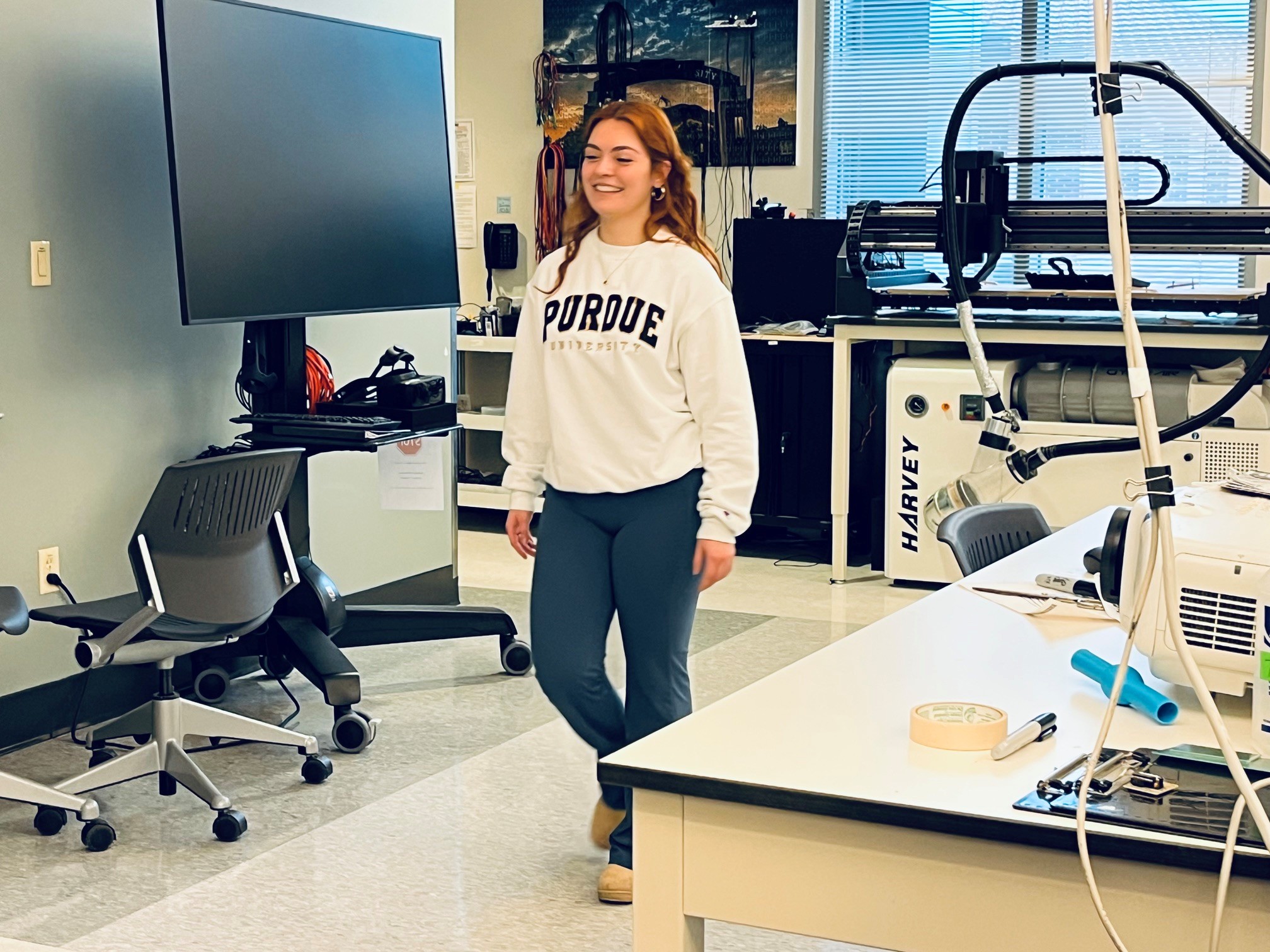

Instead, OpenCap uses cell phone cameras to capture the movement and artificial intelligence to reconstruct motion in three dimensions.
The exercise is part of an active learning activity in Experimental Methods in Biomechanics, taught by Deva Chan, that introduces students to markerless motion analysis, a modern technique used by engineers and researchers to evaluate human movement. Rather than relying on traditional marker-based motion capture systems, markerless platforms use computer vision and machine learning to estimate joint positions and generate biomechanical measurements.
For students, the technology provides a hands-on way to experience how motion capture studies are conducted. They take turns acting as participants, capturing their own movement data and then analyzing the results themselves.
Walking Into the Data
During the activity, each student walks across the classroom several times while the system records their movement. The software captures information such as walking speed, joint angles, hip flexion, pelvic tilt and stride symmetry.
The data are then processed into a biomechanical dataset that students analyze using coding and data visualization tools introduced in the course.
“It feels weird,” said Areli Rosas, a student in the class. “But I cannot wait to see the results.”
For many students, seeing their own movement translated into quantitative data makes the learning experience more tangible.
From Classroom Activity to Real-World Tools
The activity has two parts. In one, students analyze publicly available datasets comparing younger and older adults to explore how gait patterns can change across the lifespan. In the other, they participate in the classroom motion capture activity and examine their own gait parameters.
Together, the exercises help students understand the kinds of questions researchers ask when studying human movement — from how aging or disease may alter the gait cycle to how engineers develop tools that measure those changes.
“They look at stride differences and explore how motion capture data can reveal patterns in human movement,” said Cameron Villarreal, a graduate student in Chan’s research group who assists with the activity.
Watch Ariel's walk here.
Many of the broader applications of gait analysis — including its role in studying aging populations, rehabilitation and performance — were discussed with students by Defne Ekici, a graduate teaching assistant for the course.
Experiential Learning in Action
The teaching module itself has its roots in another educational setting. Villarreal first worked with markerless motion capture while teaching in Purdue’s High School High Scholars summer program, where he helped develop an activity introducing younger students to the technology.
Now adapted for BME 314, the classroom exercise gives Purdue biomedical engineering students a similar opportunity to engage directly with tools used in biomechanics research.
For Chan, that hands-on exposure is the goal.
By combining biomechanics, computer vision and data analysis, the activity allows students to explore how engineers study human movement — and how technologies like markerless motion capture are expanding the ways those measurements can be made.
Because how we move is more than motion.
It is data that engineers can measure, analyze and use to understand the mechanics of the human body better.
Watch Cooper's walk here.
Acknowledgments
The BME 314 teaching team extends tremendous thanks to the developers of OpenCap, led by Dr. Scott Delp of Stanford University, for making their markerless motion analysis platform freely available for research and educational use. Their contributions significantly enhance the learning experience in BME 314.