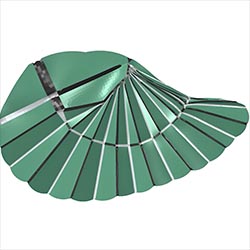
The earwig insect has more folds in its wings than any other organism in the animal kingdom but uses minimal energy to move. Through simulations and creating a 4-D replica of these folds, researchers from ETH Zürich in Switzerland and Purdue University have likened the wing to self-folding origami that could inform how to make machines be more adaptable and responsive with less energy used.
"The theory of origami assumes that you have 2-D, unstretchable materials," said Andres Arrieta, Purdue assistant professor of mechanical engineering, whose Programmable Structures Lab< contributed to the study. "But imagine that you have a piece of paper and you try to stretch it, and you store some energy there. That stretching creates bistabilities."