
Purdue twins win racing competition for fixed-wing drones
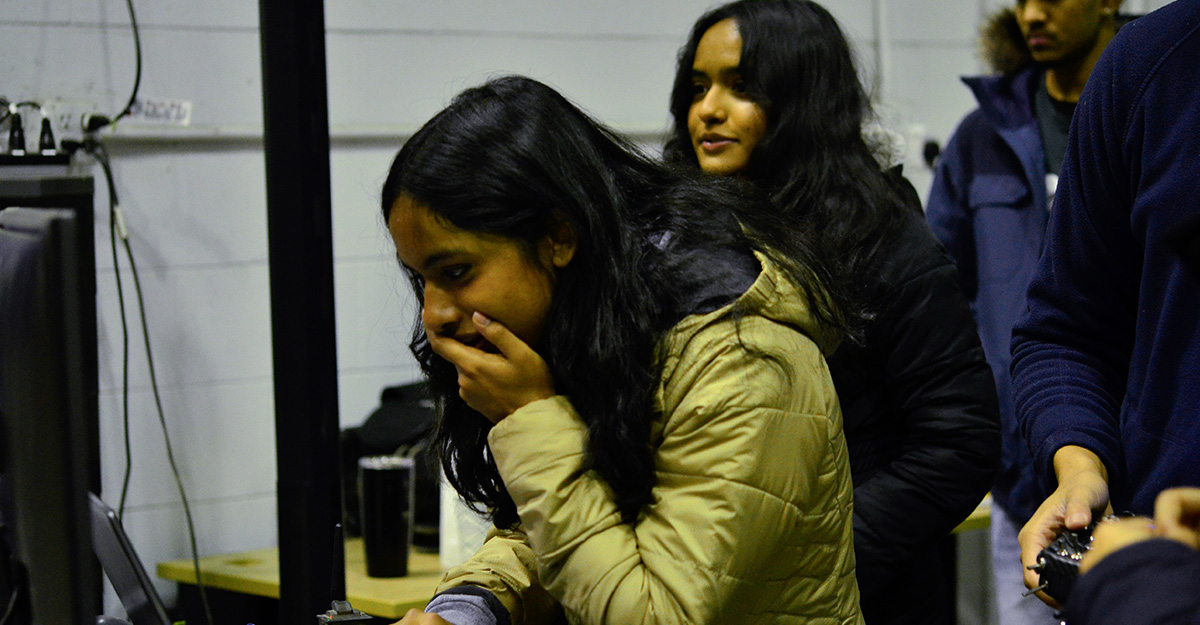
For the students who research and compete at PURT, even winter can’t temper their enthusiasm and ambition. They’re here to test their talents as autopilot engineers.
But PURT, the Purdue UAS Research and Test facility, also tests them. The simple, metal building at Purdue Airport is just a repurposed hangar. Though food and coffee were plentiful on competition day, amenities and heat are sparse always. The concrete floor, especially in December, is a challenge for anyone with thin socks.
From the outside, steel trusses above the roof are the building’s only distinguishing feature. But those trusses provide an unobstructed 30,000 cubic feet of space inside — no support beams to crash into. A million dollars’ worth of high-tech motion capture cameras hang from the rafters, making PURT the largest indoor motion-capture space in the world.
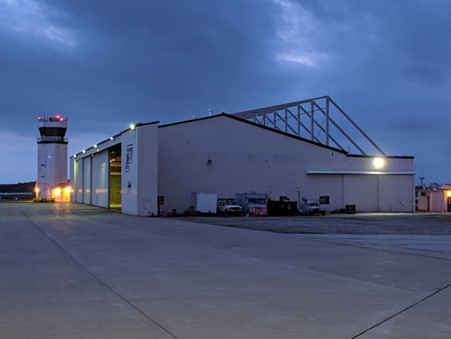
Big enough to fly model airplanes and drones. At up to 90 mph. The camera system can track anything that moves with millimeter precision.
That kind of tracking helps Purdue’s commercial and defense partners to validate controls software for the next generation of autonomous military and commercial drones. It makes PURT an essential facility in Indiana’s national drone test site, and to AIDA3, a Purdue research center for physical AI in aviation.
The competition commences
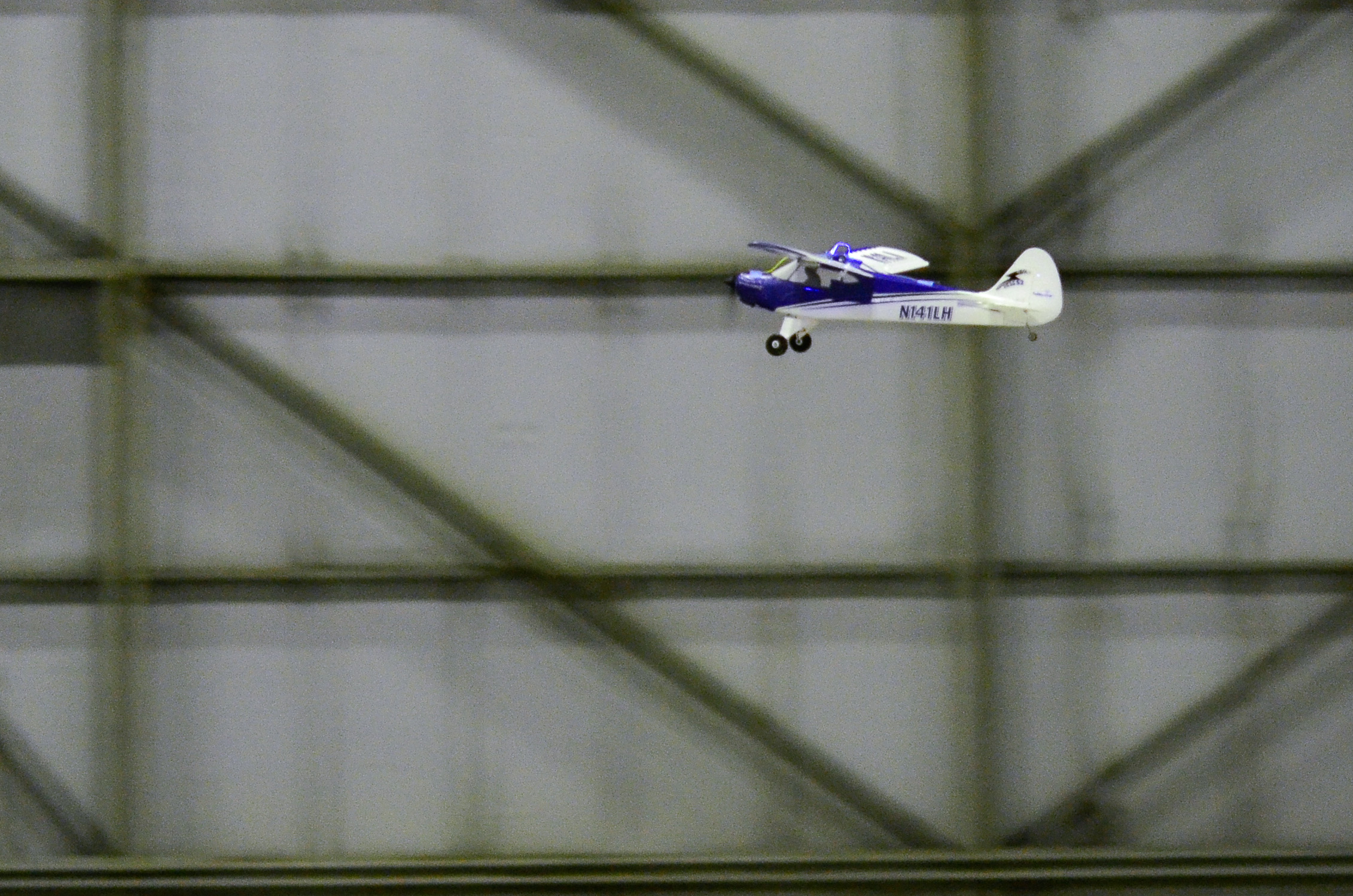
In December 2025, the Autonomous Fixed-Wing UAS Pylon Racing competition drew 25 teams from multiple institutions and industry to design the best autopilot system; Five teams advanced to the final stage. The event welcomes newcomers — minimal experience is needed in control engineering and Python programming. Teams wrote software to fly small, off-the-shelf radio-controlled planes. These fixed-wing drones were fitted with a custom interface to communicate with a ground-based autopilot.
Real-world pylon racing at PURT was the final stage of competition. Up to this point, the teams had only tested their guidance, navigation, and control (GNC) software schemes in computer simulations.
Races are held one at a time, against the clock. Each team flies as many timed laps s they can manage in their 15-minute window, making tweaks in real time to get their best clean run.
After a team’s software is loaded into their computer, a graduate student first operates the plane by remote control, taking it into a stable path over the course before the autopilot takes over.
Despite a beginner-friendly format, more experienced teams still came to compete.
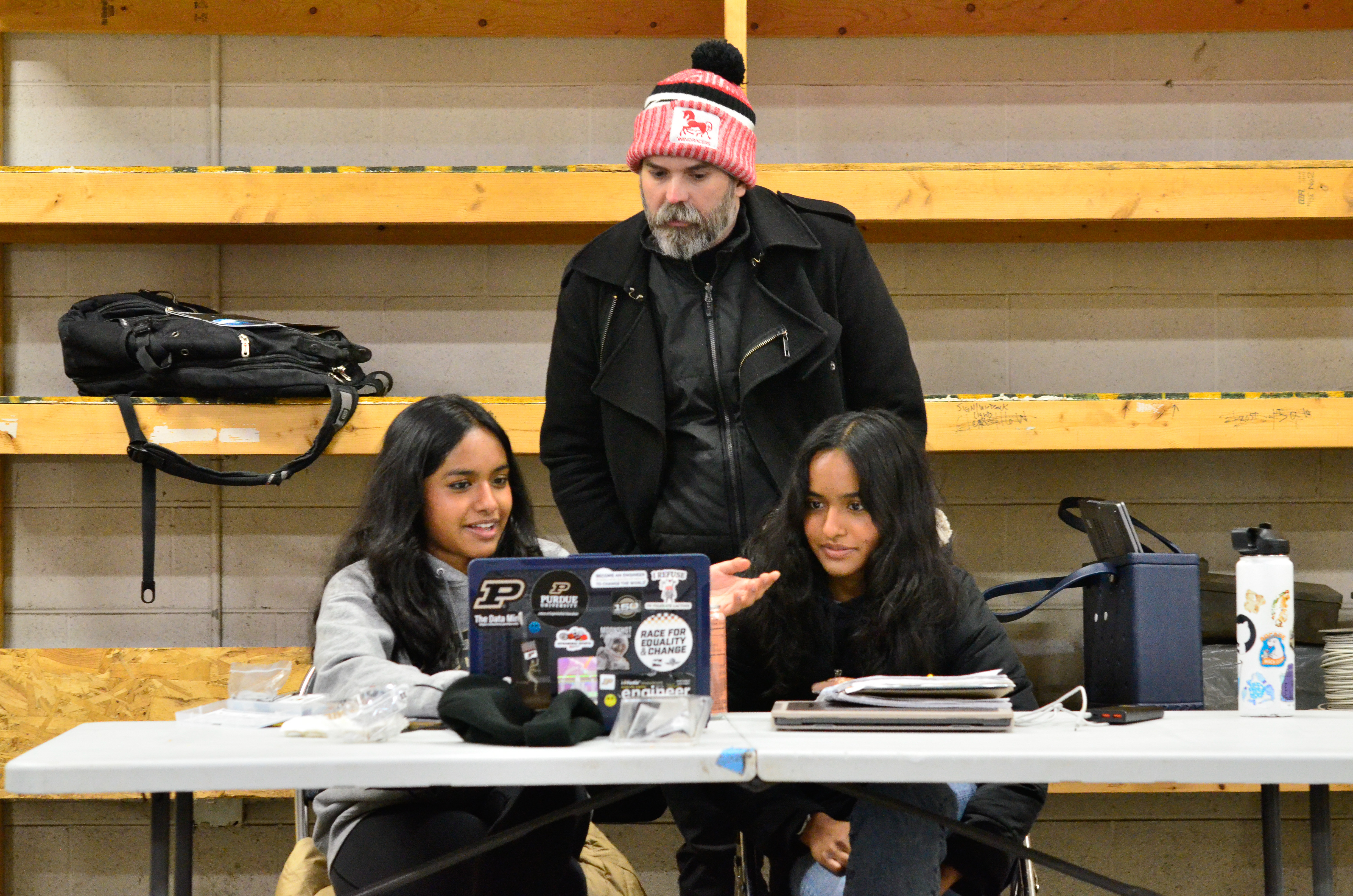
One team was made up of graduate students, who brought their own high-powered computer with an advanced model using machine learning to find the fastest path. Another student team has research experience with Windracers, Inc., an autonomous aviation firm and founding partner for Purdue's Center on AI for Digital, Autonomous and Augmented Aviation (AIDA3).
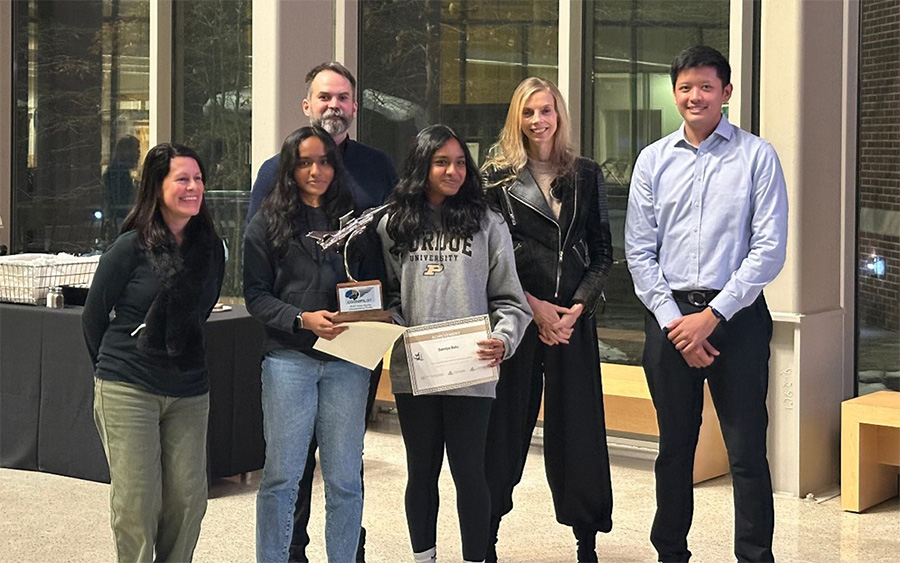
But the winners were neither of these. They were freshmen, First-Year Engineering students Samiya and Shriya Balu. Twin sisters, actually. They brought bright personalities and a competitive spirit to the hangar. They also pushed the flight envelope farther than other teams.
They finished big, too. Their best lap, at 9.360 seconds, bested the second-place finishers by an astonishing 2.3 seconds. That’s a bigger separation than between the second and seventh-place teams.
Cash prizes were awarded to the top five teams, as well as swag from the sponsoring organizations: Purdue's AIDA3, the School of Aeronautics and Astronautics, and the Rosen Center for Advanced Computing.
Students interested in real-world engineering challenges are encouraged to participate in the Spring 2026 running of this competition. Participants work directly with experts in the industry, and gain valuable hands-on experience in AI, robotics, and aviation.
Details are expected to be announced on January 28. The simulation portion will begin on February 4.
The final stage, another real-world test at PURT, is happening later in the semester. April 18.
A likely comfort to anyone suffering cold feet.
Competition signup and more details are at the UAS Pylon Racing competition website.