
Definitely Look Up: Planetary-Defense Activities at Lawrence Livermore National Laboratory | an AAE Special Seminar
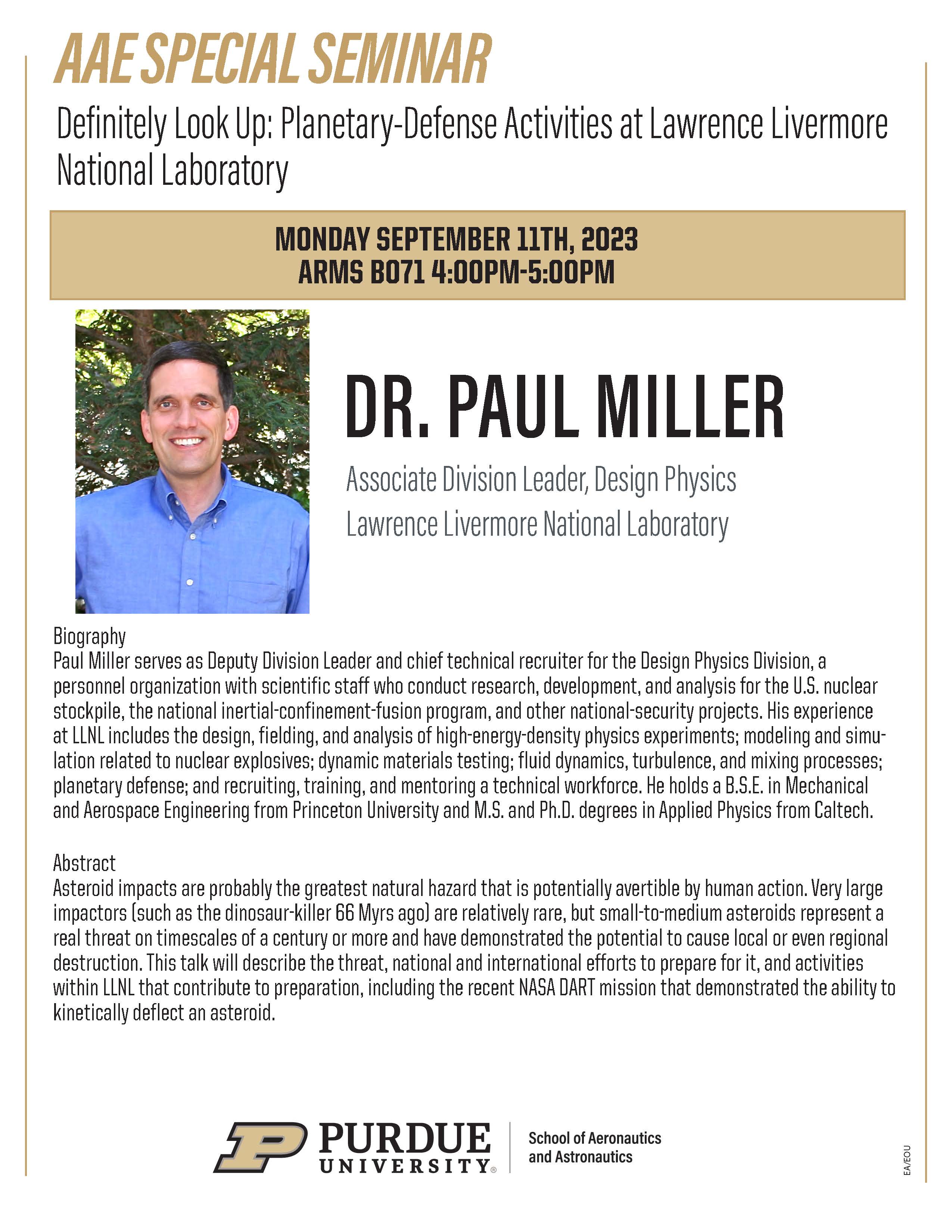
Smaller asteroids represent a real threat and have demonstrated the potential to cause local or even regional destruction. This talk will describe the threat, national and international efforts to prepare for it, and preparation activities underway at Lawrence Livermore National Laboratory. Presented by Paul Miller, deputy leader for the design physics division at LLNL.
Abstract
Asteroid impacts are probably the greatest natural hazard that is potentially avertible by human action. Very large impactors (such as the dinosaur-killer 66 million years ago) are relatively rare, but small-to-medium asteroids represent a real threat on timescales of a century or more and have demonstrated the potential to cause local or even regional destruction. This talk will describe the threat, national and international efforts to prepare for it, and activities within LLNL that contribute to preparation, including the recent NASA DART mission that demonstrated the ability to kinetically deflect an asteroid.
Biography
Paul Miller serves as Deputy Division Leader and chief technical recruiter for the Design Physics Division, a personnel organization with scientific staff who conduct research, development, and analysis for the U.S. nuclear stockpile, the national inertial-confinement-fusion program, and other national-security projects. His experience at LLNL includes the design, fielding, and analysis of high-energy-density physics experiments; modeling and simulation related to nuclear explosives; dynamic materials testing; fluid dynamics, turbulence, and mixing processes; planetary defense; and recruiting, training, and mentoring a technical workforce. He holds a B.S.E. in Mechanical and Aerospace Engineering from Princeton University and M.S. and Ph.D. degrees in Applied Physics from Caltech.