
Purdue AAE Professor James Garrison to Advance Satellite-Based Earth Sensing Through TUW Global Fellowship
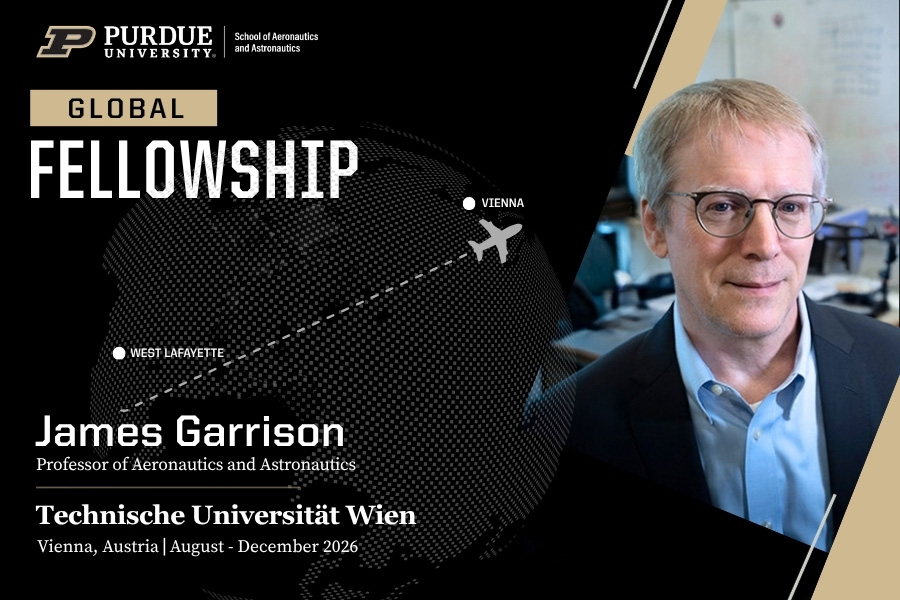
From August through December 2026, Purdue AAE professor James Garrison is sharing his Earth sensing expertise with Technische Universität Wien (TUW) in Vienna, Austria, through their Global Fellowship program.
Garrison's research examines how radio signals from satellites can be used to study the Earth. He has worked in this field for most of his career, with his most notable contribution being early development of Global Navigation Satellite System Reflectometry (GNSS-R). This method captures GPS and other navigation signals reflected off Earth’s surface to study environmental factors like moisture in the soil, the extent of surface water in wetlands and flooded areas, and wind speed over oceans. He has since generalized these techniques to nearly any emitted signal that interacts with the natural environment, a technique now known as "signals of opportunity."
At TUW, Garrison will teach a course introducing GNSS-R methods, starting from fundamental physical principles and signal theory, and showing how they are applied to extract useful measurements from transmissions designed for other purposes.
His research at TUW will examine how signals of opportunity interact with land surfaces, aiming to disentangle the effects of vegetation and standing water. He will work closely with colleagues from the Department of Geodesy and Geoinformation of TUW, who will bring in their expertise in microwave remote sensing and GNSS data analysis.
The aim of the collaboration is to apply physics-informed machine learning to this problem, first to better understand its underlying physics, then to use that understanding to constrain the retrieval of geophysical parameters.
These methods could enable new, higher-accuracy retrievals of land surface parameters from ESA's recently launched HydroGNSS mission. New applications of these measurements could also expand research in wildfire risk, ecology, and flood mapping. Garrison's visit will help lay the groundwork for future research using signals of opportunity from upcoming Earth observation satellites and strengthen collaboration between Purdue and Austria in this research area.