
Engineering at Full Speed: Chenkai Zhang's journey from Formula SAE to Formula 1
Three days.
That’s how long it can take for an idea sketched out to become a real aerodynamic component on a Formula 1 car. The team uses computer simulations to experiment with roughly 10,000 different geometries every year; Of those, roughly 1,500 show enough potential to test in a wind tunnel.
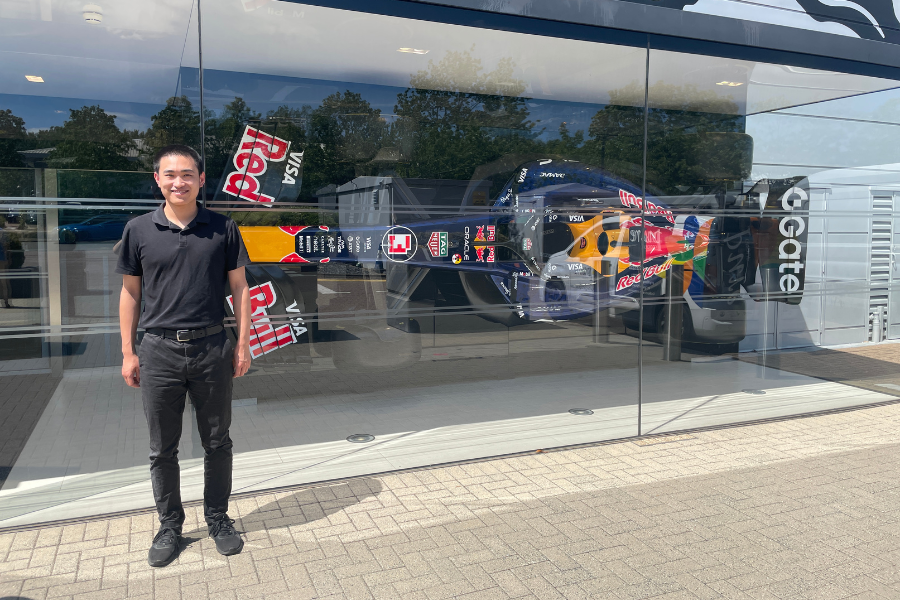
For Purdue alumnus Chenkai Zhang, that relentless pace is just another day at Red Bull Racing, where he helps design the aerodynamic components that push one of the world's fastest race cars to peak performance.
After earning both his bachelor's and master's degrees in Aeronautical and Astronautical Engineering from Purdue, Zhang built the foundation for his Formula 1 career through hands-on experiences that mirrored the sport itself. He led aerodynamic development for Purdue Formula SAE, completed an industrial placement with the Mercedes-AMG Petronas Formula One Team, and developed the technical expertise that prepared him for one of engineering's most competitive industries.
Where Every Millisecond Matters
For Zhang, Formula 1 is unlike any other engineering field. The wind tunnel model changes every week, presenting new aerodynamic challenges with no guaranteed solutions. Engineers must balance theory, creativity and data, refining and analyzing every change in pursuit of even the smallest performance gains.
The pace and pressure leave little room for hesitation. Success isn’t guaranteed, which is exactly what keeps Zhang motivated.
“The thing I love the most about working on F1 cars, particularly aerodynamics, is that it is challenging,” he said. “You have to learn as you go. I learn something new every day when I go to work. “
With the emphasis on rapid decision-making, engineers can focus on what they love most.
“You don't even write reports. You just do your thing. It's all about engineering the car to the max.”
Building a Formula 1 Foundation
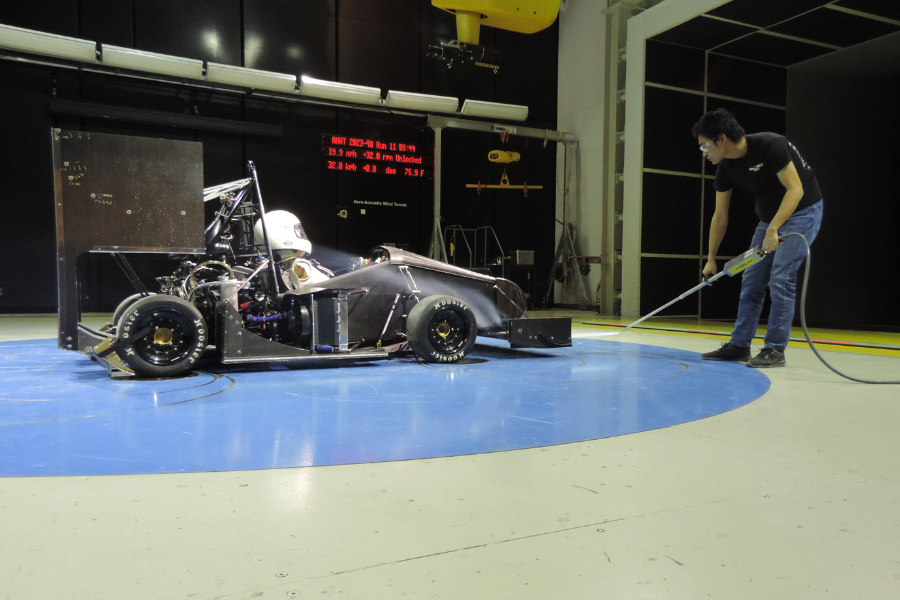
Long before Red Bull Racing, Zhang was developing many of the same skills through Purdue Formula SAE. He led the aerodynamics development of the team's 2023 vehicle and continued to play a major role in the aerodynamic development of the 2024 and 2025 cars.
Through Formula SAE, Zhang gained experience across the full aerodynamic development cycle, including CFD, aerodynamic design, full-scale wind tunnel testing at both Ford and Stellantis, track testing and CFD correlation. “The Formula SAE team is really like a mini F1 team. The work you do and the things you learn are directly applicable to F1.”
That hands-on experience led to an industrial placement with the Mercedes-AMG Petronas Formula 1 team, where Zhang applied those skills in a professional environment.
“That was my first connection to this industry and was also crucial for me to be hired full time,” Zhang said. “I encourage anyone with an interest in motorsports or anyone who is after a challenging experience to check out F1 industrial placement.”
The Fundamentals Behind the Fastest Cars
Although Formula 1 aerodynamics involves highly complex, real-world flow conditions, Zhang says the fundamentals he learned at Purdue continue to shape his work today. The concepts introduced in the classroom provided the foundation needed to understand and solve the aerodynamic challenges of elite motorsports.
“You cannot develop a deep enough understanding of aerodynamics required for F1 without first learning about the basics you do in school, which Purdue teaches very well,” Zhang said.
Zhang points to several courses that played an important role in his development as an aerodynamicist.
“AAE333 Fluid Mechanics by Professor Shih was my first fluids related class Purdue,” Zhang recalled. “This was the most useful class at Purdue for me. And thoroughly enjoyed the class. It covered everything from fluid statics at the start, to pipe flows, to potential flows, and ultimately to extremely simple applications of the Navier Stokes Equation.”
That foundation continued through courses such as AAE412: Introduction to Computational Fluid Dynamics, which shaped how Zhang approaches aerodynamic analysis. The course helped him better understand the mathematics and methods behind the simulations he now uses every day.
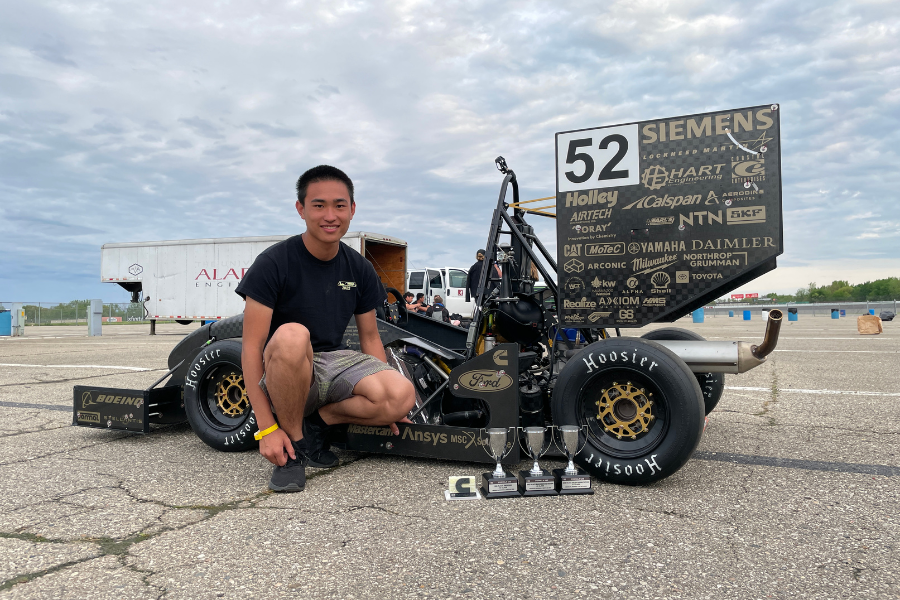
While these courses provided the technical foundation for his career, Zhang says some of his most meaningful Purdue memories came from applying that knowledge through Formula SAE. His favorite moment was winning the design event at Formula SAE Michigan during his final year at Purdue.
“Winning design was something we always dreamed about because that is proof we were the best engineers out of the 100+ universities that competed, as evaluated by experienced industry professionals. And for that to happen during my last year as well, it was an incredibly proud moment for all of us.”