
Engineering innovation: Purdue seniors invent a dual swing conveyor unloader
Engineering innovation: Purdue seniors invent a dual swing conveyor unloader
During harvest time, tractors pull grain trailers beside combines to catch the golden streams of dried corn and soybeans pushed overhead by an auger unloader. While scenic, the work is not always easy nor the technology perfect.
The modern day auger was designed in the 1940s and hasn’t changed much since. It works by spinning a screw-like helix inside, pushing the grain upwards. It hangs stationary off the left side of the combine, meaning that grain can only be unloaded from that one side. The tractor and grain trailer can’t drive through a standing crop, so they have to wait for the combine to turn around.
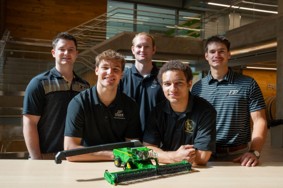
Five agricultural systems management seniors (David Will, Ethan Mestach, Kyle Matthys, Harrison Bailey, and Brant Kunz) in Purdue’s Department of Agricultural and Biological Engineering (ABE) rose to the challenge to develop a new unloader for their capstone project, with the goal to save farmers time and money.
David Will said, “This was kind of a daunting idea at the start. For me, this project reinforced that we should never be afraid to push the envelope on something and find something new. Even though a system might work well today, there's nothing saying that it can't be improved, or a new design won't increase efficiency in the future.”
Unlike stationary augers, their prototype can spin around a full 360 degrees, meaning farmers can unload from both sides of the combine. While current augers remain at one angle, which can fall in a driver’s blind spot, the dual swing unloader would allow farmers to unload at whatever angle was most comfortable for them, even if they want to unload in front of the combine. A hinge in the middle of the unloader also enables it to fold over 90 degrees to reduce the footprint of the combine when it is driving on the road.
The unloader also boasts an adjustable spout that allows a farmer to better aim the grain into the trailer.
“On a roughly rectangular 320 acre field, with about 200 bushels per acre of corn, we calculated that our unloader would save farmers 3.82 hours of field time and about 21 cents per acre. Now, that might seem kind of low at first, but for farmers with 1000s of acres, the more acres you run, the more money and time you save,” Harrison Bailey IV said.
Through an online forum, the ABE team also found Ben Dillon, a farmer with an innovative spirit, who was posting about his designs for something similar in Logansport, Indiana, only an hour away from campus.
“We contacted him, and he was nice enough to invite us out to his farm to view his ‘museum,’ which is what he calls all his old prototypes,” Kyle Matthys said. “We asked him every question we could think of, gained his feedback, gathered some of the data that he had seen with his prototypes, and learned what he liked and didn't like, and that was the basis we used for coming up with an enclosed conveyor.”
Instead of building their unloader with the common screw-type auger, the students designed a conveyor belt that pushed the grain up and out, and then covered it with side walls and a roof to keep out moisture that could damage the machine and grain.
Ethan Mestach said, “A conveyor is a lot smoother on the grain than an auger, so yield quality is improved. There's less chipping, less cracking. When you go to a grain elevator and the corn is cracked and chipped, you get docked for it.”
The team built their prototype using computer-aided design in Autodesk Fusion 360 and 3D printed the parts using ABE’s Bambu printers. While currently fitted to a one-thirty-secondth scale model John Deere X9 combine, they said it would be able to fit larger headers as they came to market. Since the students on this team have graduated, they hope another capstone group will take the torch to begin manufacturing their idea for a real combine.
The team roped in a favorite faculty member to advise them: Robert Stwalley, an ABE clinical associate professor. He is proud of their work and said, “I pushed them really hard on the analytical side of this. I was big on making sure that they had their economics right behind it and that the idea made sense and added value for farmers, and this group did not disappoint. The model and their work speaks for itself.”
The students, now alumni, all came from different backgrounds and interests: from farming to agricultural research to computer-aided design and seed industries, their diversified interests and skills made them stronger. When one had an idea, the others could take it, refine it and make it happen.
Brant Kunz said, “This project is a large tribute to Purdue and ABE. The faculty and staff, from day one, have challenged us to put our minds together, to learn from each other. Working with these guys didn't feel like work, and it was fun to put our capstone project together the way we wanted. Innovation comes from this program, and it's because of the people here.”