News

June 10, 2026

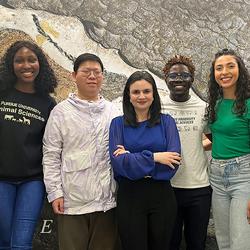
Your next burger might be thanks to a dairy cow

Even if you don’t know much about beef or dairy production, if you imagine a ranch or a milking barn, you probably picture different cattle breeds. A shiny Black Angus makes a great steak, whereas a black and white Holstein produces creamy milk.

These days, however, many dairy farms are incorporating beef genetics into their breeding programs, said Hinayah Rojas de Oliveira, assistant professor of animal sciences. The beef-on-dairy crossbred cattle produced help maximize profit for dairy farmers, who can see premiums of $350 to $700 per head for their meat quality compared to purebred dairy calves.

June 10, 2026

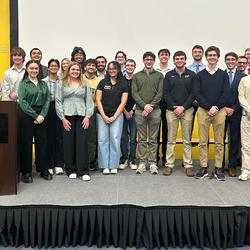
ASABE: Purdue ASABE Midwest Rally sparks leadership growth and industry connections

Purdue’s American Society of Agricultural and Biological Engineers (ASABE) student chapter energized the campus this year by hosting its first Midwest Regional Rally in 15 years. The event drew more than 90 students from seven universities. Students took part in hands-on activities, built lasting networks, and embraced leadership roles that laid the foundation for academic success and future careers in agricultural and biological engineering.

Shawn Ehlers, associate professor of agricultural and biological engineering and ASABE Purdue Chapter adviser, highlighted the event's outcomes. "Planning the Midwest Rally gave our students direct networking with peers from other universities, insight into graduate opportunities at Purdue, exposure to local industries and access to academic, research and career pathways," Ehlers said.
June 10, 2026

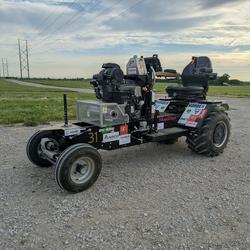
Congratulations to the Purdue Pullers Team!

3rd place overall out of 23 teams from across the US and Canada
Received 3rd place in the Performance Events and
Earned the Serviceability Award for their tractor design.
May 7, 2026

Kaur-Singh: Purdue outlines sustainable ruminant roadmap

Purdue University researchers published a literature review laying out an integrated approach to cut the environmental footprint of ruminant livestock while supporting animal welfare and production. According to the team, the livestock sector is responsible for 18% of emissions globally, and addressing that requires coordination across breeding, nutrition, management and technology rather than a single fix. The review appears in the journal Agriculture and was featured on the cover of a special issue on environmental threats to farm animals.
May 6, 2026

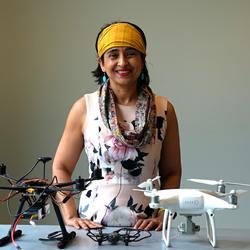
Casey: Megan Casey develops hydrologic models to help restore ecosystems

Before Megan Casey was studying post-wildfire flooding, she was a teenager at camp, learning how ecosystems work and imagining how they could be protected.

“I realized I wanted to go into agricultural engineering when I was around 16 years old,” she says. “That was really my first experience that this could be something that I could do.”

That curiosity led to a career tackling one of today’s toughest challenges: understanding how landscapes change after disruption.
May 6, 2026

IDAAS: Purdue institute powers the future of Indiana, U.S. agriculture through AI, data

On any given day in Indiana, you will find farmers checking weather apps before sunrise, monitoring equipment diagnostics from their phones, and analyzing yield maps long after the combine has shut down. Agriculture has always depended on experience and instinct. Today, it also requires data. At Purdue University, that change is being addressed by the Institute for Digital and Advanced Agricultural Systems (IDAAS), led by co-directors Dennis Buckmaster, professor of agricultural and biological engineering, and Ignacio Ciampitti, professor of agronomy.
May 6, 2026

Chaterji: Better driving by design: Purdue-Led NSF CHORUS Center makes autonomous systems stay safe

There were more than 1,000 crashes involving vehicles equipped with automated driving systems or Level 2 advanced driver assistance systems in the first half of 2025, according to the National Highway Traffic Safety Administration. Whether on highways or farms, automated systems must remain safe despite sensor failures, GPS disruptions, network dropouts or even cyber-attacks.

That’s why Purdue University is leading CHORUS, a multi-institution research center funded by a $7 million National Science Foundation (NSF) grant, to build resilience into cyber-physical systems (CPS). The name is inspired by the Egyptian god Horus, who symbolizes protection from disasters, with the “C” added to emphasize the center’s cyber focus.
March 24, 2026

ABE research team: Purdue research team wants to harness AI to secure corn crops from pathogenic threats

A research team at Purdue University’s colleges of Agriculture and Engineering aims to ensure the security of the nation’s corn crops by using artificial intelligence as an early warning system.

The team is using cutting-edge technological advances and research infrastructure to pursue the project with a nine-month, $450,000 contract from the United States Defense Advanced Research Projects Agency (DARPA).
March 24, 2026

Ambrose: Grain dust explosion incidents decrease, fatalities increase

The number of explosions is slightly below the 10-year national average of 8.5 and down from the nine that occurred in 2024. Even though there were fewer explosions, the number of injuries and fatalities increased compared to two injuries and no fatalities in 2024.
< Previous 10 | Viewing 11 to 20 of 28 | Next 8 >