
Agricultural and Biological Engineering Graduate Program
Graduate Student Policies & Procedures Manual
Download PDF version of the manual
This accessible web version is intended to provide the same manual content in a readable, navigable page format. The PDF remains available as a secondary download for printing or archival use.
Welcome to Purdue University and the Department of Agricultural and Biological Engineering (ABE)!
We are delighted that you will be joining us in ABE and are excited to be a part of your professional journey. The purpose of this manual is to acquaint you with the graduate policies and the Department of Agricultural and Biological Engineering at Purdue University.
We believe that you will find your journey meaningful and intellectually challenging. We encourage you to take advantage of the vast resources and opportunities available to you at Purdue University as you strive to reach your professional and personal goals. If you have any questions or need further information, please contact Graduate Program Administrator Nikki Zimmerman at nzimmerm@purdue.edu, or Academic Program Coordinator, Yvonne Hardebeck at hardebey@purdue.edu.
Dharmendra Saraswat
ABE Graduate Chair
Nathan S. Mosier
ABE Department Head
 While timelines are different for each student, the list below provides an overview of what to plan for and expect as you work to complete your degree, with links to the section of this manual where you can find more information.
Before Your First Semester
- Communicate regularly with your major professor before your arrival at Purdue about research, courses, and your arrival plans.
- Arrive at least one week before classes start, as graduate assistantships start one week before classes. Attend ABE Graduate Student Orientation and the Office of the Vice Provost for Graduate Students and Postdoctoral Scholars’ (OGSPS) Orientation during this week.
-
Meet with your major professor to plan first semester courses and research.
- Register for courses (often 6-9 credits) and research credits, which should normally total 10 credits for fall/spring. Include graduate student orientation seminar ABE 69400. (See Section 3 of the Manual for details.)
- Discuss research expectations and complete the Research Registration Form, which should help ensure that you and your major professor have shared expectations. (See Section 3 and Appendix D of the Manual.)
Semester 1
- Take courses and ABE 69400, the ABE Graduate Student Seminar (offered fall semesters).
- If you had any admissions conditions that remain to be satisfied per the OGPSPS, complete these.
- Develop your Plan of Study as a part of ABE 69400, based on discussions with major professor, your research project, and your interests. You must include a draft Committee, which can be changed later if needed.
- Register for the following semester. Complete the registration form for the following semester of research credit registration, discussing research expectations with your advisor.
Each Semester
- Meet with your Committee to discuss courses, research, and progress each semester.
- Take ABE 696 Seminar in a spring semester before completing your prelim exam or master’s degree.
- Register for the next semester including research credits. Discuss expectations with your advisor and complete the Research Registration Form.
*Ph.D. students only
- If you are a direct to ph.D. student, complete Qualifying Sequence starting in Year 2. See Section 1 for details
- All Ph.D. students: Complete Preliminary Exam as described in Section 6. You must complete this at least one full year before you graduate.
- Complete ABE 69700 seminar in a fall term before your prelim exam.*
Before Your Final Semester
- Register as CAND 99100 or 99200 for the semester you plan to graduate (See Section 7).
- Plan process for final exam with your major professor and committee.
- Ensure that your Plan of Study is complete, courses in your Plan are correct, and all degree requirements are met, including ABE 69400, ABE 69600, and if required, ABE 69700 (Ph.D. only).
Final Semester
- Schedule Defense date with major professor and committee. The Defense date must be at least 2 weeks before the end of the semester.
- Follow the details of the defense and submittal process in Section 7. Your responsibilities include filing Form 8 “Request for Appointment of Examining Committee” and getting electronic approvals at least 2 weeks before the exam, preparing a Defense Announcement using the ABE template, printing rubric forms, submitting your thesis/dissertation to the OGSPS for a formatting consultation, and then uploading your thesis to the OGSPS. Read these carefully and discuss with Nikki and your major professor to make sure all are clear.
After Graduation
• Keep in touch with your major professor and the ABE Graduate Program. We look forward to hearing about your successes!
1. Degrees, Concentrations, and the Graduate Certificate
- Master of Science in Agricultural and Biological Engineering (MS-ABE): generally, for students with a bachelor’s degree in an engineering discipline, and
- Master of Science (MS): for students with non-engineering bachelor’s degrees.
Master of Science in Agricultural and Biological Engineering
Students who have received a Bachelor of Science in Engineering from an ABET (Accreditation Board for Engineering and Technology)-approved engineering program are normally admitted to this program. The guidelines for an engineering degree are defined by ABET to include 32 hours of engineering sciences, math requirements, and at least 16 hours of design courses.
International students are also eligible for the MS-ABE degree, if their undergraduate degree is in engineering, or a closely related program. Given the diversity of engineering programs and educational systems throughout the world, the Purdue ABE Graduate Committee may ask the student to document their eligibility for this degree option. In this case, the student may be asked to list their courses and to provide translations of any catalogue descriptions not found in English, which correspond to the 32 hours of engineering sciences, math requirements, and at least 16 hours of design, as specified above.
Members of the ABE Graduate Committee will ultimately decide whether an applicant is eligible for admission to the program.
Master of Science
Admission to the Master of Science program is available to graduates with non-engineering baccalaureate degrees. Students with a bachelor’s degree in Agricultural Systems Management, for example, or an equivalent area, are normally admitted to this degree program. Such students must have demonstrated an acceptable level of performance at the undergraduate level in the areas of biological sciences, chemistry, physics, mathematics, economics, management, and have thorough knowledge of computer use for communications and problem-solving.
International students are also eligible for this degree. The ABE Graduate Committee may ask the student to provide documentation that demonstrates an equivalent academic background. Members of the ABE Graduate Committee will ultimately decide whether an applicant is eligible for admission to the program.
Students without an Engineering Degree
Applicants with BS degrees from non-engineering or non-accredited programs are normally admitted to the MS program rather than the MSABE. They may become eligible for the MSABE by taking courses to meet the guidelines for an engineering degree as defined by ABET. A minimum of 15 credit hours of remedial undergraduate engineering courses from the five categories listed below are required. Credit for these remedial courses may be applied from equivalent courses from the applicant’s BS degree, subject to approval by the major professor and the ABE Graduate Program Committee. The selection of courses from the five categories is left to the student and subject to the approval of the student’s major professor and advisory committee.
- Keep in touch with your major professor and the ABE Graduate Program. We look forward to hearing about your successes!
The equivalent of two semesters of engineering physics and four semesters of mathematics (through differential equations) are prerequisites for the engineering courses and must be considered part of the remedial coursework if the applicant's background does not include them. Two suggested remedial (20000 and 30000-level) course plans of study are given below.
Agricultural Engineering
- Engineering Statics (ME 27000 – Basic Mechanics I or equivalent)
- Engineering Dynamics (ME 27400 – Basic Mechanics II or equivalent)
- Thermodynamics (ABE 21000, ME 20000, or equivalent)
- Fluid Mechanics (ME 30800, CCE 34000, or equivalent) – also called Hydraulics, Momentum Transfer
- Mechanics of Materials (NUCL 27300, or equivalent) – also called Strength of Materials or Geotechnical Engineering 1 (CCE 34300, or equivalent)
Biological Engineering
- Thermodynamics (ABE 20200 or equivalent)
- Physical Chemistry/Advanced Thermodynamics (ABE 30300 or equivalent)
- Fluid Mechanics (ABE 30700 or equivalent) - also called Hydraulics, Momentum Transfer
- Heat and Mass Transfer (ABE 30800 or equivalent)
- Kinetics and Reaction Engineering (ABE 37000 or equivalent)
Depending upon the applicant’s background and work experience, completion of at least one 40000- or 50000-level engineering design course is required, and a senior capstone engineering design class (ABE 48400 and ABE 48600, or ABE 55700 and ABE 55800) is strongly encouraged.
Remedial courses taken at the 10000, 20000 and 30000-level cannot be listed on the student’s graduate plan of study. Courses completed in addition to the above suggestions, which meet the 32 credit hours of engineering science and 16 credit hours of design (48 hours total), may be applied toward the requirements of completing the MS degree. A maximum of 6 hours of 40000-level (at a grade “B-” or higher) and any 50000-level engineering science or design courses may be listed on the student’s MS degree plan of study if approved by the student’s major professor and ABE Graduate Program Committee. For international students, 30000- or 40000-level courses may count toward the department’s recommended registration total of 10 credits in fall and spring semesters and eight credits in summer only when the course is required for the student’s approved plan of study and degree completion. If the course is not required for the plan of study, it must be taken in addition to the full-time graduate credit load.
Completion of these courses does not guarantee eligibility for the Fundamentals of Engineering exam, which depends on the state engineering licensing agency requirements for candidates without an ABET- accredited engineering degree.
DOCTOR OF PHILOSOPHY DEGREE
Ph.D. programs are directed by professors who work in close association with the graduate student. In contrast to the various master’s degrees, the Purdue doctoral degree is not designated by department or by area of specialization. Only concentrations and majors are recorded on graduate transcripts, along with thesis and dissertation titles. The Ph.D. is available to qualified students desiring either an engineering, technology, or systems management program in the Agricultural and Biological Engineering Department.
Admission to the Ph.D. program is usually contingent upon the satisfactory completion of a MS degree in an Engineering, Technology, Sciences, or Agricultural Systems Management program. If the MS is received from ABE at Purdue University, a recommendation from the examining committee is also required, which will be stated in the MS Exam Rubric. A direct-to-Ph.D. option is also available (see next section).
Doctoral programs are composed of formal courses, successful completion of oral and written preliminary exams (see Section 6), guided individual study in a chosen field or discipline, study in such cognate subjects as may be required by the candidate’s advisory committee, and original research that serves as the basis of a scholarly thesis. The Ph.D. degree requires 90 total credits of coursework and research, which includes a minimum of 30 credit hours of coursework and 48 credit hours of research. The balance of 12 credits may be coursework or research and is left to the discretion of the advisory committee based on the educational needs of the student.
Request for admission of a student who has received an MS degree in another department or university will be carried out through the established OGSPS and Department of Agricultural and Biological Engineering application procedures.
Direct-to-Ph.D. Option
Students with an outstanding record including a minimum GPA at graduation of 3.5/4.0 at their undergraduate institution who are entering the Ph.D. program without a master’s degree may choose the Direct-to-Ph.D. option. Students choosing this option will be required to complete the Qualifying Exam in their second year. If successful, they will continue to the Preliminary Exam stage one to two years later and must meet other requirements of all Ph.D. students to graduate with a Ph.D. degree. Master’s students may enter the Direct-to-Ph.D. track up to one year after they begin, by submitting a request to the Graduate Program Coordinator with major professor approval.
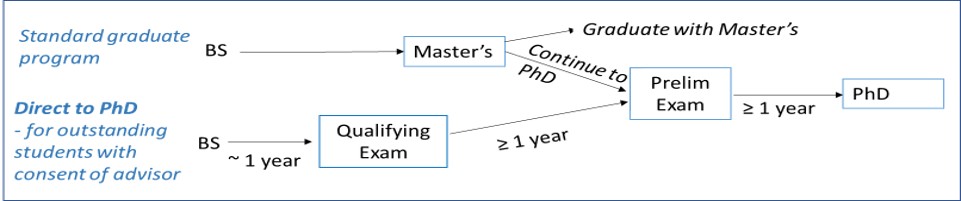
*The Direct to Ph.D. is an alternative track to the Ph.D. for some outstanding students that do not wish to complete an MS.
- Student performance in coursework to ensure that the student demonstrates understanding of and ability to apply key principles at the graduate level
- Written Research Plan
- Oral Exam
Written Qualifying Research Plan
- Introduction, including research objectives
- Literature review and theory that form the basis for your study
- Methods and materials you plan to use, based on what you know so far (recognizing they will be expanded and fine-tuned in future years)
- Any preliminary results (if available) and/or discussion of what you have learned so far
- A plan for research in the next 12 months
Oral Qualifying Examination
Possible Outcomes of the Qualifying Exam
- Pass: The student is admitted to the Ph.D. program and must complete all Ph.D. program requirements to be awarded a Ph.D. degree. (The Qualifying Exam does not replace the Preliminary Exam, which must be completed at least one year after the Qualifying Exam.)
- Retake: The student must retake the required part of the Qualifying Exam, which may include the written exam, oral exam, or both. Students admitted in the fall semester must complete the retake by the end of March, i.e., during the Spring semester of their second year. Students admitted in the Spring semester must complete the retake by the end of October, i.e., during the Fall semester of their second year.
- Pursue Master’s Degree: The student moves from the Direct-to-Ph.D. track to the master’s degree program (non-thesis or thesis). At the master’s Final Exam, the committee will determine whether the student may be admitted to the Ph.D. program.
CONCENTRATIONS
A concentration is used to allow a specialized area of graduate study to be reflected on a student’s final transcript. The department currently offers the following:
- Biotechnology (PULSe program students only)
- Biotechnology Innovation and Regulatory Science (offered to Purdue Online students only)
- Computational Science and Engineering (through CIGP)
- Computational Life Sciences (through CIGP)
- Data Science for Agricultural and Biological Engineering (DSAG)
- Fluid Power and Motion Control (FPMC)
- Interdisciplinary Ecological Sciences and Engineering (IESE)
Approved core courses for these concentrations can be found in Appendix B. Please note that some concentrations offered in ABE are independent of the department. Computational Interdisciplinary Graduate Programs (CIGP), Interdisciplinary Ecological Sciences and Engineering (IESE), and PULSe, an Interdisciplinary Life Science Program, all offer interdisciplinary concentrations in collaboration with the ABE department. Please visit their websites for more information.
GRADUATE CERTIFICATE
Two Graduate Certificates that are popular with ABE students are the Hybrid Vehicle Systems certificate available through the School of Mechanical Engineering and the Geospatial Information Science certificate offered by the Purdue Libraries and School of Information Sciences. Please see their respective websites for information.
A third certificate, Biotechnology Quality and Regulatory Compliance (BQRC) is available for online professional students usually with interest in the online Biotechnology Innovation and Regulatory Science master’s program.
TRANSFERRING TO ABE FROM ANOTHER PURDUE UNIVERSITY GRADUATE PROGRAM
Requirements
The student must meet the OGSPS requirements to be considered by ABE for a transfer from another Purdue department. This means the student’s GPA must be at least a 3.0. The student should be coming from a discipline which closely relates to work done in the ABE department and must be able to demonstrate knowledge of the field of agricultural and biological engineering and articulate how ABE is a good fit for them based on their research goals. Students must have an ABE faculty member willing to serve as their major professor.
Materials Needed to Approve Transfer
- A Statement of Purpose for Transfer will be written by the student, explaining which degree they are currently pursuing (master’s or Ph.D.), the justification for the transfer, and explaining why ABE is an appropriate fit for the student.
- A letter or statement by the ABE major professor justifying the transfer and indicating a willingness to supervise and provide funding for the student as per the OGSPS requirement.
Process of Assessment
Members of the ABE Graduate Committee will review the file and determine whether the transfer is appropriate for the student and for the department.
2. Major Professor
When admitted to Purdue, most ABE graduate students have already chosen a major professor. If not, they will be initially assigned to one. This initial assignment is based on expressed research interest, the research programs of the staff member, and the availability of research funds. Faculty with courtesy or adjunct appointments are members of the graduate faculties of Purdue and may serve as a major professor or an advisory committee member.
3. Coursework and Plan of Study
COURSE REQUIREMENTS
Courses provide fundamental knowledge needed for graduate students to not only excel in today’s research, but also to be equipped to address new research questions in the future. Therefore, students and their advisory committees should ensure that students take the breadth and depth of courses needed to provide this foundation.
The ABE department has set the minimum requirements described below, but it is appropriate for many students to take more courses to ensure they have the fundamental knowledge needed for current and future research. The ABE department does not have a “common” or “core” set of graduate courses, and students’ degree programs are customized to meet their goals.
Master’s Degree - Thesis
Minimum requirements for the program are 18 course credits beyond the bachelor’s level, and an acceptable research thesis that contributes to knowledge in the field of research specialization. At least half of these credits must be taken at Purdue University. For the thesis option, courses taken must include:
- At least three credits of graduate coursework (50000- or 60000-level) in any mathematics, statistics, quantitative data processing and/or data science course. (See Appendix D).
- At least six credit hours of graduate coursework (50000- or 60000-level) in ABE, ASM, or core courses as listed in a specific ABE concentration (see Appendix B).
-
Two semesters of Graduate Seminar:
- ABE 69400 (typically taken in fall of the first graduate year), and
- ABE 69600 (typically taken in spring).
Class attendance and participation in Graduate Seminar is mandatory and required for graduation. ABE 69400 and 69600 should not be entered on the electronic copy submitted through the OGSPS.
The plan of study should provide a well-balanced and integrated program in support of the student’s concentration or area of interest. Students should normally complete at least 12 to 18 credit hours of coursework within the first twelve months of the student’s entry into the department, although in cases where the student has a heavy initial research involvement due to the nature of the research, 16 months may be required for coursework completion. The coursework total can include up to three credits of ABE 59000 (see Appendix G for the Special Topics Contract), or an equivalent designation in another department.
A maximum of six hours of 30000 or 40000-level course credits (with a grade “B-” or higher) and any 50000- and 60000-level engineering science or design courses may be listed on the student’s MS degree plan of study if approved by the student’s major professor and ABE Graduate Program. For international students, 30000- or 40000-level courses may count toward the department’s recommended registration total of 10 credits in fall and spring semesters and eight credits in summer only when the course is required for the student’s approved plan of study and degree completion. If the course is not required for the plan of study, it must be taken in addition to the full-time graduate credit load.
Master’s Degree - Non-Thesis
The non-thesis MS requires 30 semester hours of graduate coursework beyond the BS. At least half must be taken at Purdue University. A non-thesis degree is not a typical route to a master’s degree for ABE students; instead, nearly all ABE students complete thesis-based degrees. For the non-thesis option, courses must include:
- At least three credits of graduate coursework (50000- or 60000 level) in any mathematics, statistics, quantitative data processing and/or data science course. (See Appendix D.)
- At least six semester hours of graduate credit (50000- or 60000 level) in ABE, ASM, or core courses if identified in a specific concentration (see Appendix B).
- One semester of Graduate Seminar - ABE 69400 (typically taken in fall of the first graduate year).
Class attendance and participation in Graduate Seminar is mandatory and required for graduation. ABE 69400 should not be entered on the electronic copy submitted through the OGSPS.
The plan of study should provide a well-balanced and integrated program in support of the student’s concentration or area of interest. The coursework total can include up to three credits of ABE 59000 (see Appendix G for the Special Topics Contract), or an equivalent designation in another department. Further recommendations for coursework should come from the student's major professor.
A maximum of six hours of 30000- or 40000-level course credits (with a grade “B-” or higher) and any 50000- and 60000-level engineering science or design courses may be listed on the student’s MS degree plan of study if approved by the student’s major professor and ABE Graduate Program. For international students, 30000 or 40000-level courses may count toward the department’s recommended registration total of 10 credits in fall and spring semesters and eight credits in summer only when the course is required for the student’s approved plan of study and degree completion. If the course is not required for the plan of study, it must be taken in addition to the full-time graduate credit load.
Doctor of Philosophy Degree
Minimum requirements for the Ph.D. program are 30 semester hours of graduate work and the completion of an acceptable research dissertation that contributes to knowledge in the field of research specialization. This total can include three credits of ABE 59000 (see Appendix G for the Special Topics Contract), or an equivalent designation in another department. At least half of Ph.D. course credits must be taken at Purdue University, not including credits taken to complete the MS degree. The plan of study should be a well-balanced and integrated program including in-depth work in the concentration or research area of interest, breadth in Agricultural and Biological Engineering, and a sound mathematical background including:
- At least six credits of graduate coursework (50000 or 60000-level) in any mathematics, statistics, quantitative data processing and/or data science course. (See Appendix C.)
- At least twelve credits of graduate coursework (50000 or 60000-level) in ABE, ASM, or core courses as identified in a specific concentration. (See Appendix B for course lists.)
-
Three semesters of Graduate Seminar, ABE 69400, ABE 69600, and ABE 69700. The three Graduate Seminar courses are not to be listed on the electronic plan of study.
- ABE 69400 is generally taken in the first fall semester of graduate studies.
- ABE 69700 is taken after the second year of graduate studies is completed, but before, or in the same semester as, the prelim exam.
- ABE 69600 is generally taken after the student has compiled enough research results to develop a departmental seminar on their work.
4. Plan of Study
Each graduate student admitted to a degree program must file a Plan of Study through the myPurdue portal before the end of the first semester of graduate work, or in their first fall semester. Plans of Study are discussed and created as a part of the ABE 69400 Graduate Seminar requirements. The Plan of Study includes the specific courses the student is expected to complete. No courses that have S/U grades, such as research credits (ABE/ASM 69800 or 69900), should appear on the Plan of Study, nor should any P/NP classes.
Waiver of course requirements (only for Ph.D. students with a MS earned from Purdue University or another accredited institution) are subject to the rules as described in the last paragraph of section 3 (above) and are subject to the approval of the student’s major professor and ABE graduate committee. Waived courses from another institution will not appear on the Purdue University transcript. Waived courses applied to a MS earned at Purdue University or another institution should not be individually listed in the student’s electronic plan of study. The major professor (or designee) will enter and approve the total number of waived credit hours (≤18) on the electronic plan of study.
Per OGSPS policy, course credits earned by a student whose graduate study and/or professional activity have been inactive for five years or more cannot be used in a plan of study for an advanced degree. A plan of study approved prior to such a period of inactivity is invalid. A preliminary examination passed prior to such a period of inactivity is invalid.
Up to six credits of 30000- or 40000-level course credits, with a grade of B- or better, are allowed on plans of study for both a master’s and Ph.D. degree. For international students, 30000- or 40000-level courses may count toward the department’s recommended registration total of 10 credits in fall and spring semesters and eight credits in summer only when the course is required for the student’s approved plan of study and degree completion. If the course is not required for the plan of study, it must be taken in addition to the full-time graduate credit load.
FILING THE PLAN OF STUDY
An initial plan of study will be developed as part of each new graduate student’s successful completion of ABE 69400, the Graduate Seminar Course.
The Plan of Study Worksheet (Appendix A) can be used to outline coursework and to assure that the coursework fulfills the requirements described in section 3. The Plan of Study must be approved by the major professor.
The approved worksheet will aid in completing the electronic submission of the plan of study. The Plan of Study is filed electronically and must be completed by the student after his or her major professor has approved. It includes the specific courses the student is expected to complete and other requirements of the degree being sought. No research credits (ABE/ASM 69800 or 69900) or graduate seminars (ABE 69400, 69600, or 69700), should appear on the plan. No courses taken pass/fail (P/NP) or satisfactory/unsatisfactory (S/U) may be included in the plan. The initial Plan of Study must be finalized and submitted for approvals before the end of the first semester in a graduate degree program.
CREDITS FROM ANOTHER UNIVERSITY
Students who transfer to ABE from another university may transfer graduate courses to fulfill course requirements at Purdue, provided they are approved by the student’s advisory committee and meet the following criteria:
- Courses are graduate level and taken at an institution regionally accredited at the graduate level
- A grade of B- or better was earned
- Credits were not used toward another awarded degree
- There is less than a five-year gap between when the courses were taken and the beginning of the graduate program at Purdue University.
The advisory committee should ensure that the courses are suitable for transfer to Purdue and may review the course syllabus or other information before approving. At least 50% of the course requirements for any degree must be taken at Purdue.
RESEARCH AND COURSE REGISTRATION PURPOSE
Registration for all students should reflect the student’s activity as accurately as possible. Any student must be registered for research during each semester or summer session when doing research utilizing faculty direction or consultation, and/or requiring the use of university facilities. Research includes literature reviews and thesis writing. Policy requires that each graduate student supported by an assistantship (teaching or research) must be registered as a full-time student each semester. In fulfilling degree requirements, a maximum of 18 credit hours will be allowed from any one semester (nine credit hours for the summer session.)
Research credits represent effort to reach research goals outside of the employment appointment (usually 20 hours per week for a research or teaching assistantship). Learning to conduct research with mentorship by the advisor is an important part of the graduate student experience and is different than work required by the assistantship. At least one research credit is required for all students in every semester.
- The ABE Department recommends that students with assistantships (RA or TA) register for a total of 10 credits (course plus research credits) during the fall and spring semesters, and eight credits in the summer. (Note that international students on assistantships must be registered for a minimum of eight credits to maintain legal F-1 status.)
- Students on fellowships or who are self-funded may register for more research credits if they wish, because they do not have assistantship-based employment responsibilities. (International students who do not have assistantships must be registered for a minimum of eight credits to maintain legal F-1 status, so international students on fellowships may want to register for more than 10 credits to ensure they do not fall below this minimum.)
These are general recommendations, but student circumstances may lead to different levels of research activity in various semesters and therefore graduate students and their major professor should select an appropriate number of credits each semester.
All thesis master’s students must be registered in ABE or ASM 69800 (Research MS Thesis) and all Ph.D. students must be registered in ABE or ASM 69900 (Research Ph.D. Thesis). ABE/ASM 69800 and ABE/ASM 69900 should not appear on the Plan of Study but count toward meeting residency requirements. Early registration is recommended. Late registration will result in additional fees.
RESEARCH REGISTRATION PROCESS
The OGSPS requires that each student complete a “syllabus” for each semester of research credit registration. This includes general goals and expectations agreed upon by a student and their major professor for the semester in question. In ABE, the form found in Appendix E is used both to fulfill this requirement and to allow a process for students to request registration for research credits. The syllabus should be completed by the student and approved by the major professor.
The Research Expectations section includes two parts. The top part is standard and applies to all students each semester. The second part should describe the specific accomplishments expected during the upcoming semester and should be developed by the student and major professor together. This clarification of expectations is very helpful in ensuring smooth progress forward.
REGISTRATION AND BILLING
REGISTRATION AND HOLDS
To check if you have a Hold on your account that may prevent registration, please login to your myPurdue and locate the Registration Holds card. Common examples of holds that will prevent you from being able to register or obtain official transcripts are:
- Immunizations - All Purdue students must have their immunization records on file with Purdue University Student Health (often called PUSH). For office information, see Section 13.
- Financial Responsibility - The Division of Financial Aid requires all Purdue students to acknowledge and accept their responsibility for incurred charges. This hold is placed on every student account before spring registration opens each year. For office information, see Section 13.
- Emergency Contact - The University requires each student list an Emergency Contact. This hold is also placed on every student’s account before spring registration opens each year. If you have an Emergency Contact listed already, you must click “Verify” to remove the hold once it is in place.
- Outstanding Admission Conditions (such as missing official transcripts or official diploma) - This is a hold that you may see in your second semester of registration. Many students fail to provide official transcripts or certificates to the OGSPS upon their arrival to Purdue. This hold means you still need to contact the OGSPS Admissions Office to fulfill an admission condition. More information can be found on the How to Apply site.
GRADE REQUIREMENTS
5. Graduate Research
ADVISORY COMMITTEE
6. The Preliminary Exam for Ph.D. Students
Preliminary Exams Timeline
| Timeline | Actions |
| Near the beginning of the semester in which you take your Preliminary Exams. |
|
| Several weeks before the Oral Preliminary Exam. |
|
| At least 2 weeks before the Oral Preliminary Exam. |
|
| At the Oral Preliminary Exam |
|
7. Thesis and Defense
Appropriate CAND course registrations:
|
CAND 99100 (General Candidacy) |
CAND 99200 (Degree Only) |
| Students plan to fulfill all requirements during the semester. (See OGSPS Deadlines Calendar for due dates.) | Students must have met all degree requirements, except for defending and/or depositing. Satisfactory research is required in the previous session, and students must meet a mid-semester deadline. |
CAND 99200 is considered a “privileged registration” status which results in lower fees, but not in full-time student status. As a general rule, students registered for CAND 99200 may NOT be funded (supported on an assistantship). Be aware that most students who select CAND 99200 leave campus before semester’s end.
8. Other Policies
9. Professional Development
| Award |
Typical Deadline (subject to change) |
Description |
|---|---|---|
| Mentoring Award for Ph.D. Students (Nomination to OGSPS) | January | Based on sustained mentorship throughout Ph.D. program assisting undergraduate and other graduate students |
| Excellence in Postdoc Mentoring Award (Nomination to OGSPS) | January | Recognizes Postdocs who dedicate significant time and energy to other postdocs, grad student and undergrad students |
| OGSPS Excellence in Teaching Award (Nomination to OGSPS) | January | Evidence of excellence in teaching, mentoring, professional development, and engagement activities focused on teaching |
| Outstanding Graduate Research Award (COE) | February | Based on publications, awards for research and contribution to research field and society |
| Magoon Teaching Award (COE) | February | Must have half-time teaching assistantship and other eligibility as determined by COE |
| Outstanding Graduate Service Award (COE) | February | Service to the department, college, university, and community |
| Outstanding Postdoc Award | February | Demonstrated excellence in research, teaching, mentoring and/or service. |
| ABE Outstanding MS and Ph.D. Awards | March | Based on research contributions, academic excellence, teaching or mentoring, and service to ABE |
| Bilsland Dissertation Fellowship | December | For Ph.D. students in final year. Selection based on funding need, merit, service, and career promise |
10. Graduate Student Employment
11. Resources for Graduate Student Research
12. Beyond Research: Taking Advantage of Life at Purdue
13. Important University Offices & Their Duties
|
Purdue Fire: (765) 494-6919 Purdue Police: (765) 494-8221 |
|
University Parking Services
MMDC
700 Ahlers Dr
West Lafayette, IN 47906
(765) 494-9497
- Get a parking permit
- Appeal a parking ticket
|
|
Card Services Office
Stewart Center, room 194
(765) 496-0444
- Get your student identification card
- Add money to your Boiler Express Account
|
|
Purdue IT
Customer Service Centers located in
HIKS or WALC
(765) 494-4000
- Ask questions about your student email account
- Get computer/IT support of any kind for campus
accounts and devices
|
|
PUSH (Purdue University Student Health)
601 Stadium Mall Dr.
(765) 494-1700
- Immunization requirements
|
|
The OGSPS
Young Hall, room 170
(765) 494-2600
- Admissions and turn in original documents
- Fellowship Office
- Thesis and Dissertation Office
- Office of Graduate Assistance - Ombudsman services: https://www.purdue.edu/gradschool/student/oga/index.html
|
|
International Students and Scholars (ISS)
Young Hall, 5th floor
(765) 49-5770
- Immigration services
- International student Orientation
- Visa questions, issues
|
|
Office of the Dean of Students
Schleman Hall (formerly Recitation Building), 2nd floor
(765) 494-1747
- Find a student organization to join
- Disability Resource Center
|
|
Office of the Registrar
Stewart Center, room 176
(765) 494-6165
- Course registration issues
- Holds
- Schedule changes
- Transcripts
- Commencement and diploma questions
|
|
Bursar’s Office
Stewart Center, room 194
(765) 494-7570
- Pay tuition or fees
- Aid disbursement
- Fee deferment
|
|
Division of Financial Aid
Stewart Center, room G18
(765) 494-5050
- Financial assistance eligibility
- Grants and loans
|