
New erosion rig at Purdue will help make the Navy's jet engines more durable
A little grit can be a great thing. In toothpastes and automotive polishes, it can bring dull surfaces to a beautiful shine. As a personal quality, grit means resilience — something Purdue's Boilermakers are known for.
But jet engines must be designed to resist grit. Airborne sand, volcanic ash, and other materials can wear away at engine blades, requiring more frequent overhauls. In extreme cases, grit can destroy jet engines in just one flight.
That's why the new Purdue High-speed Automated Sand Erosion Rig (PHASER) is so important. It's a next-generation machine for studying new ways to help engines endure what the U.S. Navy calls "austere environments" — like a full-power takeoff on a desert airfield. Designed to use Purdue's unique capabilities at Zucrow Labs, PHASER will go to higher velocities and temperatures than other erosion test facilities.
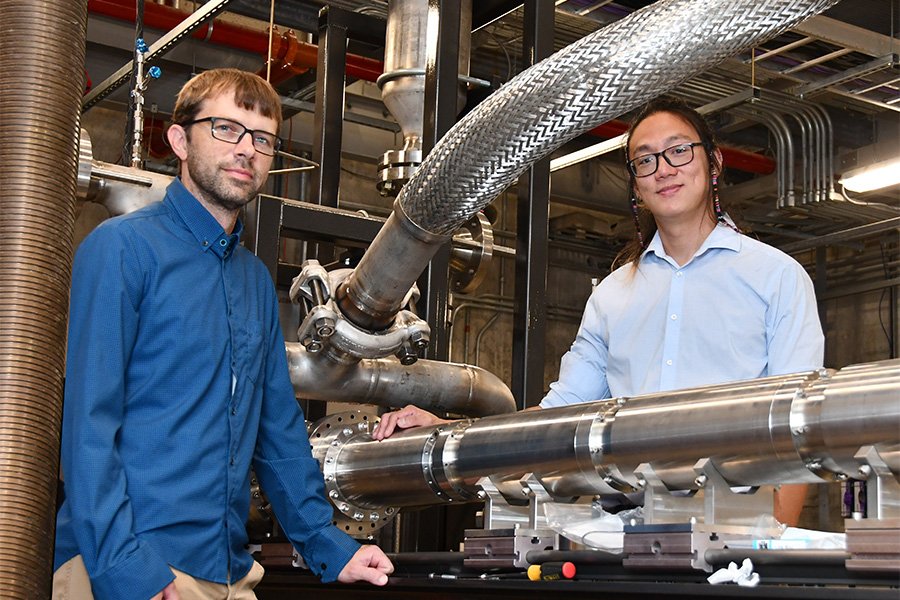
"No experimental facility currently exists in the nation that can generate these testing conditions," says Zherui Martinez-Guo, assistant professor at Purdue and principal investigator on this project. "Our operating speeds and temperatures are well in excess of test conditions achievable in the nation's current ground-based erosion facilities."
Designed and built at Purdue
In 2023, a grant from the Defense University Research Instrumentation Program (DURIP) was awarded to Purdue to design and build PHASER. Researchers collaborated with the Office of Naval Research, jet engine manufacturer Rolls-Royce, and Purdue-affiliated design company IN Space throughout the process.
After its completion in 2025, the Navy awarded an additional research grant to commission, install, develop, and test PHASER. Martinez-Guo, together with associate professor of mechanical engineering Daniel Guildenbecher, led the installation and commissioning at Purdue's Zucrow Labs, the largest academic propulsion laboratory facilities in the world.
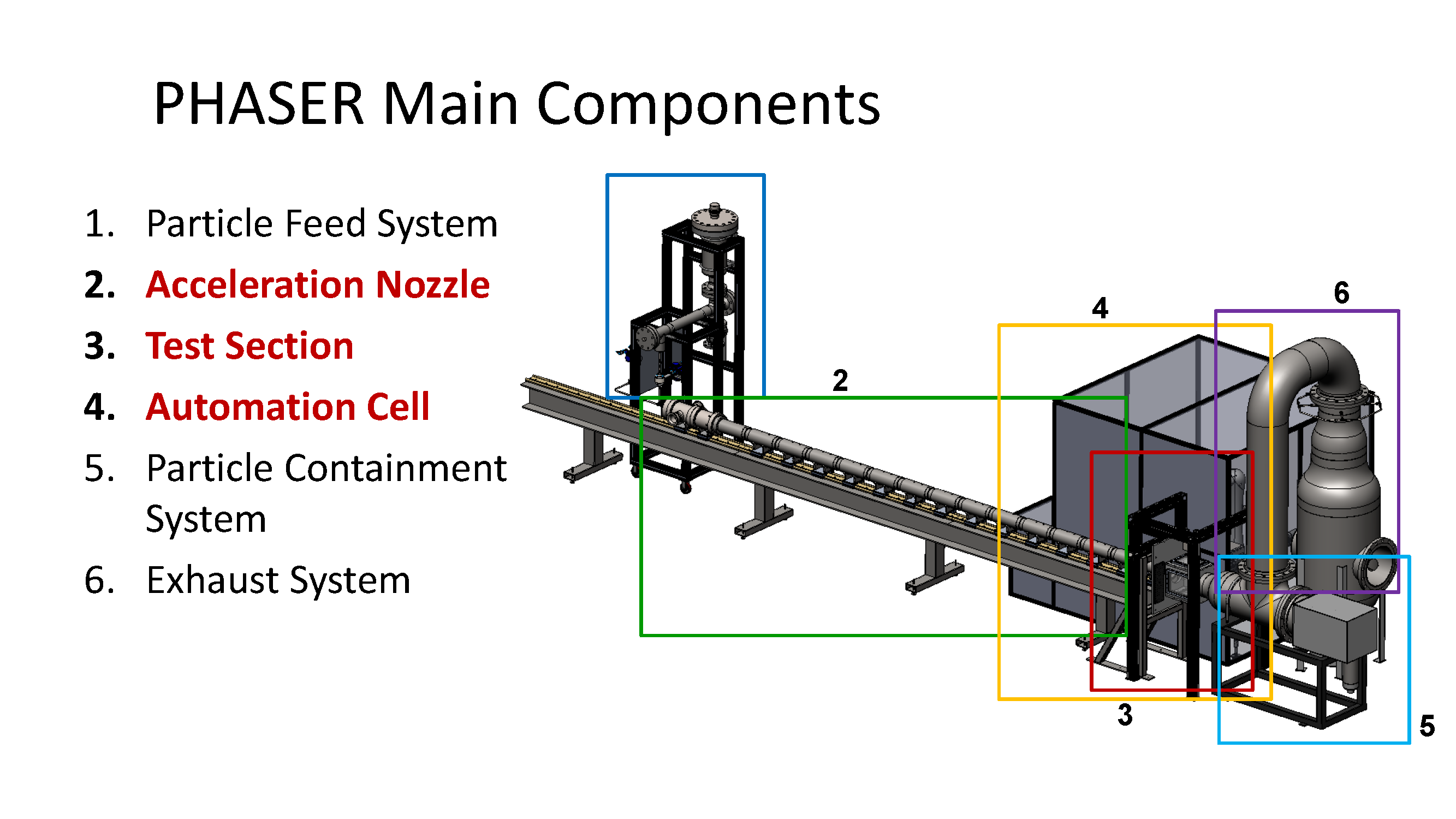
PHASER aims to reproduce the severe erosion conditions at the inlet of operational jet engines, including:
- particle diameters of 3-800 μ
- impact velocities of 300-500 meters per second, with a uniform cross-sectional velocity profile
- stagnation temperatures of 80-200°F
PHASER promises better results than even real-world tests. Experimenting with new materials on actual, running engines is more than just complicated: "Erosion testing with sand rigs have thus far struggled to reproduce realistic conditions that can help with improvements in surge margins and engine life," Martinez-Guo says. That's why this test rig is so valuable.
"Running full engine erosion experiments is extremely expensive. If the laboratory conditions simulate those in real applications, the experimental erosion results can be calibrated with the field data, making the low-cost lab experiments closely correlated to the practical operations," Martinez-Guo says.
The first experiments will use simplified geometries and OEM hardware to generate computational simulations. Later, researchers will use experimental data to optimize computer models, validate OEM hardware, and verify simulations.
"The conditions for different stages in a compressor include proper sand particle size, air-flow pressure and temperature, and impact speed and angle. The most difficult conditions to simulate in the lab are those experienced by the first-stage rotors," Martinez-Guo says.
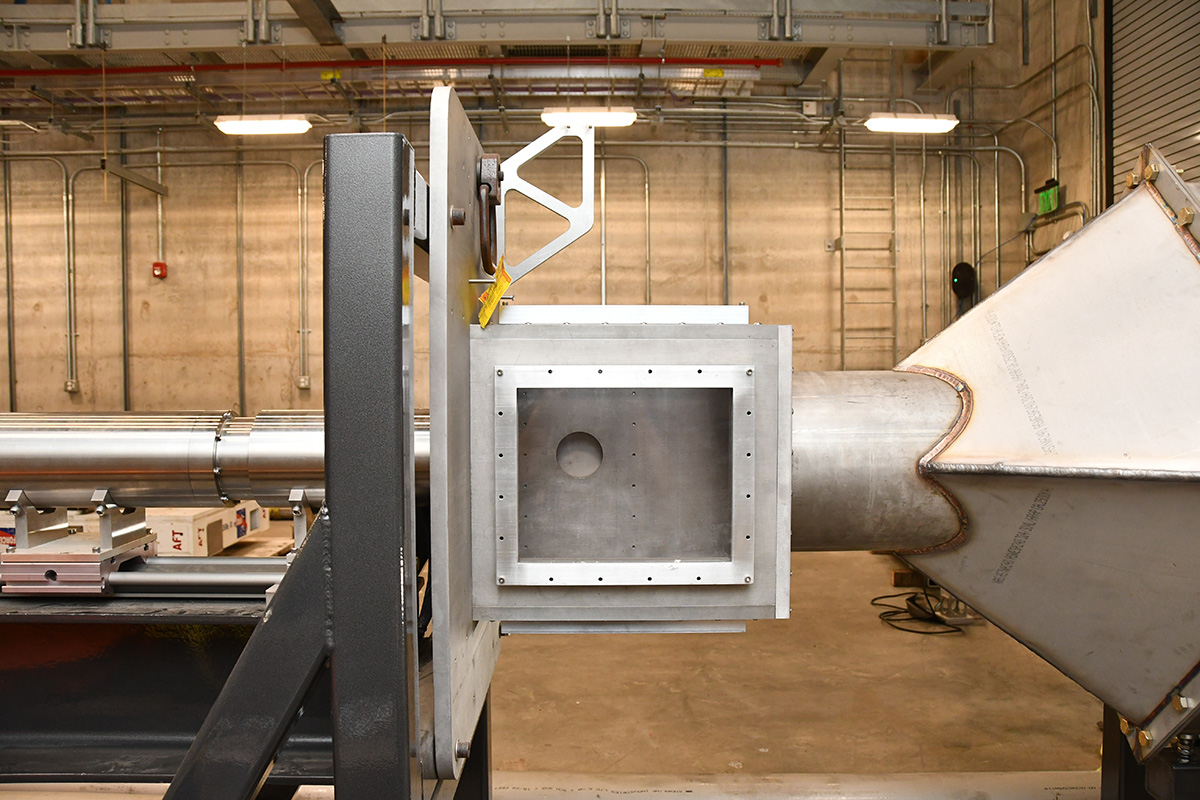
"This rig will be instrumental in development of erosion-resistant materials and coatings. It will allow for testing under realistic engine conditions and it will reveal the shortcomings of current compressor material options."
Designing jet engines to better survive in harsh environments would stretch maintenance intervals on what is often the most expensive and critical component of any aircraft. Now that PHASER is up and running, it will provide a new use for that famous Boilermaker grit.