
Advancing Hypersonics: Q&A with Amelia Earhart Fellow Emma Nicotra
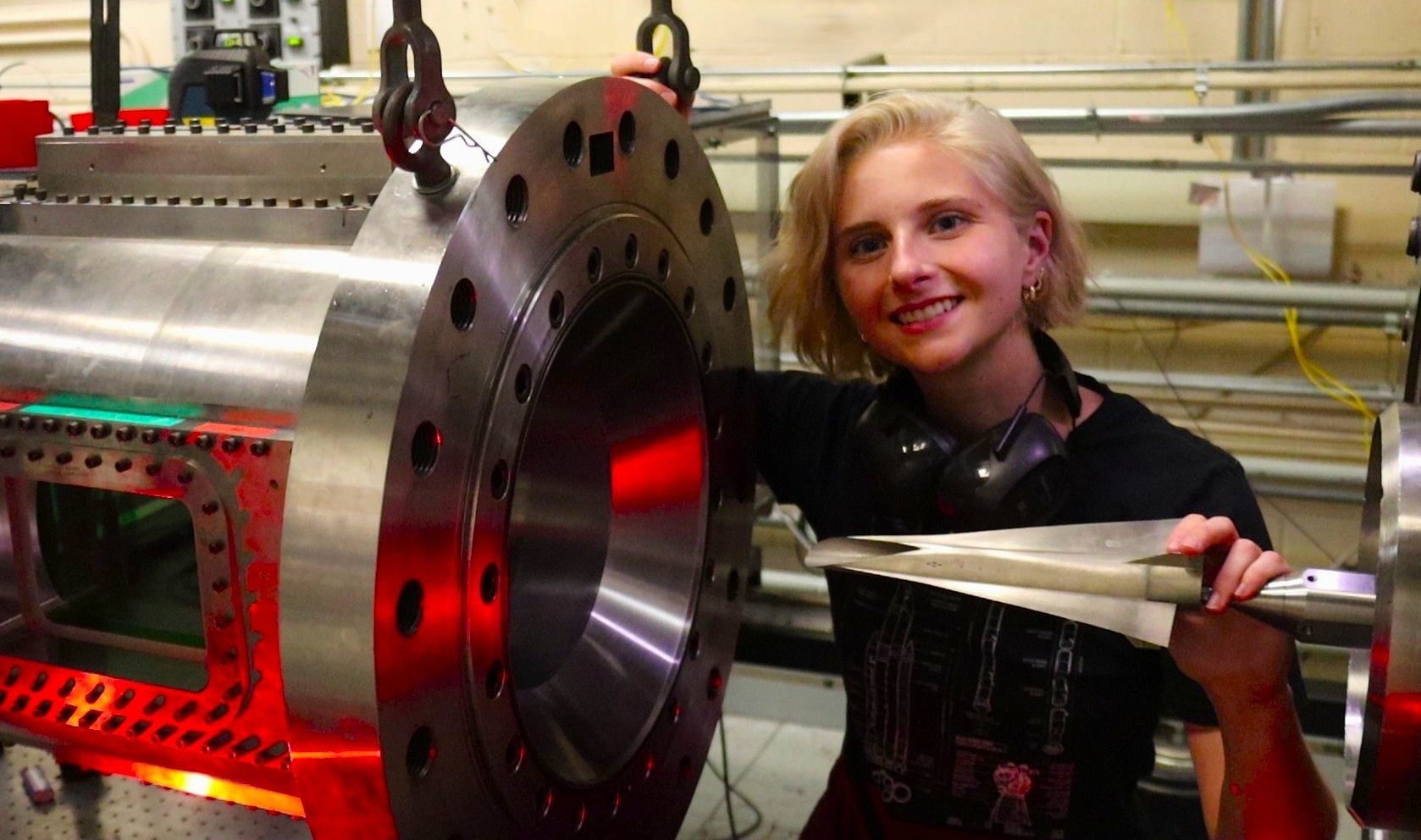
Purdue AAE Ph.D. student Emma Nicotra has been named a 2026 Zonta International Amelia Earhart Fellow, an award presented annually to just 30 women worldwide pursuing doctoral degrees in aerospace engineering and space sciences. She was also recently selected to represent Purdue as the invited graduate student speaker at Caltech's 2026 Trailblazers Symposium, where she will present her hypersonics research. Nicotra conducts experimental hypersonics research in Purdue's Boeing/AFOSR Mach-6 Quiet Tunnel under the guidance of Professors Joseph Jewell and Sally Bane.
Nicotra earned her master's degree in aeronautics and astronautics from Purdue and expects to complete her Ph.D. in spring 2027. Below is a Q&A with Nicotra about the Earhart Fellowship and her ongoing work at Purdue.
How did you feel when you got the email that you won this fellowship?
I honestly was pretty shocked when I got the notification that I was selected. I knew that only 30 women worldwide are awarded this fellowship, so it felt like a longshot when I applied. But I also felt very grateful for the recognition; it provides a sense of validation that I'm going in the right direction.
What drew you to get your master’s degree at Purdue, or what kept you here for your doctorate?
I joined Purdue as a direct PhD student, so I knew coming in that I wanted to stay around for the long haul. I came to Purdue because I wanted to study experimental hypersonics, and I had heard from multiple trusted sources that Purdue was the best place for that. A big part of the draw to Purdue was knowing that I'd be working in the Boeing/AFOSR Mach-6 Quiet Tunnel.

What do you find interesting or captivating about studying this topic?
Shockwave/boundary-layer interactions are very complicated flow phenomena that have been extensively studied, but there are still gaps in our understanding about their behavior. Also, since I'm an entirely experimental researcher, I get to design, build, and implement different elements of those experiments, like high-voltage plasma generators, wind-tunnel models, and optical systems for flow visualization. Working with these systems is always interesting for me, especially when I get to combine them all with a world-class hypersonic wind tunnel facility.
What’s unique about Purdue that makes it a great place to do this research?
I'd say that my test facility (the BAM6QT) is the key element that makes my research possible. I'm talking specifically about the low-disturbance (or "quiet") capabilities of the facility. Since I study aerodynamic features which are highly sensitive to external disturbances, my findings would be negatively affected if I were to conduct these tests in a different hypersonic wind tunnel, and certain aspects of my research would not be possible at all.
The hypersonics know-how of the faculty and graduate researchers at Purdue has been such an advantage for me. My work has really benefited from collaborations with computational fluid dynamics researchers at Purdue. I also just have a plethora of people that I can go to when I need advice about my work. I came to Purdue without much knowledge of hypersonic aerodynamics, so I would not have reached this point without a lot of people helping me along the way!