
From Purdue to Formula 1: Q&A with Williams Racing Senior Aerodynamicist Claire Diffey
Claire Diffey didn't expect to end up in elite motorsports. The Canada-born student knew little about the racing series when she applied to Purdue, drawn to the university's reputation as the "Cradle of Astronauts." She hoped to work in the space industry. But the hands-on wind tunnel experience she got with the School of Aeronautics and Astronautics led elsewhere.
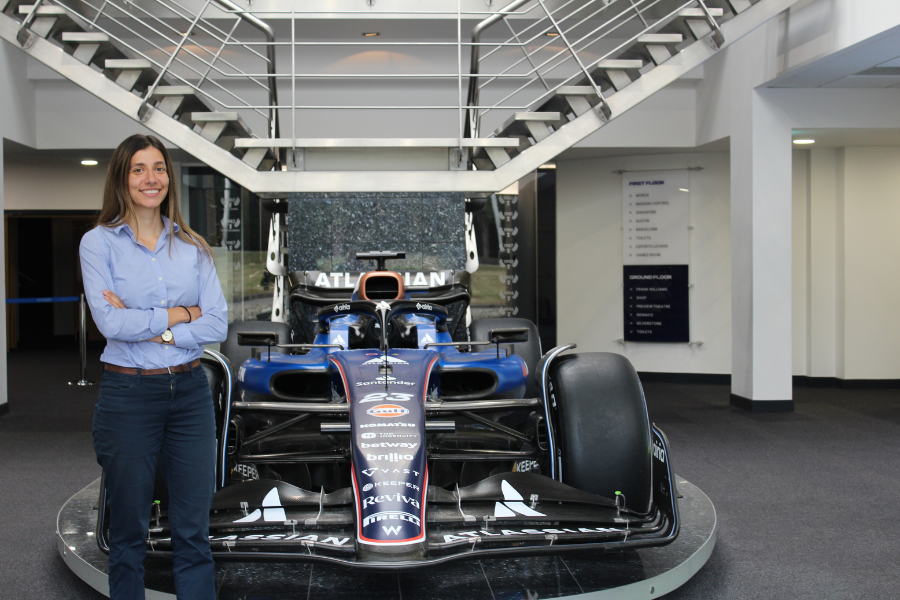
Claire Diffey didn't expect to end up in elite motorsports. The Canada-born student knew little about the racing series when she applied to Purdue, drawn to the university’s reputation as the “Cradle of Astronauts.” She hoped to work in the space industry. But the hands-on wind tunnel experience she got with the School of Aeronautics and Astronautics led elsewhere.
After graduating in 2019, Diffey landed a prestigious role in aerodynamics design and research for the Atlassian Williams Racing Formula 1 team. Now, as a senior aerodynamicist, she hopes her creative engineering solutions will give their team an edge over their competitors.
In the Q&A below, Diffey reflects on her path to Formula 1, the challenges and rewards of developing race cars, and how Purdue prepared her for the role.
What initially drew you to F1, and how did your path from Purdue lead you to where you are now?
My initial interest was in the space industry, which is why I wanted to come to Purdue, the "Cradle of the Astronauts". The opportunities for a non-US citizen in that field are limited, but the training prepared me well for other opportunities. I didn't really know anything about F1 when I applied for the job — what I was really after was a role where I could use the aerodynamics knowledge that I had gained at Purdue.
What does a typical day look like in your role?
I work on the car's bodywork, having recently moved over from working on the front wing. Most days I'm drawing new aerodynamic components in CAD, then using computational fluid dynamics (CFD) to analyze the performance of those components before running further simulations to test potential improvements. When I have some options that I believe are worth pursuing, I move on to a wind tunnel test. We send scale model parts to the tunnel where I'm in the wind tunnel facility, organizing the test, and looking at the wind tunnel data to see if it performs as expected. If it doesn't, I look at what we can learn to improve the next design.
What do you find most exciting or rewarding about working on Formula 1 cars?
We have relatively short development cycles. You can come up with a new design, test it, and see it on the car all in the span of one single season. I also like the mix of creativity and math/science: because the sport sets strict regulations on what we can draw, you have to really think outside the box and think about how you can push the limits of the regulations. At the same time, you still need to ensure you are thinking about the fundamental engineering behind it all.
How did your experience at Purdue AAE prepare you for this environment?
At Purdue, my masters research/thesis was focused on the experimental side of aerodynamics, specifically on wind tunnel testing. This hands-on experimental background helped me a lot in my first role as a Wind Tunnel Methodology Engineer where I developed and improved the experimental methods used to test in the wind tunnel. This, combined with the more computational and foundational understanding I gained in classes, then gave me another skill set to move into the aerodynamicist role I have now.
I would also be remiss if I didn't say that, as a Canadian, I arrived at Purdue with virtually no funding. It was the staff in graduate program office who helped match me with a Boeing research grant, which involved wind tunnel work. It was not only a practical support while I was in school, it ultimately led me to qualifying for my first F1 job.
Publish date: August 21, 2026