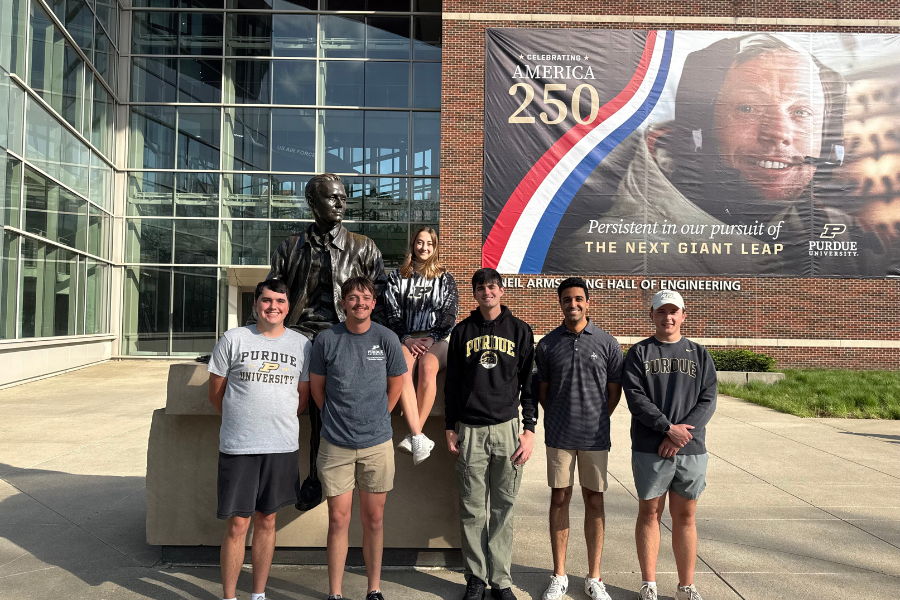
Purdue team earns second place in NASA Human Lander Challenge
The Future of Human Spaceflight Starts at Purdue
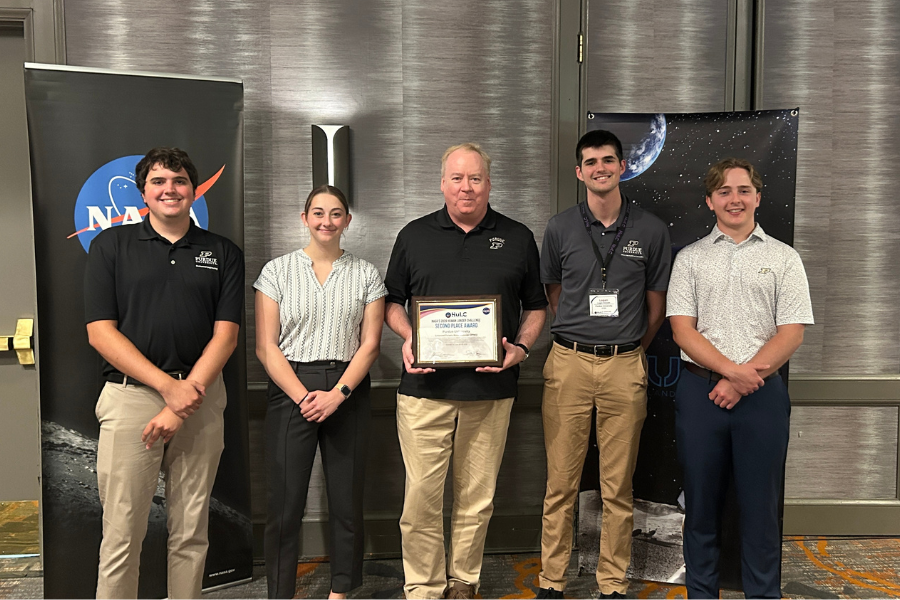
After nearly eight months of research, design, and collaboration, a Purdue student team earned second place and a $5,000 prize at NASA’s 2026 Human Lander Challenge (HuLC). Composed primarily of students from the School of Aeronautics and Astronautics (AAE), the team was nationally recognized for their Enhanced Potable Water Dispenser (EPWD).
The team included Riley Ficker (BSAAE '26), Logan Hussein (BSAAE '26), Andrew Jensen (BSME '26), Sloan McDonald (BSAAE '26), Harii Soni (BSAAE '26), and Chris Butler (BSECE '26) under the guidance of faculty advisor Thomas Cunningham, an award-winning lecturer in AAE.
The annual competition calls on college teams to develop systems-level solutions to support NASA’s future Artemis missions. This year’s challenge, held June 23-25, focused on life support systems for long-duration spaceflight.
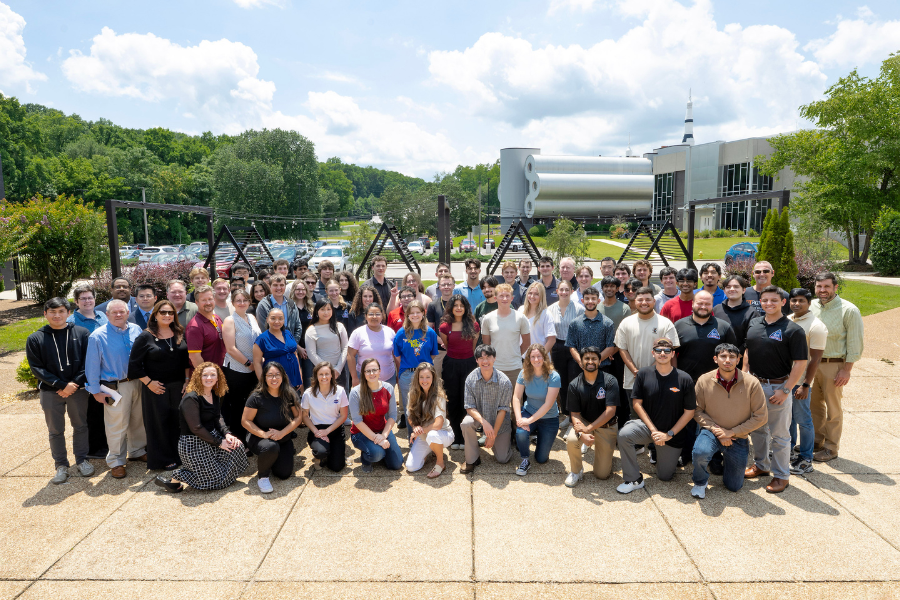
Eleven finalist teams — including two from Purdue — presented their concepts to NASA engineers and aerospace professionals near NASA’s Marshall Space Flight Center in Huntsville, Alabama.
For Ficker, advancing alongside another Purdue team demonstrated the university’s growing presence in human spaceflight research.
"I think it's a testament to the university that both Purdue teams reached the finals with completely different concepts and approaches to solving the challenges of human spaceflight," she said. "After spending almost eight months developing our concept, we found it very exciting and rewarding to present our work to NASA engineers, industry professionals and other student teams."
Learning Beyond the Classroom
Throughout the competition, the team learned to balance engineering trade-offs involving safety, reliability, and usability with feedback from Cunningham and NASA’s judges. Throughout the challenge, members also strengthened their ability to communicate complex technical ideas and collaborate across disciplines.
Ficker said the diverse perspectives within the Purdue community had the biggest impact on their success.
"I love that at Purdue, I am surrounded by like-minded people who are equally as passionate and motivated as I am. While we had fun at our meetings, we also shared the same goals and ambitions for this project. We wanted to push ourselves. Everyone brought different strengths and perspectives, and I learned just as much from working with this team as I did from the technical side of the project."
Launching Into a Career
The competition also gave Ficker clarity about her career.
"I've spent the past four years knowing I wanted to work in aerospace, but, I've never been sure exactly what I wanted to do. HuLC has made me confident that I want to work in human spaceflight."
For this team, HuLC was more than a competition. It was a chance to apply classroom knowledge to a real NASA engineering challenge. The experience that reinforced the collaborative spirit driving the next generation of human spaceflight.
"Going into my final semester, I've realized that the community I've built at Purdue is just as valuable as anything I've learned in the classroom,” Ficker said. “The friendships, mentorships and collaborations I've found here are what have made opportunities like HuLC possible."