Shaping Thrust: Inside the Purdue Course Putting Student Rocket Designs to the Test

To most people, a rocket launch lasts only a few seconds: a flash of fire, a plume of exhaust, and a vehicle shooting skyward. But a complex engineering challenge hides behind that instant. A successful rocket motor must convert stored chemical energy into thrust with remarkable precision, maintaining performance, reliability, and safety under extreme conditions.
Learning careful control of that combustion reaction is the idea behind the long-running AAE 439 Rocket Propulsion course. It’s always been a hands-on course, but Prof. Tim Pourpoint and graduate teaching assistants Erika Denker and Justin Kruse wanted students to go even further beyond the textbook. They would use Purdue’s rare capabilities to offer a unique experience – and truly test what Boilermakers are capable of.
“When working with solid rockets, a big component of what determines of your thrust is the shape of the solid propellant, because that’s the surface that actually burns away,” Denker says. “So, we wondered, what if, instead of using commercially available rocket motors, they designed their own propellant grain geometry?” (see sidebar)
So, for Fall 2025, AAE students didn’t just learn the close relationship between surface area, chamber pressure and thrust. They participated in a classroom first for Purdue: More than 100 students designed and flew their own solid rocket motor designs, all in one semester.
A solid rocket motor of this size is similar to what’s available in a hobby shop. They are usually made of a tough cardboard tube. With one end capped off, the propellant is poured in while it’s still in liquid form. Then an insert is placed in the middle while the propellant hardens, creating what is usually called a propellant grain. Removing the insert leaves behind the desired propellant grain geometry, which is then capped off with a nozzle.
Off-the-shelf propellant grains have a standard “axisymmetric cylindrical” geometry – a round shape that’s safe and relatively easy to mass-produce.
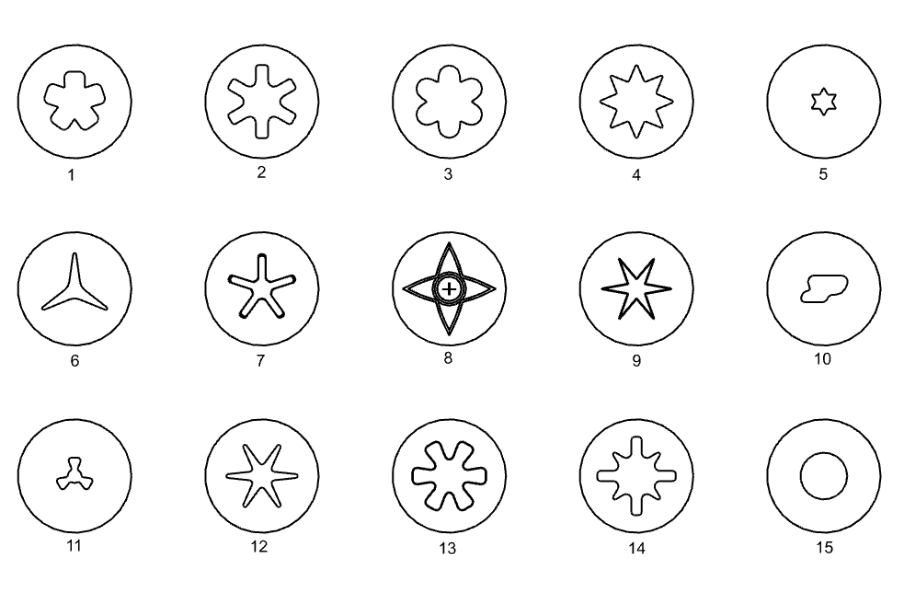
The engineering challenge is to optimize that shape to your specific flight. A star profile, with many sharp points, provides a lot of surface area and gives the reaction a fast start – but also burns out quickly. Fewer, shallower points slow the reaction down. Round profiles burn the slowest, providing more consistent thrust for the duration.
Combining these factors can yield a motor with mission-optimized characteristics, like a strong initial thrust for launch and a slower burn later in flight.
Even making solid rocket propellant is rare capability in academia — one set up by mechanical engineering professor Steve Son, whose research group studies energetic materials.
Understanding these materials is important in industry: NASA’s Space Launch System, ESA’s Ariane 6, United Launch Alliance’s Vulcan Centaur, and most missiles use solid rocket boosters.
But because solid rocket propellant sits closer to “handle with extreme care” than “classroom craft project,” students don’t mix the propellant themselves:
“We’re very hands-on at Zucrow, and we encourage learning from mistakes. But you need careful oversight when there’s possibility that someone could get hurt,” says Chris Nilsen (BSMDE ’19), associate engineer at Purdue’s Zucrow Labs.
Throughout the semester, students studied equations, came up with ideas, and ran computer simulations of their designs. Denker says a lot of insights came from Rocket Propulsion, a textbook co-authored by AAE professors Heister, Anderson and Pourpoint.
“You typically want something that’s symmetric. We asked teams to look at similar shapes in literature and study their pressure traces,” Denker says.
In a preliminary design review, the 14 teams in the class presented calculations showing that their rocket would be safe enough to fly and would accomplish the goals of the course. Most designs were symmetrical, using various iterations of a star-shaped cross-section.
One team harnessed their Boilermaker spirit for an unconventional shape: They chose Purdue's "Motion P" logo.
Final designs were 3D-printed, making inserts that Nilsen and Kruse used to make the rocket motors for the final test.
“Designing a rocket motor can be quite challenging. It's very important to get the details right, otherwise you could have major consequences,” Pourpoint said. “The students got a great sense of that in this course.”
Pourpoint didn’t set a simple altitude or thrust minimum for the flight test. His challenge was elegantly aligned with the precision required of aerospace engineers.
“We told them, ‘Design the rocket however you want. It doesn’t matter how high it goes. What matters is how close you are to your prediction,’” he said. “They are learning what it takes to translate equations into very practical applications.”
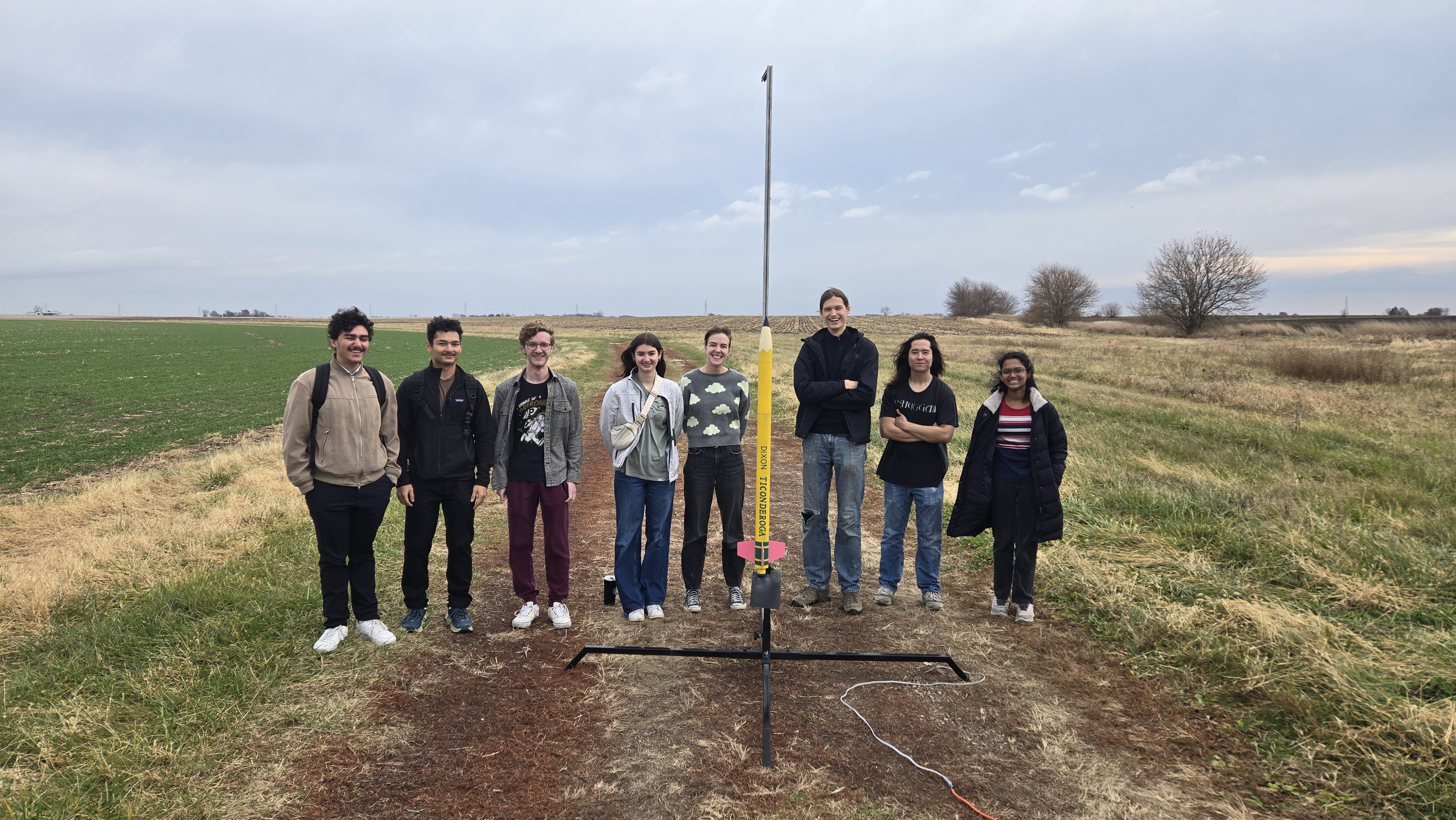
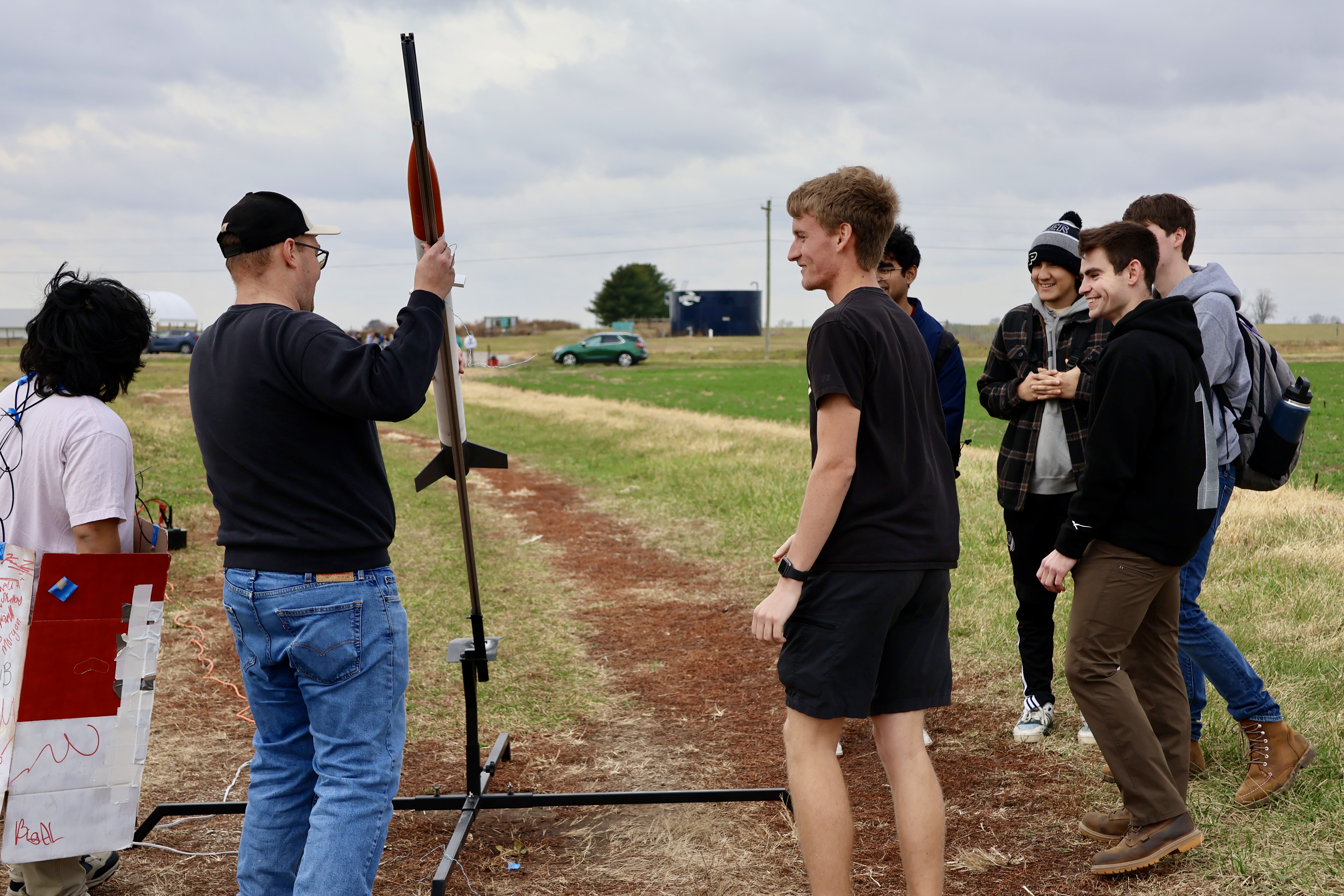
Launch day was held in December 2025 at Purdue Dairy, an agricultural research facility in unincorporated Tippecanoe County that also supports rocket tests. Student clubs like Purdue Space Program regularly hold tests there to prepare for competitions. The cows don’t seem to mind.
Test day, Denker says, was a resounding success. “All of the motors worked! They all launched, we didn’t have any blow up on the pad. Any rocket failures were from normal model-rocket reasons unrelated to the grain,” Denker said.
How did the Purdue “Motion P” fare?
“It was an unconventional design, to be sure,” Pourpoint says, “but it worked, and that team got really close to their altitude prediction.”
On the heels of this success, Pourpoint has another challenge in mind for the future. In addition to propellant geometry, he’s considering giving students control of another factor to influence reaction rates: The chemical composition of the propellant itself.
Stay tuned. It could get fiery.
The crucial role of grain geometry
Safety is mandatory
A test against themselves