
Hypersonics research co-led by Prof. Schneider receives NATO research excellence award
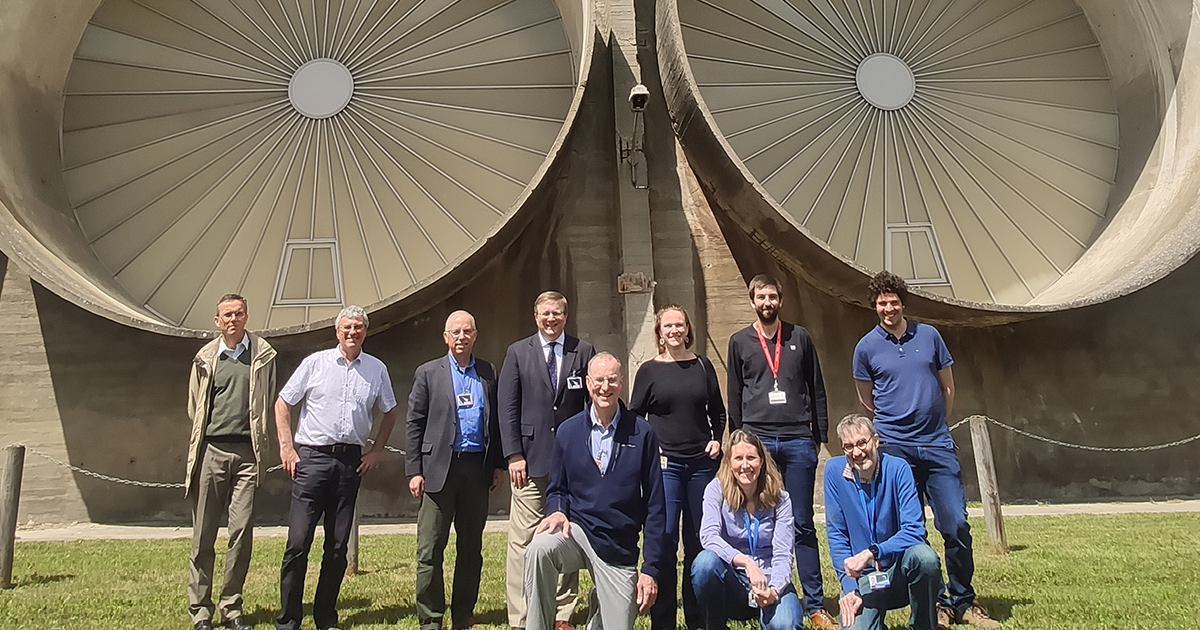
Pictured above is a portion of the award-winning AVT-346 research group, together with representatives from the U.S. Air Force Office of Scientific Research (AFOSR) and leadership from the ONERA aerospace lab in France. They stand in front of a subsonic wind tunnel at ONERA. They are:
Back row, left to right: Jean-Philippe Brazier, AVT-346 contributor; Reynald Bur, AVT-346 contributor; Doug Smith, AFOSR; Joseph Jewell, AVT-346 contributor; Sarah Popkin, AFOSR; Mathieu Lugrin, AVT-346 contributor; Sylvain Morilhat, ONERA.
Front row, left to right: Steven Schneider, AVT-346 co-chair; Estelle Piot, ONERA; Denis Sipp, ONERA.
NATO's Science and Technology Organization has announced that a hypersonics research group, which includes Purdue contributors, are winners of the STO Excellence Award for 2026. This is the highest team recognition granted by the organization.
"This award recognizes high-quality original work of considerable military relevance and benefit, while achieving a significant degree of international collaboration," wrote John-Mikal Størdal, director of NATO's Collaboration Support Office.
The group was lauded for its publication, "Predicting Hypersonic Boundary-Layer Transition on Complex Geometries." Purdue professor Steve Schneider served as co-chair of the international group, which included 74 scientists representing 9 NATO member nations. Professor Joseph Jewell, currently on leave to serve as U.S. Assistant Secretary of War for Science and Technology, also contributed to this work, along with several of Schneider’s former Ph.D. students.
"This award highlights Purdue's leadership in hypersonics and willingness to support national defense related research," says William Crossley, head of the School of Aeronautics and Astronautics at Purdue.
The group organized cooperative research to improve understanding of several phenomena related to hypersonic transition, including:
-
mechanisms of boundary-layer transition as affected by separation bubbles near control surfaces or compression corners;
-
mechanisms of transition on complex surfaces with multiple interacting instabilities;
-
ability to predict the effect of high enthalpy on transition induced by the second-mode instability; and
-
ability to predict the effect of ablation.
Measurements and computations were performed in several different nations using the same geometries under the same or similar flow conditions, enabling detailed comparisons that no single nation can accomplish on its own. Improvements in physical understanding resulted, along with improved experimental and numerical simulation capabilities.
The award was one of several announced in April 2026. The award will be formally delivered at a ceremony in September. NATO STO is the research wing of the North Atlantic Treaty Organization. The organization aims to deliver “cutting-edge research and timely, evidence-based advice to maintain NATO’s military and technological edge,” according to their website. NATO is a defensive alliance of 32 countries across North America and Europe.